
Experienced in the field of novel drug delivery system research for over a decade of years, Creative Biolabs provides a range of customized lipid-based drug delivery formulations and the world’s leading services to help customers’ projects get improvement.
Lipid microparticles are micro-scale drug delivery systems, of which the particle size ranges larger than 1 μm. Similar to other lipid particulate systems particular lipid nanoparticles, lipid microparticles consist of a drug containing core and lipids shell. The difference between nanoparticles and microparticles is size or diameter of the particles, which affects many properties of the carriers such as aggregation, permeability across the biological membranes, cell entry and tissue retention as well as drug loading efficiency. Lipid microparticles are possible to be particulate dispersions or solid particles with microcapsules and microspheres two common micromorphologies.
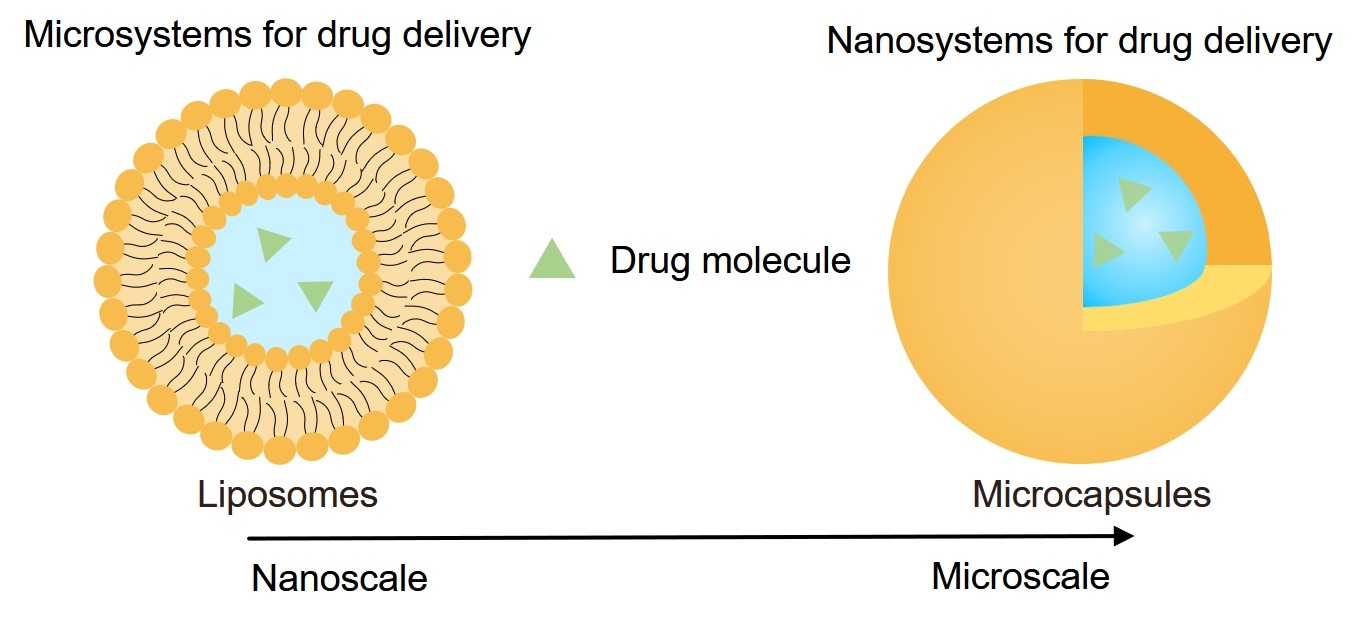 Fig.1 Microparticles and nanoparticles for drug delivery.
As a promising drug carrier system, lipid microparticles are extensively applied for delivery pharmaceutical ingredients with poor solubility and bioavailability. Lipid microparticles delivery system can realize drug release in a sustained way by encapsulation limiting the biological fluid access into the drug until the time of degradation. The inner core delivered drugs also are able to be released in a controlled manner and targeted manner at a predetermined rate, systemically or locally for a specified period of time. Delivery or release mechanisms generally are three different ways including diffusion, polymer degradation, and hydrolysis or erosion.
Lipid microparticles drug carriers can protect the inner delivered pharmaceutical drug from adverse affection by environment via encapsulation. This type of drug delivery system plays a critical role in improving the bioavailability of conventional drugs and minimizing side effects. Compared to conventional formulations, lipid microparticles offer numerous biomedical superiorities, such as:
Despite these advantages, lipid microparticles still have imperfections and some aspects to be improved such as sensitive to changes as temperature, pH and higher costs.
For your lipid microparticles carries researches or programs, Creative Biolabs possesses absolute advantages to fulfill customers’ specific demands with perfect solutions and strategies. Our work and high-quality services comprise of various lipid drug carriers formulations and other related services.
Please feel free to contact us and communicate with us for more information. Our service team is available all the times.
 For Research Use Only. Not For Clinical Use
Supports
Online Inquiry

Creative Biolabs is a world-leading liposome provider with extensive experience in liposome preparation, custom formulation development, and characterization.

© 2026 Creative Biolabs. All rights reserved.