
Scientists at Creative Biolabs are expert in targeted delivery system research. We have a series of innovative and advanced platforms to provide fast and convenient liposome development services for our worldwide customers. Currently, we can provide affordable, high-quality ufasomes-based drug delivery services for diseases diagnosis and therapeutic with unbeatable rapid turnaround times.
Ufasomes (unsaturated fatty acid vesicles) are suspensions of closed lipid bilayers that consist of fatty acids, and their ionized species (soap) which are restricted to narrow pH range from 7 to 9. In ufasomes, fatty acid molecules are targeted where their hydrocarbon tails are directed toward the membrane interior and the carboxyl groups are in contact with water. The formation of ufasomes is considered to result from associative interaction in mixtures of fully ionized and unionized fatty acids at pH > 7.0. Stability of ufasomes relies on suitable selection of fatty acid, amount of cholesterol, buffer, pH range, amount of lipoxygenase, and the presence of divalent cations. Recent innovative improvement renders advancement to formulate ufasomes with tailorable features such as extension of pH range, insensitivity toward divalent cations, and enhanced stability.
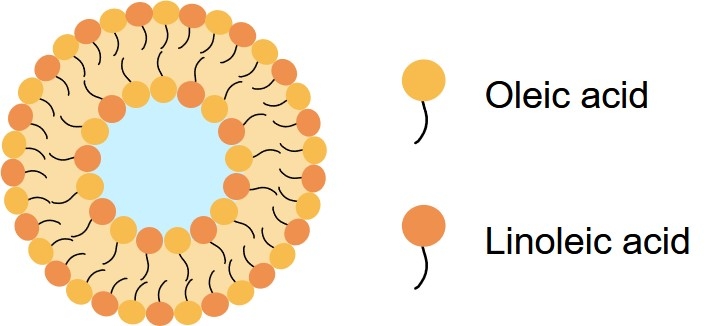 Fig.1 Structure of ufasomes made of unsaturated fatty acids.
Ufasomes have advantages as vehicles for the oral administration of poorly absorbable drugs. The effect of oleic acid vesicles (ufasomes) on the intestinal absorption of entrapped carboxyfluo-rescein (CF) is explored by an in situ closed-loop method in rats. Entrapment of CF in ufasomes promotes the absorption of CF at the earlier stage following intraduodenal administration, and the threshold concentration of the fatty acid for facilitating the absorption of CF is approximately 8 mM. The absorption of CF from the large intestine is enhanced much more effectively than from the small intestine. These studies suggest that ufasomes have potential as drug delivery system for the oral administration of poorly absorbable drugs. In addition, ufasomes have been considered as pre-biotic models for cellular compartments, thus, which also can be used for the horizontal transfer of genes from plants either soil-microbes or to environment and have more stabilized membrane than liposomes.
Creative Biolabs is specialized in the targeted drug delivery system design and preparation that are suitable for a number of disease therapies. Our ufasomes-based drug delivery services may promote the drug administration and treatment of diseases for our worldwide customers. Moreover, we offer customized solutions for our clients to meet every specific research requirement. Please contact us to experience the value of our expert services.
 For Research Use Only. Not For Clinical Use
Supports
Online Inquiry

Creative Biolabs is a world-leading liposome provider with extensive experience in liposome preparation, custom formulation development, and characterization.

© 2026 Creative Biolabs. All rights reserved.