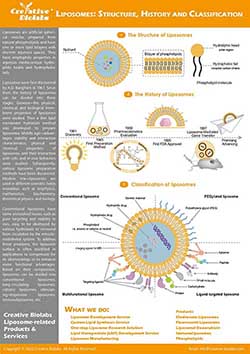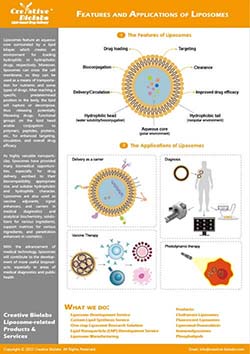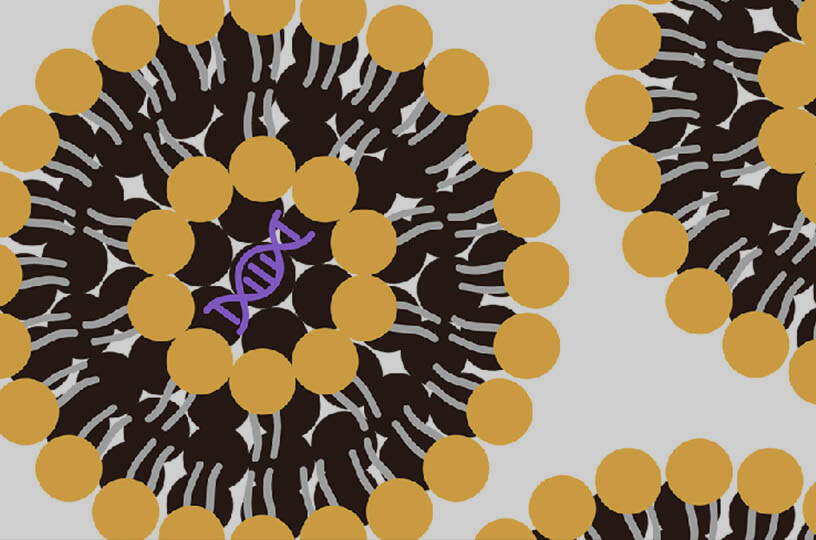
Creative Biolabs offers a wide range of high-quality plain liposome products in different formulations. All the products are prepared by our advanced LipoDrive™ technology platform using the highest quality lipids provided by leading global ingredient suppliers. The particle size of liposomes is ranged from 50nm to micron level with high batch-to-batch consistency and homogeneity. You can choose any of the formulations, PEGylated or non-PEGylated according to your experimental needs.
Liposomes have received extensive attention and are widely investigated as a promising drug carrier. They can be functionalized through the incorporation of different small molecules, surface modifications, and valent coupling. Plain liposomes have the simplest lipid composition and function and therefore be used to study lipid membrane-protein interactions, in vivo studies of liposomes, and encapsulation of hydrophobic drugs. Liposomes made from phosphatidylserine (PS) are negatively charged vesicles, which can be used to mimic cell membranes. Positively or neutrally charged liposomes are also available, mainly consisting of DOTAP and Phosphatidylcholine (PC) respectively. Additionally, all the plain liposome products can be loaded with hydrophobic drugs through hydrophobic interaction or used as control formulations for drug-loaded liposomes. If you are looking for any other liposome products, please see our liposome development service, every parameter of the liposome is highly customizable.
Representative Product
Standard Formulations (Neutral)
Classic bilayers for general research.
Examples: (Available in various molar ratios)
Stealth (PEGylated) Liposome
Long-circulating formulations with reduced MPS uptake.
Examples:
Anionic (Negatively Charged) Liposomes
Formulated for specific membrane-protein interaction studies.
Examples:
Tailored Specification Options
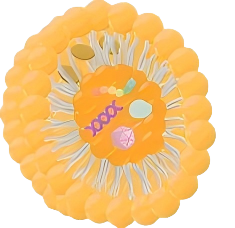
As a leader in the field of liposome development, Creative Biolabs has served clients all over the world. Each batch of our product is freshly manufactured with the best quality and stability. Feel free to contact us for any technical support about our products.
 For Research Use Only. Not For Clinical Use
Protective effect of saccharides on freeze-dried liposomes encapsulating drug
Author: Guimarães, Diana, et al.
This study investigated the protective effects of adding different saccharides to liposomes during the freeze-drying process. Researchers added five saccharides at varying concentrations to the liposomes: trehalose, lactose, glucose, mannitol, and sucrose. Subsequently, the size and polymer dispersity index (PDI) of liposomes after the freeze-drying-rehydration cycle were measured to monitor the aggregation and fusion of liposomes in each group during the freeze-drying process. The results showed that, compared to plain liposomes, liposomes with saccharides could prevent aggregation and fusion in a concentration-dependent manner, thereby maintaining the integrity of freeze-dried liposomes. Among them, the protective effect of sucrose was most significant, making it a promising method for liposome storage. This highlights the importance of plain liposomes as controls, providing a baseline for studying the protective effect of saccharides as cryoprotectants on liposomes.
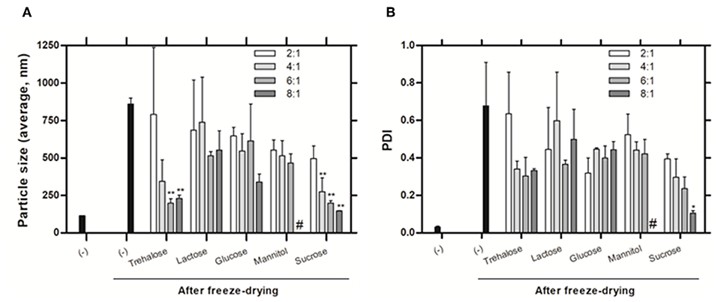 Fig.1 The particle size and PDI of each group of liposomes.1,2
References
For Research Use Only. Not For Clinical UseOnline Inquiry

Creative Biolabs is a world-leading liposome provider with extensive experience in liposome preparation, custom formulation development, and characterization.

© 2026 Creative Biolabs. All rights reserved.