
As a leading source provider in the field of biological research and drug discovery, Creative Biolabs is fully competent and dedicated to providing a series of lipid-based drug delivery (LDD) platform. As a member of the liposome emulsion, dry emulsion is of interest because of their stability and sustained release effect. We offer customized services of dry emulsion for drug delivery. With years of experience and high-end technologies, we provide our clients with products and custom services to help get a milestone development in the drug delivery project.
Dry emulsions are regarded as lipid-based powder formations from which an O/W emulsion can be reconstituted. Dry emulsion formulations are typically prepared from O/W emulsions containing a soluble or an insoluble solid carrier in the aqueous phase by spray drying, lyophilization or evaporation. Drug, solid carrier, aqueous phase and lipophilic solvent were used for the preparation of dry emulsions. The solid carriers used to prepare dry emulsions are gelatin, lactose, maltodextrin, mannitol, povidone, sucrose etc. Insoluble carriers like colloidal silica can also be used. Dry emulsions were investigated for their possible use in cosmetic and pharmaceutical fields. When exposed to an aqueous solution, they present a potential for drug delivery system.
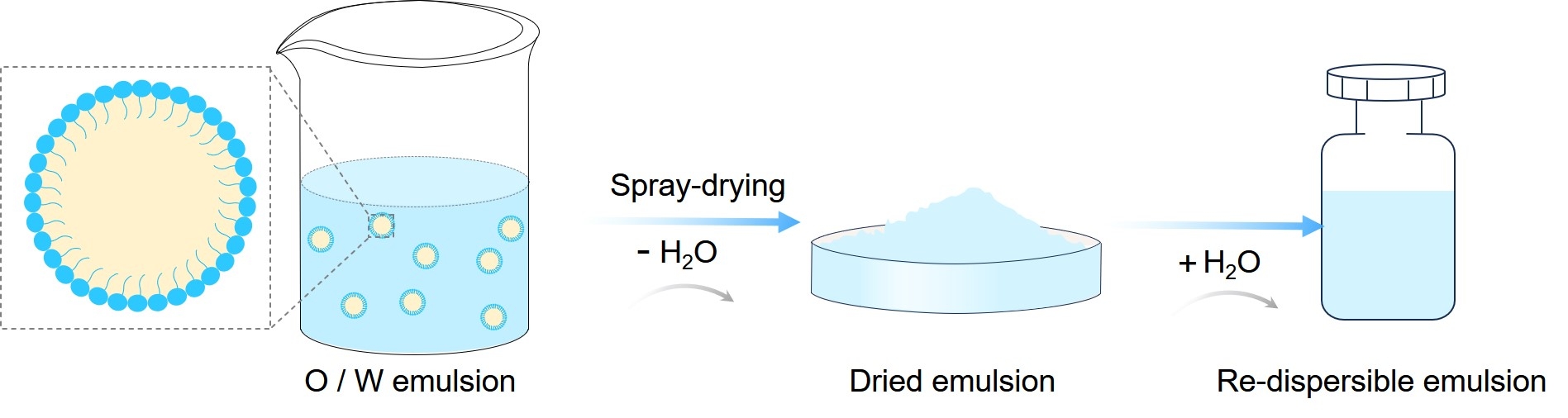 Fig.1 Preparation of the dry emulsion and its re-dispersion.
From a pharmaceutical point of view, dry emulsions are attractive due to their physical strength and ease of administration as capsules and tablets. This emulsion formulation could be extensively applicable to oral delivery of pharmaceutical peptides and proteins. They present a potential oral drug delivery system for lipophilic and low soluble drug substances and for drug substances needing protection against light or oxidation because they are powdery, lipid-based formulations from which an o/w-emulsion can easily be reconstituted in vivo or when exposed to an aqueous solution. Moreover, they can improve the bioavailability of drug substances and reduce the side effects. Dry emulsions provide the most constant possible and effective blood levels over prolonged durations of therapy.
Dry emulsion formulation is aimed to improve the bioavailability of drug substances and reduce their side effects. They present a potential oral drug delivery system for lipophilic and low soluble drug substances and for drug substances needing protection against light or oxidation. Based on well-established platforms and experienced scientists, we can provide customized services of dry emulsion and also provide more liposomal formulation development services for drug delivery.
In terms of the extensive experience in Formulation Optimization, Creative Biolabs is proud to offer our clients a series of lipid-based drug delivery (LDD) platforms for the drug delivery. We have the ability to grow with clients and offer the customized services and high-quality products. If you are interested in our services, please contact us for more details.
 For Research Use Only. Not For Clinical Use
Supports
Online Inquiry

Creative Biolabs is a world-leading liposome provider with extensive experience in liposome preparation, custom formulation development, and characterization.

© 2026 Creative Biolabs. All rights reserved.