Creative Biolabs is offering the most comprehensive services for antibody development projects. With strict regulation and effective execution, we are dedicated to providing the most valuable solutions to complete your projects.
HighlightsCreative Biolabs is offering the most comprehensive services for antibody development projects. With strict regulation and effective execution, we are dedicated to providing the most valuable solutions to complete your projects.
HighlightsCreative Biolabs has established a broad range of platforms for developing novel antibodies or equivalents. These cutting-edge technologies enable our scientists to meet your demands from different aspects and tailor the most appropriate solution that contributes to the success of your projects.
HighlightsWith deep understanding in antibody-related realms and extensive project experience, Creative Biolabs offers a variety of references to help you learn more about our capacities and achievements, including infographic, flyer, case study, peer-reviewed publications, and all kinds of knowledge that can assist your projects. You are also welcome to contact us directly for more specific solutions.
HighlightsGet a real taste of Creative Biolabs, one of the most professional custom service providers in the world. We are committed to providing highly customized comprehensive solutions with the best quality to advance your projects.
HighlightsPhage display is a transformative technology that has revolutionized antibody engineering, protein-protein interaction studies, and epitope mapping. Central to this system are specially engineered Escherichia coli strains capable of rescuing and amplifying phagemid particles efficiently. Among them, TG1 phage display electrocompetent cells have emerged as a versatile, high-performance host optimized for cloning, library construction, and high-fidelity phage amplification.
TG1 is a derivative of the E. coli K-12 strain with the following genotype: Δ(lac-pro), supE, thi, hsdD5/F'traD36, proA+B+, lacIq, and lacZΔM15. These genetic modifications endow TG1 with:
TG1's unique genetic landscape positions it as one of the most versatile strains for molecular cloning and phage display, especially in the context of antibody library system and peptide library system.
In M13-based phage display systems, it is critical that host cells can both accept recombinant DNA and support phage replication and assembly. TG1 satisfies both conditions:
These capabilities make TG1 cells indispensable in the selection, rescue, and propagation of phage libraries.
Meanwhile, TG1 offers built-in compatibility with widely used helper phages (e.g., M13KO7) and phagemid display systems, making it an industry-standard host for:
Electrocompetent cells are prepared under specialized protocols to ensure maximum membrane permeability upon pulsed electric fields. Their advantages include:
In phage display workflows, electrocompetent TG1 cells are particularly valued for preserving library diversity, an essential factor in the success of affinity-based selection.
TG1 electrocompetent cells offer a unique combination of high transformation efficiency, amber codon suppression, and compatibility with M13 phage infection. These features make TG1 a go-to strain for researchers engaged in phage display, antibody library screening, molecular cloning, and synthetic biology.
TG1 electrocompetent cells deliver exceptionally high transformation efficiency, often achieving: ≥ 4 × 10¹⁰ colony-forming units (cfu) per µg of pUC19 supercoiled DNA. This level of efficiency is crucial for experiments requiring:
High transformation efficiency directly correlates with successful maintenance of library diversity, which is essential in phage display for identifying rare binders with high affinity.
TG1 carries the supE allele, enabling suppression of amber (UAG) stop codons during translation by inserting glutamine. This feature is particularly beneficial in phage display, where many phagemid vectors intentionally utilize UAG codons to control protein expression.
Functional Benefits:
Amber suppression enables strategic control over the timing and location of protein display, making TG1 ideal for stepwise workflows involving phage rescue and soluble protein production.
TG1 harbors the F' episome, which encodes for the F pilus, a filamentous appendage required for infection by M13 helper phages. This makes TG1 intrinsically competent for phage uptake, without the need for additional plasmid engineering.
Key Advantages:
This compatibility ensures high-yield and consistent production of functional phage particles, a prerequisite for reliable panning cycles in display systems.
Beyond phage display, TG1 also serves as an excellent host for routine cloning due to the presence of:
TG1 can be seamlessly integrated into workflows involving:
This versatility makes TG1 a multipurpose workhorse in both research and production environments.
The hsdD5 mutation in TG1 results in deficiency in restriction-modification systems, allowing for:
This genetic trait is particularly advantageous when working with PCR products, synthetic constructs, and plasmids derived from other bacterial species.
Electrocompetent cell preparation and utilization serves as an essential molecular biology technique because it facilitates the effective introduction of plasmid DNA into bacterial cells. TG1 electrocompetent cells represent engineered systems that focus on membrane physiology and ionic balance to deliver high transformation efficiencies during growth phase optimization for applications including phage display and synthetic biology.
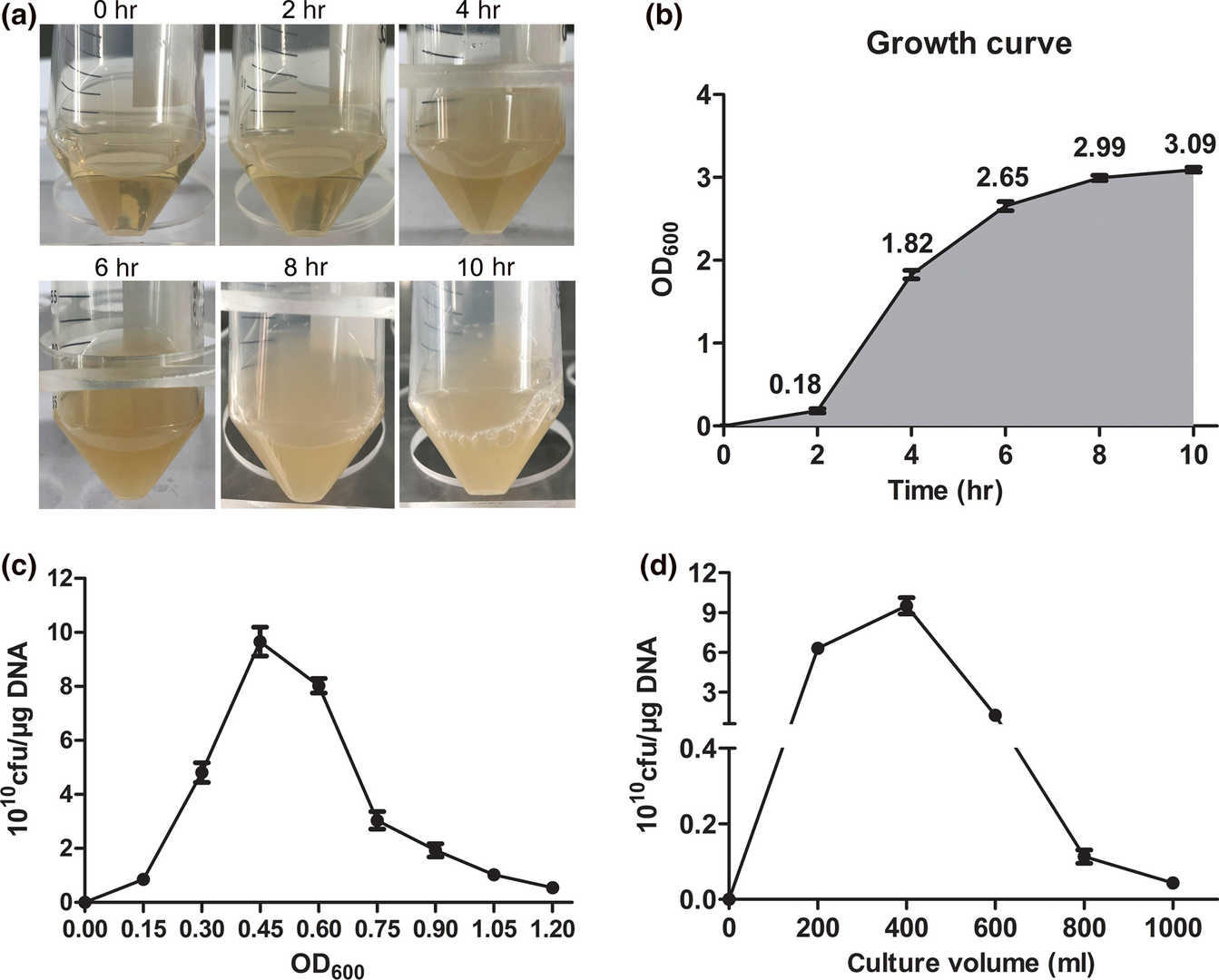 Fig. 1 Effects of culture conditions on electrotransformation efficiency in TG1.1
Electrocompetence describes the capability of bacterial cells to absorb foreign DNA when exposed to a short electrical pulse. The process operates by keeping membrane integrity intact while creating temporary membrane permeability to charged substances such as plasmid DNA. The procedure of electroporation requires the application of high voltage (1.8–2.5 kV) which generates temporary nanopores in the membrane for DNA molecules to pass through. The restoration of membrane potential which leads to cell regeneration depends on immediate post-pulse recovery in nutrient-rich media like SOC.
Proper storage and handling methods are critical because even the most efficient electrocompetent cells will fail to perform well if these methods are not followed. TG1 cells exhibit sensitivity to temperature changes, mechanical stress and ionic impurities similar to all electrocompetent E. coli strains.
| Factor | Recommendation |
| Temperature | Store at –80°C in single-use aliquots |
| Avoid freeze-thaw | Each thawed aliquot must be used immediately |
| Longevity | Verified performance for ≥12 months under proper storage |
With their powerful combination of amber suppression, F' episome compatibility, and ultra-high transformation efficiency, TG1 electrocompetent cells are not just a standard tool for phage display—they are a platform for innovation.
One of the most impactful uses of TG1 electrocompetent cells lies in their ability to support the construction, transformation, and amplification of ultra-diverse phage display libraries, often exceeding 10⁹–10¹⁰ unique variants.
Key Insight: The ability to preserve rare clones during high-throughput library cloning and amplification is essential for downstream hit discovery. TG1 cells are engineered to maximize this retention.
TG1 cells continue to be at the forefront of advanced display formats that extend beyond classical biopanning.
At Creative Biolabs, our in-house optimized TG1 electrocompetent cells are trusted by researchers worldwide to drive innovation in antibody discovery, directed evolution, and synthetic biology. Want to streamline your phage display workflow? Contact Creative Biolabs for customized solutions tailored to your application.
Learn more about Creative Biolabs custom phage display services and premade phage display library licensing:
All listed services and products are For Research Use Only. Do Not use in any diagnostic or therapeutic applications.