
Creative Biolabs is offering the most comprehensive services for antibody development projects. With strict regulation and effective execution, we are dedicated to providing the most valuable solutions to complete your projects.
HighlightsCreative Biolabs is offering the most comprehensive services for antibody development projects. With strict regulation and effective execution, we are dedicated to providing the most valuable solutions to complete your projects.
HighlightsCreative Biolabs has established a broad range of platforms for developing novel antibodies or equivalents. These cutting-edge technologies enable our scientists to meet your demands from different aspects and tailor the most appropriate solution that contributes to the success of your projects.
HighlightsWith deep understanding in antibody-related realms and extensive project experience, Creative Biolabs offers a variety of references to help you learn more about our capacities and achievements, including infographic, flyer, case study, peer-reviewed publications, and all kinds of knowledge that can assist your projects. You are also welcome to contact us directly for more specific solutions.
HighlightsGet a real taste of Creative Biolabs, one of the most professional custom service providers in the world. We are committed to providing highly customized comprehensive solutions with the best quality to advance your projects.
HighlightsSingle-domain antibodies or VHH antibodies originate from the variable heavy-chain domains of camelids' heavy-chain-only antibodies. VHH antibodies differ from traditional antibodies by containing only a single variable domain instead of both heavy and light chains which makes them much smaller at around 15 kDa compared to conventional antibodies which weigh approximately 150 kDa. The distinct structure of these antibodies allows them to target epitopes that conventional antibodies cannot reach, including hidden molecular regions and enzymatic sites.
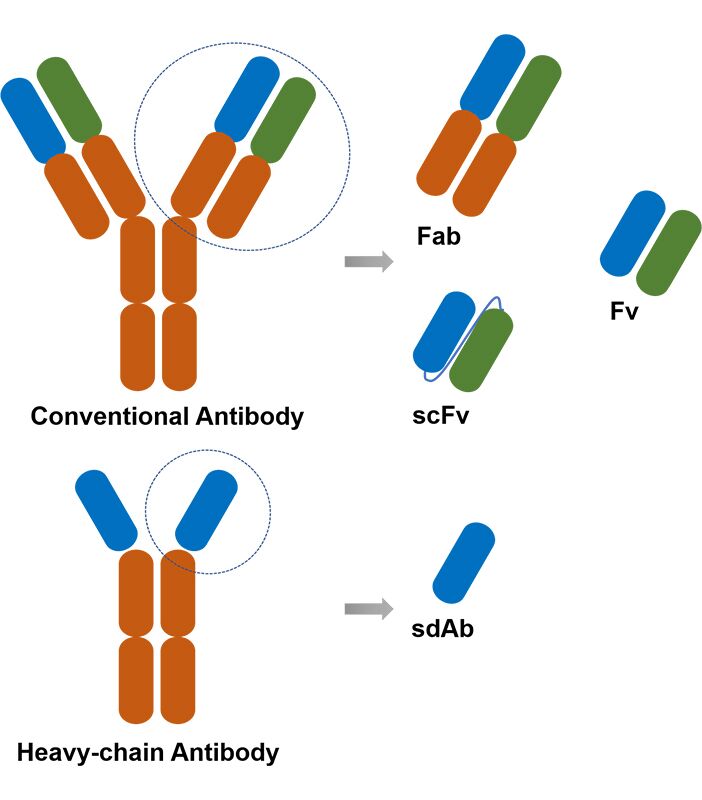 Fig. 1 Various antibody formats.
VHH antibodies outperform conventional monoclonal and polyclonal antibodies with their superior qualities which makes them perfect for multiple biotechnological uses.
| Feature | VHH Antibodies | ConventionalAntibodies |
| Size | ~15 kDa (single domain) | ~150 kDa (full IgG) |
| Stability | High (resistant to heat, pH) | Moderate |
| Penetrability | High (due to small size) | Lower |
| Expression | High yields in bacteria/yeast | Requires mammalian expression |
| Engineering Feasibility | High (easily modified) | Moderate |
VHH antibodies become attractive tools for therapeutic and research applications because they combine high specificity with small size and enhanced stability.
The VHH phage display platform operates in vitro to identify antibodies by using bacteriophages to display VHH antibodies at their surface which creates a connection between genotype (DNA) and phenotype (displayed VHH). E. coli cells receive a phagemid vector with a VHH gene which enables filamentous phages such as phage M13 to present VHH molecules attached to coat proteins like pIII on their surfaces. Biopanning enables a screening process of the phage library against immobilized antigens which selects high-affinity VHHs with high specificity. VHH libraries can originate from immunized camelids or be non-immunized random VHHs or created through engineered CDR diversity.
Creating a VHH phage display library requires isolating the genetic sequences that code for the VHH domains from antibodies found in camelids. The workflow consists of the following steps:
To increase the diversity of the VHH library, complementarity-determining region (CDR) shuffling is employed:
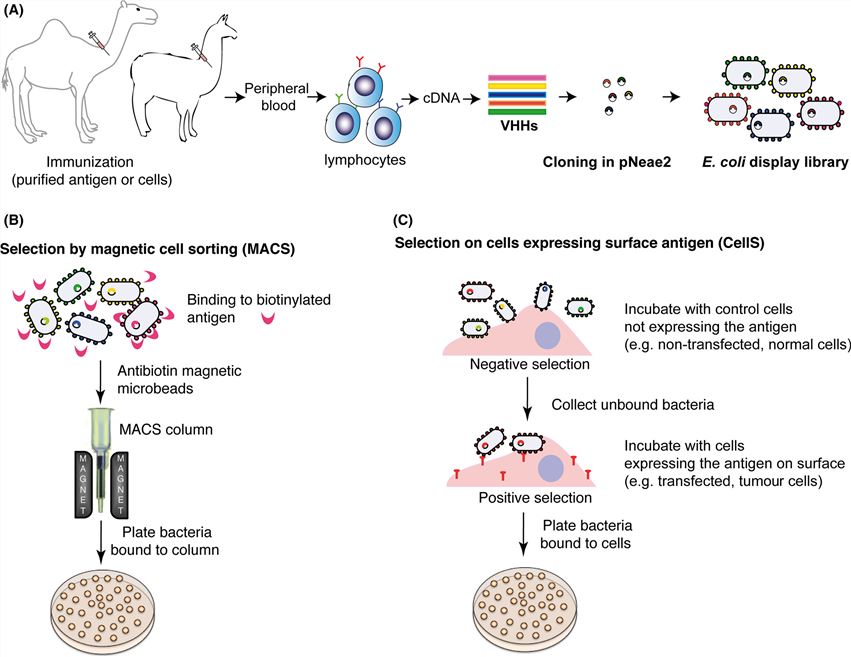 Fig. 2 Generation of E. coli display immune libraries and their selection by magnetic cell sorting (MACS) and on mammalian cells (CellS).1, 3
The screening and selection of VHH antibodies using phage display relies on biopanning process, which allows for the isolation of high-affinity binders from a diverse phage library. The efficiency of this process depends on the library quality, biopanning conditions, and affinity maturation strategies.
Biopanning is an iterative process that enriches high-affinity VHH binders through multiple selection rounds. The general steps are:
VHH phage display libraries can be categorized into immune libraries and synthetic libraries, each offering distinct advantages depending on the application.
Table 1. Types of VHH Phage Display Libraries
| Library Type | Source | Advantages | Limitations |
| Immune Library | VHHs derived from an immunized camelid | Enriched for high-affinity binders | Requires camelid immunization |
| Naïve Library | Random VHHs from non-immunized animals | Broad repertoire | Lower affinity binders |
| Synthetic Library | Designed through computational methods | Customizable, large diversity | Requires advanced design validation |
| Semi-Synthetic Library | Combination of natural and engineered VHHs | Enhances binding diversity | Still requires experimental screening |
Synthetic libraries allow for in silico CDR optimization to improve binding characteristics and affinity.
To enhance VHH selection, various biopanning modifications can be applied:
Although phage display yields high-affinity VHH antibodies, further affinity optimization can be achieved through:
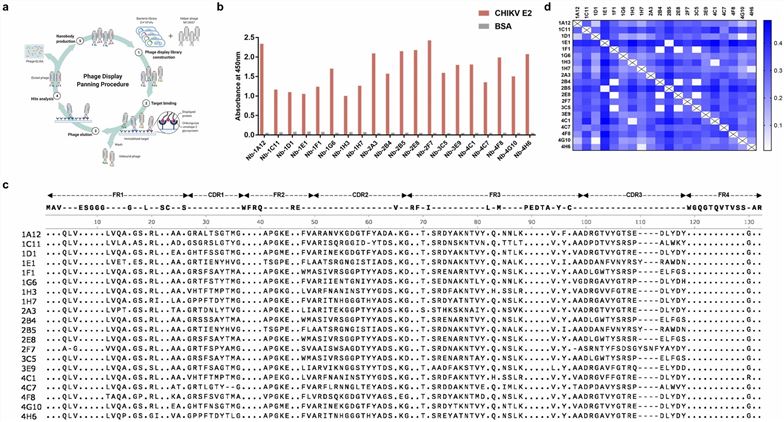 Fig. 3 Screening the CHIKV E2 specific sdAbs from a VHH phage display library.2, 3
VHH phage display technology enables new possibilities in therapeutics and diagnostics while enhancing research capabilities through the production of small yet stable single-domain antibodies that deliver precise binding to multiple applications.
Targeted therapies benefit from VHH antibodies because they demonstrate high specificity while maintaining a small size and offering engineering flexibility.
| Application | Example Targets | Benefits |
| Cancer Therapy | HER2, EGFR, PD-L1 | Deep tumor penetration, bispecific VHHs |
| Neurological Diseases | Tau, α-synuclein | Crosses the blood-brain barrier |
| Autoimmune Disorders | TNF-α, IL-6 | High specificity, low immunogenicity |
| Infectious Diseases | SARS-CoV-2, HIV | Neutralizing sdAbs for viral inhibition |
Example: The FDA has approved anti-vWF VHH specifically for the treatment of thrombotic thrombocytopenic purpura (TTP).
The stability and powerful antigen binding of VHH antibodies enhance the performance of biosensors and speed up diagnostic processes.
| Diagnostic Tool | Application |
| Biosensors | Food safety, pathogen detection (COVID-19) |
| Immunoassays | ELISA, lateral flow tests (point-of-care diagnostics) |
| Molecular Imaging | PET, MRI (tumor detection) |
Example: VHH-based fluorescent probes enable real-time intracellular imaging.
Structural biology and proteomics research alongside functional studies commonly employ VHHs as key tools.
| Research Use | Benefit |
| Chromobodies | Live-cell imaging of intracellular proteins |
| Structural Biology | Stabilization of GPCRs, membrane proteins |
| Proteomics | Immunoprecipitation, protein interaction studies |
Example: High-resolution imaging through Cryo-EM studies depends on VHHs to stabilize proteins that exhibit dynamic structural changes.
VHH phage display stands out as a rapid and economical method for discovering antibodies which has several unique benefits compared to traditional methods. The limited binding repertoire alongside a short half-life and immunogenicity concerns with VHH phage display necessitate innovative engineering solutions. Ongoing progress in protein engineering techniques along with AI-based antibody design and new display technologies enable major growth potential for VHH-based medical therapeutics and diagnostic tools in the biotechnology sector.
VHH phage display provides several unique benefits that make it highly attractive for therapeutic, diagnostic, and research applications.
| Feature | Advantages |
| High Stability | Resistant to heat, pH, and proteases |
| Small Size (~15 kDa) | Allows deep tissue penetration and blood-brain barrier crossing |
| High Specificity & Affinity | Recognizes unique epitopes, including hidden antigen sites |
| Cost-Effective Production | Expressed in E. coli or yeast, reducing manufacturing costs |
| Fast Selection Process | High-throughput screening enables discovery within weeks |
| Easy Engineering | Can be fused into bispecific, trispecific, or drug-conjugated formats |
While VHH phage display offers many advantages, it also has certain limitations that need to be considered.
| Limitation | Impact | PossibleSolution |
| Short Half-Life | Rapid clearance from circulation | Fc fusion, albumin-binding modifications |
| No Effector Functions | Cannot trigger ADCC/CDC | Fc fusion or bispecific formats |
| Limited Epitope Coverage | Struggles with large, flat epitopes | CDR engineering, improved library design |
| Potential Immunogenicity | May be recognized as foreign | SdAb Humanization strategies |
| Library Dependence | Requires high-quality diverse libraries | AI-driven synthetic library design |
VHH phage display offers faster selection, lower cost, and greater engineering flexibility compared to traditional methods, making it a powerful alternative for antibody discovery.
| Feature | VHH Phage Display | Hybridoma Technology | Yeast Display |
| Size | Small (~15 kDa) | Large (~150 kDa) | Medium (~50 kDa) |
| Stability | High (heat/pH-resistant) | Moderate | High |
| Affinity | High, optimized via maturation | High | Moderate |
| Production | Low-cost (E. coli, yeast) | Expensive (mammalian cells) | Moderate |
| Selection Speed | Fast (weeks) | Slow (months) | Moderate |
| Engineering | Easy (bispecific, Fc-fusion) | Limited | High |
VHH phage display technology provides high-affinity, stable, and cost-effective single-domain antibodies, making it a preferred platform for therapeutics, diagnostics, and research. While short half-life and lack of Fc-mediated effector functions remain challenges, advanced engineering solutions (e.g., Fc fusion, bispecific formats) are addressing these limitations, ensuring VHH antibodies' continued impact in biotechnology. Creative Biolabs leads in cutting-edge VHH phage display services, contact us to leverage our expertise in custom antibody discovery solutions!
Learn more about Creative Biolabs phage display services:
All listed services and products are For Research Use Only. Do Not use in any diagnostic or therapeutic applications.








