Creative Biolabs is offering the most comprehensive services for antibody development projects. With strict regulation and effective execution, we are dedicated to providing the most valuable solutions to complete your projects.
HighlightsCreative Biolabs is offering the most comprehensive services for antibody development projects. With strict regulation and effective execution, we are dedicated to providing the most valuable solutions to complete your projects.
HighlightsCreative Biolabs has established a broad range of platforms for developing novel antibodies or equivalents. These cutting-edge technologies enable our scientists to meet your demands from different aspects and tailor the most appropriate solution that contributes to the success of your projects.
HighlightsWith deep understanding in antibody-related realms and extensive project experience, Creative Biolabs offers a variety of references to help you learn more about our capacities and achievements, including infographic, flyer, case study, peer-reviewed publications, and all kinds of knowledge that can assist your projects. You are also welcome to contact us directly for more specific solutions.
HighlightsGet a real taste of Creative Biolabs, one of the most professional custom service providers in the world. We are committed to providing highly customized comprehensive solutions with the best quality to advance your projects.
HighlightsThe discovery of antibodies and protein engineering underwent a major transformation because of phage display technology. The development of single-chain variable fragment (scFv) phage display libraries represents one of the most significant applications of this technique as they have changed antibody screening and selection methods. This paper delivers an extensive examination of scFv phage display along with its construction methods and practical uses while highlighting its benefits and limitations.
The single-chain variable fragment (scFv) is a genetically engineered antibody fragment consisting of the variable heavy (VH) and variable light (VL) domains, linked by a short, flexible peptide linker. Unlike full-length antibodies, scFvs lack the constant domains, making them smaller, more stable, and easier to express in bacterial systems.
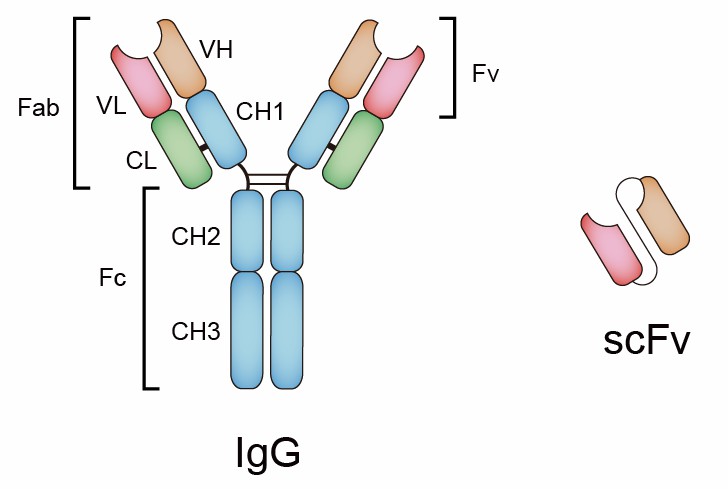 Fig. 1 scFv fragment.
Key Features of scFv:
Phage display is a powerful in vitro selection technique that enables the screening of large antibody libraries by displaying proteins of interest on the surface of bacteriophages.
Key Components of Phage Display:
The evolution of phage display technology has significantly influenced antibody engineering.
scFv phage display library construction is a meticulous process that involves the generation, assembly, and selection of diverse antibody fragments. A well-constructed library maximizes the likelihood of obtaining high-affinity binders for a given target.
For a high-quality phage display library, multiple design parameters must be carefully optimized.
| Factor | Considerations |
| Library Size | Ideally 109 - 1012 variants to capture high-affinity clones. |
| Diversity Source | Human, animal, synthetic, or hybrid origins impact specificity. |
| Codon Optimization | Ensures efficient translation and folding in E. coli. |
| Linker Design | A flexible linker ensures stability and functionality. |
| Cloning Strategy | High-fidelity assembly techniques (e.g., Gibson assembly, Golden Gate) minimize errors. |
scFv library construction requires a series of precise molecular biology techniques.
Each scFv library type is tailored for different applications, ranging from broad screening to highly specific antibody discovery.
Table 1. Different types of scFv phage display library.
| Library Type | Origin | Diversity Level | Advantages | Limitations | Best Use Cases |
| Naïve Libraries | Non-immunized donors | 109 - 1012 | Large diversity | Lower binding affinity | General antibody discovery |
| Immune Libraries | Vaccinated animals/humans | 107 - 109 | High specificity | Limited diversity | Disease-specific antibody selection |
| Synthetic Libraries | Computationally optimized | 109 - 1012 | Tailored sequences | Requires validation | Custom-engineered antibodies |
| Semi-Synthetic Libraries | Partially synthetic | 109 - 1012 | Balanced properties | Complexity in design | Optimized therapeutic discovery |
scFv phage display is an essential technology for therapeutic, diagnostic, and research applications.
scFv antibodies serve as highly specific probes for detecting pathogens and biomarkers.
| Application | Example |
| Biosensors | scFv-based ELISA for infectious disease detection |
| Immunohistochemistry | scFv staining in cancer diagnostics |
| Flow Cytometry | Cell-surface marker analysis |
Phage display-based scFv selection offers numerous advantages, particularly in high-throughput screening, antibody engineering, and cost-effectiveness.
| Feature | scFv Phage Display Advantages |
| Library Diversity | Allows screening of 109 - 1012 unique scFvs from a single experiment. |
| Rapid Antibody Discovery | Phage display enables in vitro screening in weeks, unlike hybridoma technology, which requires months. |
| Cost-Effective | No need for animal immunization, significantly reducing development costs. |
| Customization & Engineering | Easily optimized for affinity maturation, humanization, and bispecific engineering. |
| Stability & Small Size | scFvs (~25-30 kDa) have higher tissue penetration and can be expressed in microbial hosts (E. coli, yeast). |
| Selection Against Toxic or Non-Immunogenic Targets | In vitro selection eliminates immune tolerance issues, allowing antibodies against toxic, weakly immunogenic, or self-antigens. |
scFv phage display allows the construction of large, highly diverse antibody libraries with billions of unique variants, ensuring the discovery of high-affinity, highly specific antibodies against virtually any target.
Table 2. Comparison of Antibody Selection Techniques.
| Method | Library Size | Screening Speed | Customization | Cost |
| Hybridoma | 105 - 107 | Slow (months) | Limited | High |
| Phage Display | 109 - 1012 | Fast (weeks) | Highly flexible | Low |
| Synthetic Peptide Screening | 106 - 108 | Moderate | Limited | Medium |
Traditional antibody discovery via hybridoma requires immunization, cell fusion, and monoclonal selection, which is time-consuming. In contrast, scFv phage display enables rapid in vitro screening and directed evolution of antibodies through affinity maturation.
Affinity maturation via phage display:
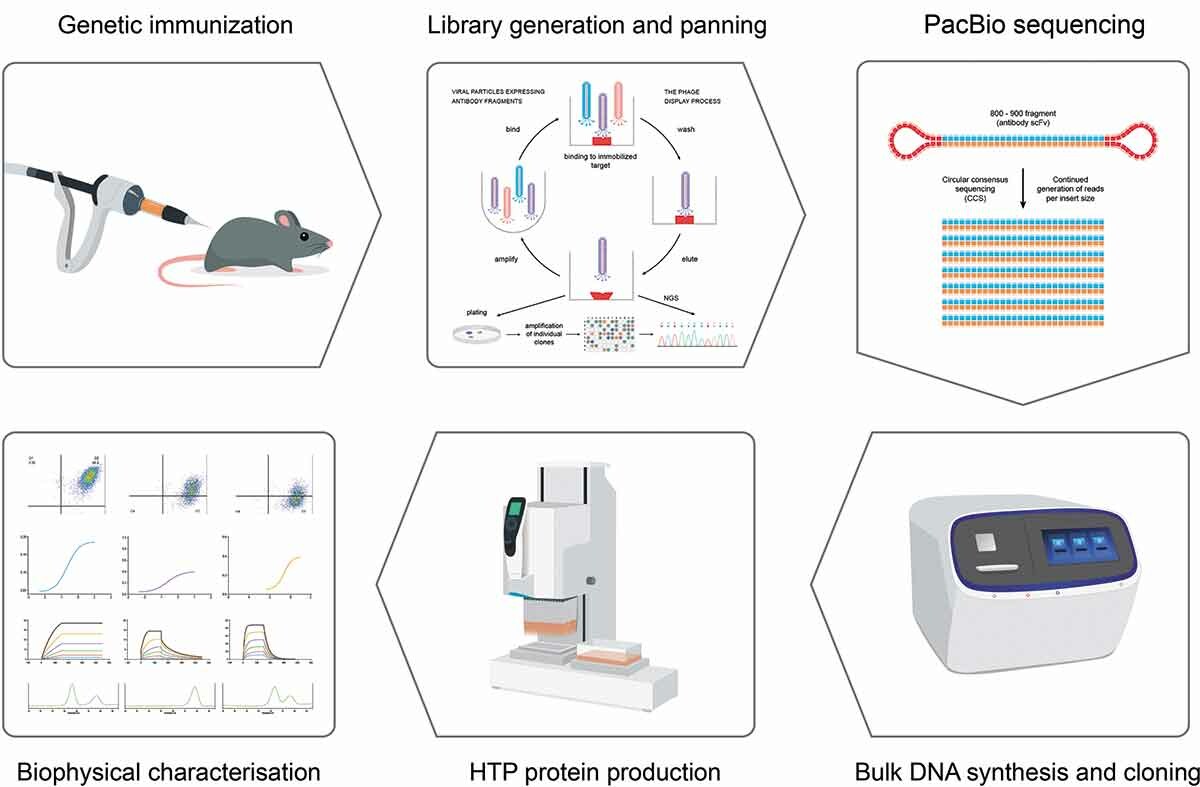 Fig. 2 Overview of strategy to generate antibodies from deep-sequenced scFv libraries.1
scFv phage display eliminates the need for animal models, hybridoma generation, and cell culture, making it cost-effective and scalable.
Table 3. Comparison of Expression Systems for scFv Production.
| Expression System | Yield | Post-Translational Modifications | Scalability | Cost |
| E. coli | High | Poor | High | Low |
| Yeast | Medium | Moderate | High | Medium |
| Mammalian | Low | High | Moderate | High |
Despite its advantages, scFv phage display is not without technical challenges. These include stability issues, expression bottlenecks, and selection biases.
| Limitation | Description | Potential Solutions |
| Poor Stability of scFv | scFv lacks Fc regions, leading to reduced half-life in vivo. | Engineering Fc-fusion proteins (scFv-Fc) or PEGylation. |
| Low Expression in E. coli | Improper folding leads to aggregates or inclusion bodies. | Co-expression of chaperones, secretion in periplasm. |
| Library Biases | Overrepresentation of certain CDR sequences due to cloning artifacts. | Use of synthetic and semi-synthetic libraries for unbiased diversity. |
| Weak Binding Affinities | scFv may exhibit lower affinities than full-length antibodies. | Affinity maturation via mutagenesis and iterative panning. |
scFv lacks the Fc region, which contributes to in vivo stability and effector functions in full-length antibodies. This limits their half-life and therapeutic efficacy.
Solutions to improve stability:
While bacterial expression is cost-effective, misfolding and aggregation can be problematic.
Solutions:
scFv phage display remains a powerful platform for antibody discovery and engineering. While challenges exist, recent innovations in library design, expression optimization, and stability engineering continue to enhance its applications. Creative Biolabs leads in cutting-edge scFv phage display services. Contact us to leverage our expertise in custom antibody discovery solutions!
Learn more about Creative Biolabs phage display services:
All listed services and products are For Research Use Only. Do Not use in any diagnostic or therapeutic applications.