Creative Biolabs' Custom 3D Culture Service employs advanced 3D culture systems to recreate in vivo-like microenvironments. It transforms undifferentiated iPSCs into mature functional 3D tissues, serving as a key bridge between in vitro assays and clinical success with prolonged organoid viability. We deliver high-purity brain, heart, liver, and kidney organoids with superior gene expression profiles versus 2D cultures, providing audit-ready IND filing data to support accurate human pathophysiology-mimicking drug testing.
Discover How We Can Help - Request a Consultation
iPSC 3D culture refers to a technology that simulates the in vivo microenvironment to culture induced pluripotent stem cells in three-dimensional space, instead of the traditional two-dimensional adherent monolayer culture mode. It can better maintain the pluripotency of iPSCs, promote their directional differentiation, and is widely used in disease modeling, drug screening, and regenerative medicine research.
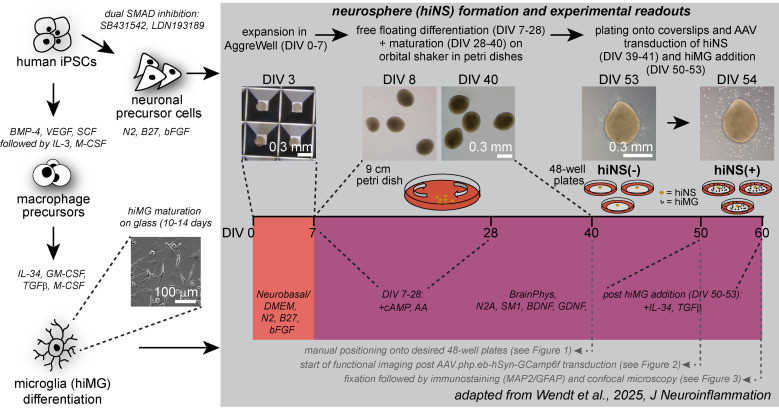 Fig.1 A culture protocol for three-dimensional neural spheres (hiNS) derived from human induced pluripotent stem cells (iPSCs).1
As a global leader in stem cell solutions, Creative Biolabs provides a robust and fully Custom 3D Culture Service to meet the rigorous demands of industrial R&D and clinical translation.
Comprehensive service from initial iPSC reprogramming and expansion to large-scale 3D organoid maturation.
Optimization of synthetic hydrogel rheology and functionalization (e.g., RGD, IKVAV) to meet the specific mechanical needs of your target tissue.
Automated extrusion and inkjet platforms capable of generating consistent tissue constructs in 96- and 384-well formats.
Strict adherence to xeno-free protocols and GMP-compliant processes to ensure regulatory-ready models.
Proprietary "Organ-on-a-Chip" systems featuring dynamic perfusion and integrated biosensors (TEER, O) for real-time monitoring.
Comprehensive validation of cell bank stability, pluripotency markers, and genomic integrity throughout the 3D cultivation process.
Specialized co-culture capabilities to integrate vascular, immune, or stromal components for high-complexity disease modeling.
Experience the Creative Biolabs Advantage - Get a Quote Today
iPSCs are induced into neural progenitor cells (NPCs) via dual SMAD inhibition. After NPCs form a dense monolayer and rosette-like structures, they are cryopreserved for later use. Separately, iPSCs are differentiated to generate human-induced microglia (hiMG), which are then integrated into 3D human-induced neurospheres (hiNS) formed by resuscitated NPCs. On days 39-41 of in vitro culture, hiNS are seeded onto Matrigel-coated 48-well plates under a dissecting microscope and will adhere to the surface within 24 hours.
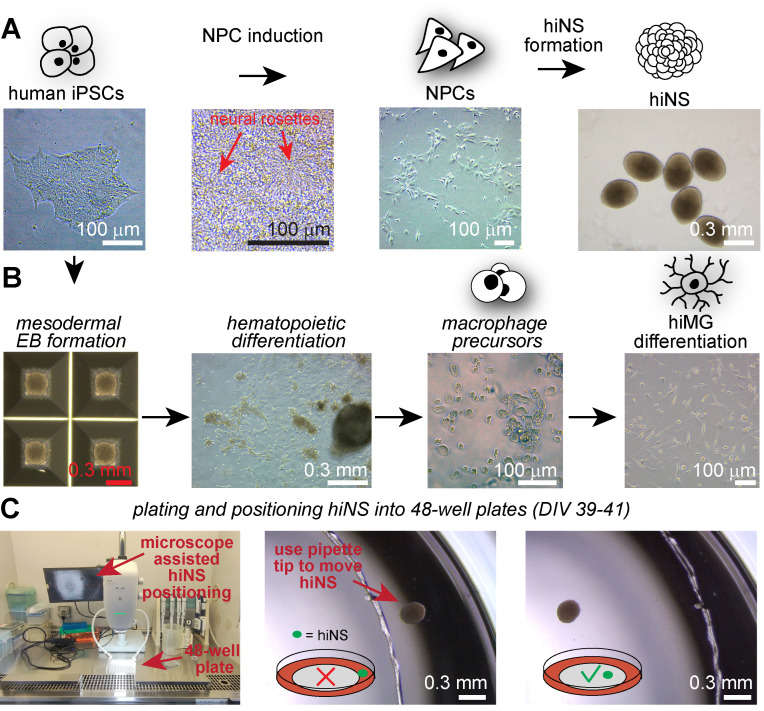 Fig.2 The results of all cell culture stages required for the generation of human IPSC-derived 3D neural spheres (hiNS) were observed under a microscope.1
A: We use chemically defined synthetic hydrogels instead of animal-derived Matrigel. By precisely controlling the hydrogels' Young's modulus and chemical composition, we guarantee uniform mechanical and biochemical properties across batches, eliminating reproducibility issues caused by biological variability.
A: Yes. Our platform is industrially scalable, fully compatible with automated liquid handlers and standard 96/384-well plates. It supports large-scale compound evaluation, enabling simultaneous treatment and imaging of thousands of organoids for statistically robust screening data.
A: It addresses the "necrotic core" issue in static cultures by mimicking physiological perfusion. Constant nutrient exchange and waste removal maintain tissue viability, extend organoid functional lifespan to months, and enable chronic drug exposure studies.
A: Yes. We offer fully xeno-free workflows from somatic cell reprogramming and animal-free expansion to 3D synthetic scaffold cultivation. This ensures clinical relevance, regulatory compliance, and meets safety standards for therapeutic applications.
A: We conduct a comprehensive pilot rheological assessment for each project. We test your cell line's compatibility with our bio-inks and evaluate post-print viability and pluripotency markers to confirm suitability for biomanufacturing.
Creative Biolabs provides end-to-end Custom 3D Culture Service, including custom bio-ink formulation, low-pressure bioprinting, and microfluidic "Organ-on-a-Chip" development. Our focus on xeno-free, chemically defined systems ensures unparalleled reproducibility for pharmaceutical and academic research.
Contact Our Team for More Information and to Discuss Your Project
Reference
For Research Use Only. Not For Clinical Use.