iPSC cultivation, a cornerstone of regenerative medicine, now focuses on standardized, animal-contaminant-free systems. Our Advanced Induced Pluripotent Stem Cell (iPSC) Culture & Expansion Services deliver clinical-ready cells and derivatives via chemically defined media, non-enzymatic dissociation, and 3D scaling. Creative Biolabs offers integrated solutions bridging basic research and therapy, providing characterized cells with verified genomic integrity for disease modeling, drug screening, and cell therapy.
Discover How We Can Help - Request a Consultation
A successful iPSC program relies on the rigorous selection of culture systems and adherence to precise technical parameters. Below, we detail the core methodologies, precautions, and necessary substances required to maintain high-quality pluripotent populations.
Maintaining iPSCs requires an environment that mimics physiological stability. Key precautions include:
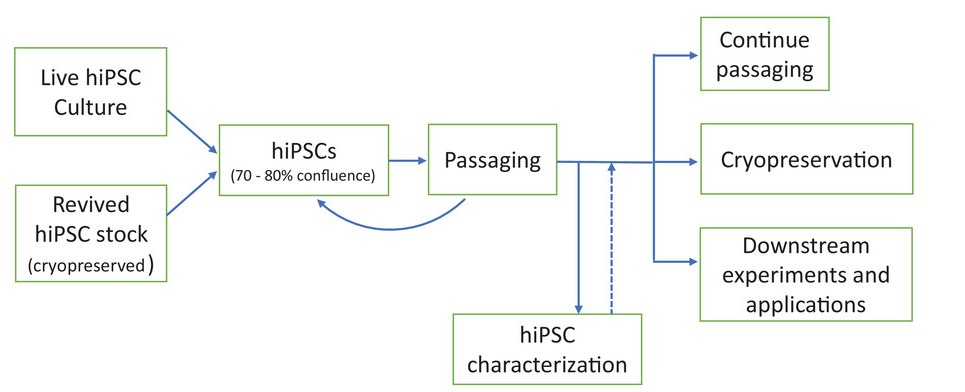 Fig.1 hiPSC culture flowchart.1
The gold standard for routine research and disease modeling. We utilize Versene-only dissociation to maintain colony density and prevent single-cell stress, which is often associated with pro-apoptotic signaling.
Essential for mimicking the in vivo microenvironment and generating organoids.
Designed for large-scale industrial and clinical applications.
To ensure project success, we utilize a standardized yet flexible operational framework.
As an industry leader, Creative Biolabs provides a robust and fully customizable Advanced Induced Pluripotent Stem Cell (iPSC) Culture & Expansion Services tailored to meet the specific demands of biology experts and clinical researchers.
Deliver seamless phase-to-phase transitions, spanning lab research, pilot, and industrial production scales to ensure consistent project progression from bench to clinic.
Specialize in upstream and downstream optimization for high-density stem cell populations, maximizing viability and functional retention during expansion and harvesting.
Integrate Quality-by-Design and Process Analytical Techniques to monitor critical parameters in real time, ensuring superior batch-to-batch consistency and therapeutic safety.
Implement strict aseptic checks and HACCP-aligned protocols throughout expansion, eliminating contamination risks and safeguarding cell line integrity.
Conduct all clinical-grade expansion in GMP facilities, ensuring compliance with international regulatory standards to streamline clinical translation and IND filings.
Offer tailored batch, fed-batch, or continuous culture systems, adjusting bioreactor parameters to match the metabolic profile of specific iPSC lines and meet yield requirements.
Provide advanced optimization services for gene-edited projects, enabling stable, high-level transgene expression in modified iPSCs to ensure downstream functional performance.
Experience the Creative Biolabs Advantage - Get a Quote Today
During the iPSC culture process, it is necessary to regularly observe the growth status of cells under a microscope. When the cell fusion reaches 70% to 80%, the passage operation should be carried out promptly. If the degree of fusion is too high, cells are prone to spontaneous differentiation, making it difficult to maintain the undifferentiated pluripotent state, which is not conducive to subsequent stable culture.
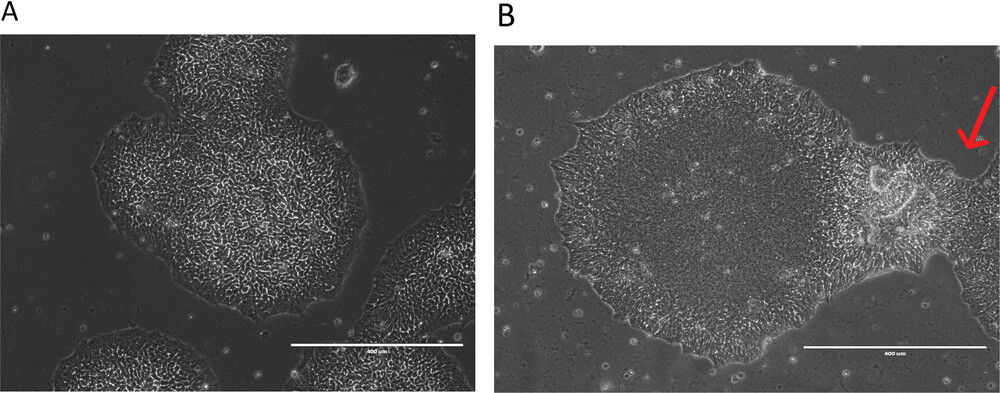 Fig.2 Under the microscope, iPSC cells in culture were observed, and spontaneously differentiated cells appeared in the right image.1
A: We implement daily morphological monitoring and use high-purity, chemically defined media that lack differentiation-inducing factors. Furthermore, our Versene-based passaging preserves cell-cell contacts, which is a natural safeguard against exit from the pluripotent state.
A: Yes, we specialize in weaning iPSC lines off feeder layers. We use a stepwise adaptation process over 3-5 passages to ensure the cells remain stable and healthy throughout the transition.
A: 3D culture more accurately represents the physiological niche, which is critical for complex tissue modeling (like cardiac or neural tissues). It also allows for significantly higher cell densities, which is necessary for large-scale therapeutic production.
A: Yes. Our QC includes G-banded karyotyping, flow cytometric marker analysis, and sterility testing. We can also perform teratoma assays or in vitro tri-lineage differentiation to satisfy regulatory requirements.
A: We use validated, temperature-controlled shipping containers and specialized cryopreservation media. We provide a detailed thawing protocol to ensure a high recovery rate upon arrival at your facility.
Creative Biolabs provides a comprehensive ecosystem for Advanced Induced Pluripotent Stem Cell (iPSC) Culture & Expansion Services, ranging from initial maintenance and feeder-free adaptation to high-volume 3D scaling and rigorous genomic validation. Our services are designed to minimize risk and maximize the therapeutic potential of your cell lines.
Contact Our Team for More Information and to Discuss Your Project
Reference
For Research Use Only. Not For Clinical Use.