Induced Pluripotent Stem Cells (iPSCs) transform regenerative medicine, but traditional CRISPR has low HDR efficiency in stem cells. Our Induced Pluripotent Stem Cell (iPSC) Genome Editing Service uses advanced CRISPR/Cas9 and transient p53-inhibition to deliver high-quality isogenic cell lines, boosting HDR rates over 90%. Creative Biolabs provides one-stop, precise modification solutions, ready-to-use genetically defined models, and isogenic pairs, accelerating drug discovery with high efficiency and regulatory compliance.
Discover How We Can Help - Request a Consultation
Induced pluripotent stem cell (iPSC) genome editing is a cornerstone technology for disease modeling, drug discovery, and regenerative medicine, enabling precise modification of genomic sequences to generate isogenic cell lines or functional gene-edited derivatives. A variety of editing methods have been developed to meet diverse research needs, varying in targeting specificity, editing efficiency, and applicability for clinical translation. The following table summarizes mainstream iPSC genome editing approaches, their core principles, key advantages, and typical application scenarios.
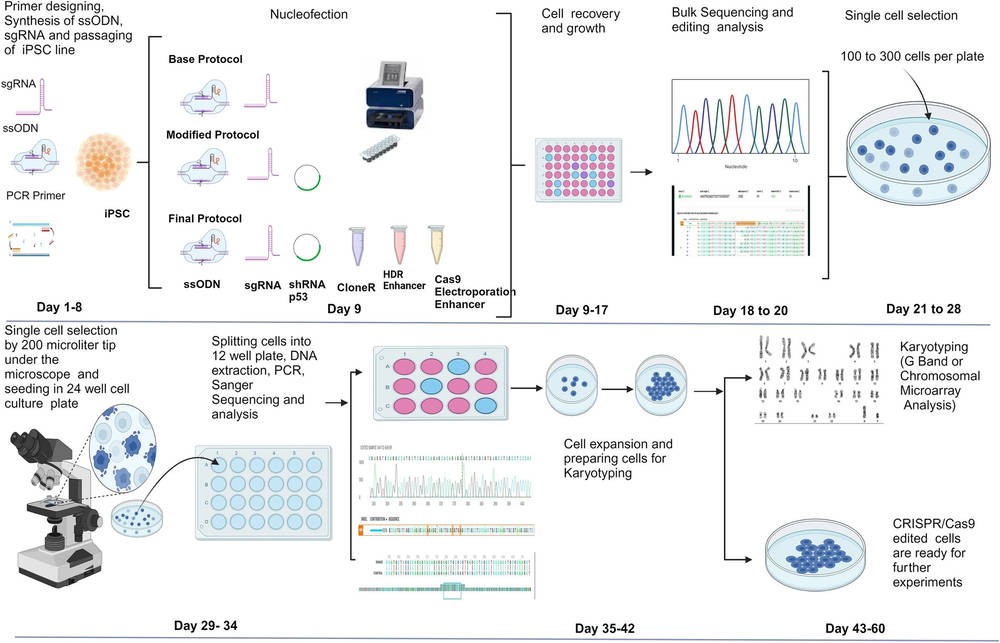 Fig.1 Research design schematic diagram: Gene editing of iPSC is carried out through the basic, modified, and final optimization schemes.1
| Technology Name | Core Principle | Key Advantages | Applicable Scenarios |
|---|---|---|---|
| Virus Vector-Mediated Genome Editing | Uses viruses (e.g., lentivirus, AAV) to deliver editing components (e.g., Cas9, sgRNA) into iPSCs via infectivity. | High delivery efficiency, stable expression, suitable for hard-to-transfect iPSCs. | Large-scale editing, long-term expression studies, and basic research model construction. |
| Restriction Enzyme-Based Method | Restriction enzymes cleave specific DNA sequences, triggering NHEJ/HDR repair for editing. | Mature, low-cost, simple, fit for basic cleavage needs. | Simple cleavage, entry-level experiments, and modification at specific enzyme sites. |
| Cas Protein Method (CRISPR-Cas System) | sgRNA guides Cas proteins (e.g., Cas9) to cleave target DNA, inducing repair for modifications. | High specificity, simple, efficient, supports multi-target editing. | Various iPSC modifications, disease models, and drug target validation. |
| Base Editing Technology (Base Editors) | Cas-deaminase fusions enable single-base substitution via sgRNA targeting, with no double-strand breaks. | Ultra-low off-target risk, precise, simple, no donor DNA needed. | Monogenic disease repair, single-base mutation models, and precise modification. |
| Prime Editing Technology (Prime Editing) | nCas9-reverse transcriptase fusions + pegRNA enable diverse edits (substitution, insertion/deletion). | No donor DNA, low break risk, diverse, high-precision. | Complex modifications, fragment replacement, and complex disease models. |
| Transcription Activator-Like Effector Nuclease Technology (TALENs) | TALE proteins target DNA, guide FokI cleavage, and rely on cellular repair for modification. | Flexible design, high specificity, no virus integration risk. | Virus-restricted models, precise modification, high-specificity experiments. |
| Oligonucleotide-Mediated Genome Editing (ODN-mediated editing) | Single-stranded ODNs with mutations trigger homologous recombination for target modification. | Enzyme-free, simple, low genomic damage, low-cost. | Small-fragment substitution, short insertion, and simple repair experiments. |
| Transposon-Mediated Gene Integration Technology (e.g., Sleeping Beauty) | Transposons integrate exogenous genes into iPSCs; elements can be subsequently removed. | Stable expression, no residual interference, precise integration. | Long-term expression models, gene function research, and clinical-grade modification. |
Our comprehensive workflow is optimized for maximum cell survival and precision, ensuring that even the most complex "difficult-to-edit" loci are successfully modified.
At Creative Biolabs, we provide a sophisticated, modular platform for iPSC genome editing that scales from basic research to therapeutic development. Our expertise ensures that every project is a "perfect fit" for your specific biological goals.
Precise knock-outs, knock-ins, point mutations, and large-scale sequence insertions.
Expert integration of fluorescent tags (GFP/RFP) or luciferase reporters under specific promoters for real-time lineage tracking.
End-to-end support including initial donor cell reprogramming, precision editing, and directed differentiation into target lineages (neurons, cardiomyocytes, etc.).
Integration of deep NGS and structural variant analysis to ensure 100% on-target accuracy and clonal purity.
Tailored design of donor templates and codon usage to maximize expression in human pluripotent systems.
Capability to produce master cell banks (MCB) and working cell banks (WCB) under stringent quality-controlled environments.
Direct access to iPSC specialists to design custom protocols for "difficult-to-edit" patient-derived lines.
Experience the Creative Biolabs Advantage - Get a Quote Today
A: We perform continuous pluripotency marker monitoring (Oct4, Nanog, SOX2) and offer embryoid body (EB) formation assays to confirm that the editing process has not impaired the cells' ability to differentiate into all three germ layers.
A: Yes. Our proprietary pro-survival cocktail and optimized nucleofection parameters are specifically designed to handle sensitive lines, significantly increasing the success rate for patient-derived materials.
A: While Sanger checks for the presence of the edit, our deep NGS platform looks for mosaicism and structural variants like large deletions that are often invisible to standard PCR-based methods.
A: Yes. We highly recommend generating an isogenic control (where the mutation is corrected or introduced into the same genetic background) to ensure that observed phenotypes are truly mutation-specific.
A: Yes. We utilize RNP (Ribonucleoprotein) delivery and transient expression systems to ensure no foreign DNA is integrated into the host genome, which is critical for clinical translation.
Creative Biolabs is dedicated to providing first-class Induced Pluripotent Stem Cell (iPSC) Genome Editing Service to empower your discovery. Our team of experienced stem cell biologists is ready to discuss your specific project needs and provide a detailed feasibility analysis.
Contact Our Team for More Information and to Discuss Your Project
Reference
For Research Use Only. Not For Clinical Use.