Our service delivers high-quality, footprint-free pluripotent stem cells via advanced non-integrative technologies and optimized OSKM induction, converting somatic samples into versatile materials to streamline lead discovery and clinical validation. As a cornerstone of personalized medicine, it ensures genomic safety and functional maturity. Creative Biolabs offers comprehensive solutions with optimized protocols, providing high-fidelity iPSCs to bypass primary tissue variability and animal model inaccuracies, bridging basic research and industrial drug application.
Discover How We Can Help - Request a Consultation
iPSC reprogramming, a personalized medicine cornerstone, uses Yamanaka factors (Oct4, Sox2, Klf4, c-Myc) to revert somatic cells to pluripotency, overcoming epigenetic barriers for safe, ethical precision drug discovery.
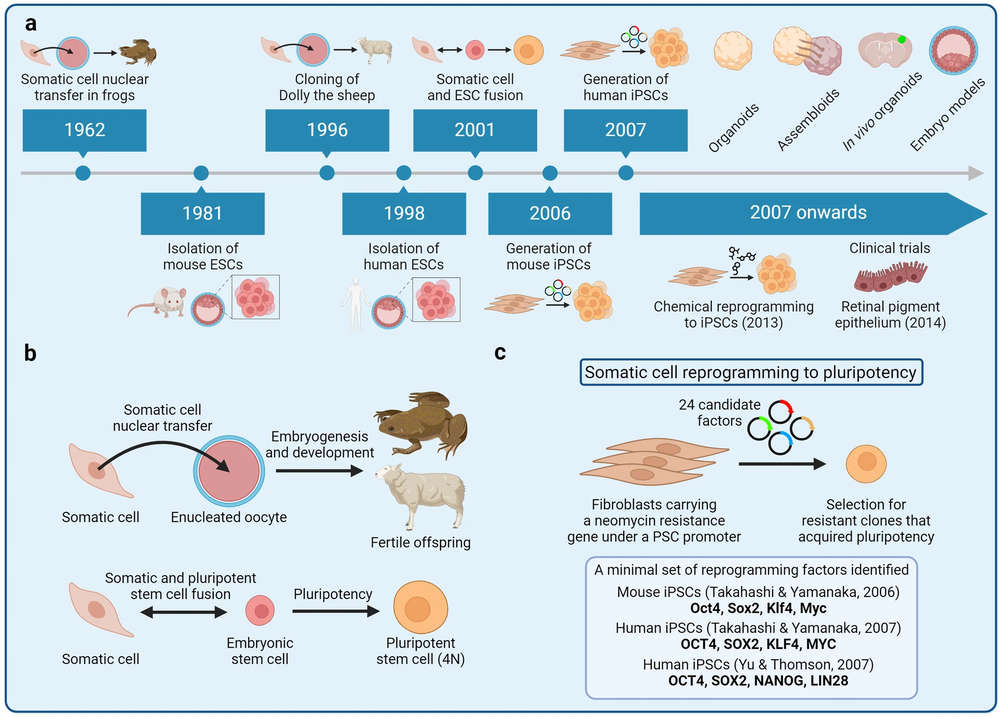 Fig.1 The timeline and key events of key breakthroughs related to iPSC technology.1
| Category | Method | Core Principle | Efficiency | Key Advantages | Limitations |
|---|---|---|---|---|---|
| Integrative Reprogramming | Retroviral Vectors | Deliver Yamanaka factors into dividing cells; integrate into the host genome for stable expression. | High | High reprogramming efficiency; easy to operate | Risk of insertional mutagenesis and oncogenesis; only infects dividing cells. |
| Lentiviral Vectors | Deliver factors into both dividing and non-dividing cells; integrate into the host genome. | Very High | Broad cell tropism; higher efficiency than retroviruses | Genomic integration risk; long-term vector fragment persistence | |
| Non-integrative Reprogramming | Sendai Viral Vectors | RNA viruses replicate and express factors only in the cytoplasm; no nuclear integration. | High | No genomic residue; high safety; suitable for clinical-grade iPSC production | Slightly higher cost; requires viral clearance verification |
| Episomal Plasmid Transfection | Circular plasmids carry reprogramming factors; replicate episomally without integration. | Moderate | Low cost; no viral components; easy to scale up | Low efficiency; plasmids need to be eliminated by cell passaging | |
| Direct mRNA/Protein Delivery | Transfect synthetic mRNA or recombinant proteins of reprogramming factors into cells. | Moderate | Zero genomic integration risk; ultra-high safety | mRNA/protein is easily degraded; requires repeated transfection | |
| Small Molecule Compound Induction | Use chemical cocktails to regulate epigenetic modifications and activate endogenous pluripotency genes. | Low to Moderate | No exogenous nucleic acids; simple operation; low immunogenicity | Low efficiency; long induction cycle; unclear mechanism |
Tab.1 iPSC Reprogramming Methods: Classification and Characteristics.
Depending on different reprogramming methods, we offer a variety of customized services:
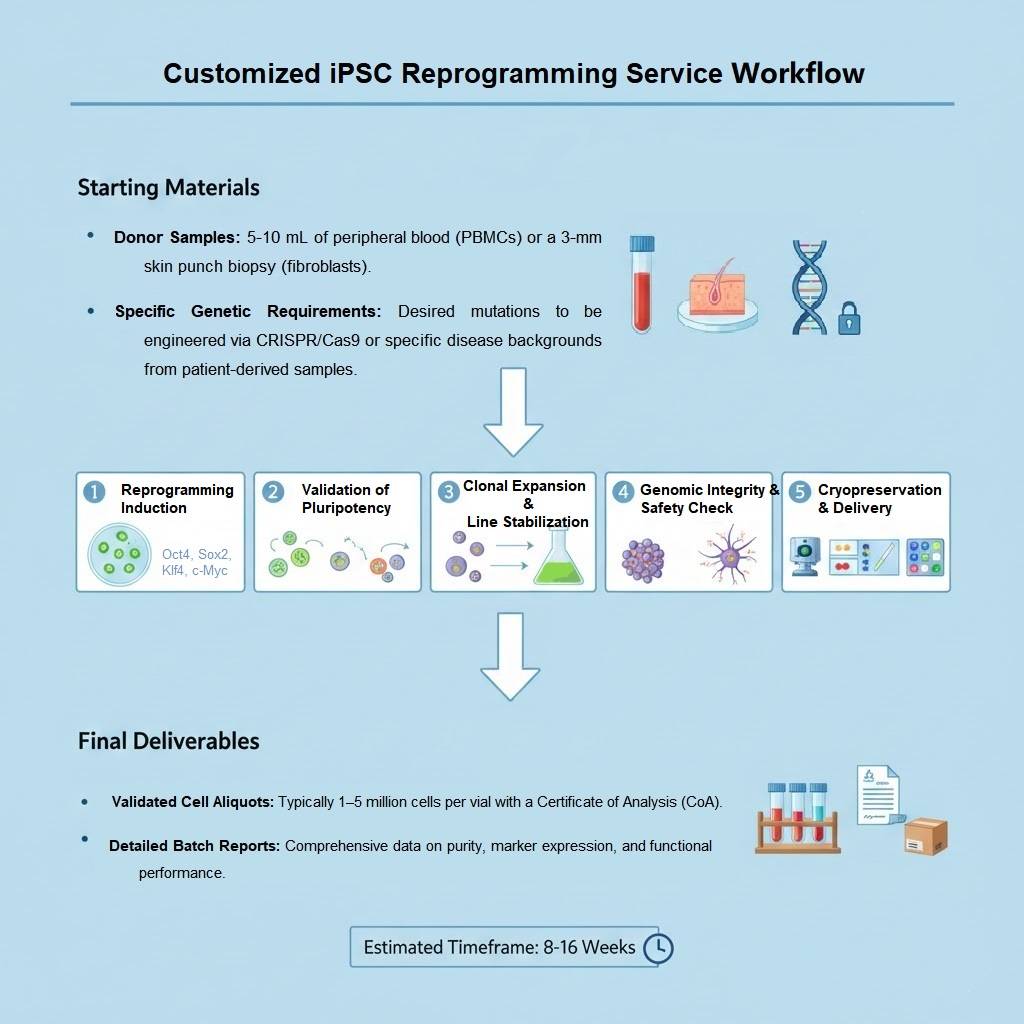
At Creative Biolabs, we translate complex biological concepts into scalable, high-quality cellular products. Our iPSC reprogramming platform is engineered to support your project from initial pilot studies to large-scale industrial applications, ensuring every cell meets the highest scientific standards.
From initial donor sample acquisition to the generation of large-scale Master and Working Cell Banks (MCB/WCB).
For optimized somatic cell expansion and rapid iPSC colony recovery.
Utilizing advanced bioreactor systems and automated liquid handling to minimize human error and batch-to-batch variability.
Incorporating Quality-by-Design (QbD) and process analytical techniques (PAT) to monitor pluripotency induction and colony morphology in real-time.
Throughout the reprogramming process, including frequent sterility testing to ensure the total absence of adventitious agents or mycoplasma.
Through long-term passage testing, ensuring the lines maintain their differentiation potential and genomic integrity over time.
To maximize induction efficiency across diverse donor cell types, including recalcitrant "aged" or "senescent" samples.
Experience the Creative Biolabs Advantage - Talk to Our Scientists
A: We implement a rigorous clearance validation process using sensitive assays such as qPCR to detect residual viral genomes or episomal plasmid DNA. For our mRNA-based reprogramming, the transient nature of the molecule ensures it is completely cleared within days. We provide a comprehensive "Vector Clearance Report" with every project to confirm that the final lines are genetically identical to the donor, minus the somatic epigenetic signatures.
A: Yes. Aging is characterized by telomere attrition and p16/p53-mediated senescence, which often acts as a barrier to reprogramming. Our platform utilizes specialized small-molecule cocktails (e.g., TGF-β and PI3K inhibitors) that temporarily interfere with these aging pathways to reset the "epigenetic clock." This allows us to successfully reprogram cells even from donors with advanced age or age-related degenerative diseases, resulting in rejuvenated cells with elongated telomeres and restored mitochondrial function.
A: We typically achieve >85% viability using our optimized cryopreservation protocols. To maximize your success, we recommend the use of a Rho-kinase (ROCK) inhibitor (e.g., Y-27632) at a 10 μM concentration during the first 24 hours post-thaw. This prevents "anoikis" (cell death caused by loss of attachment) and significantly improves the survival and colony-forming efficiency of the cells as they adapt to your local culture conditions.
A: Absolutely. While fibroblasts and PBMCs are the most common, we have extensive experience with non-invasive sources such as renal epithelial cells from urine samples and keratinocytes from hair follicles. These sources are particularly beneficial for pediatric studies or patients where invasive biopsies are contraindicated. We adapt our induction protocols (e.g., specific seeding densities and media compositions) to suit the unique requirements of each donor cell type.
A: Yes, we offer a "Functional Pluripotency Suite" that includes Embryoid Body (EB) formation assays. These 3D cell aggregates are maintained in suspension culture to allow spontaneous differentiation into the three germ layers: ectoderm (detected via Nestin/Sox1), mesoderm (Brachyury/Vimentin), and endoderm (GATA4/Sox17). This "patient-in-a-dish" validation proves that your iPSC lines possess the unlimited potential to become any cell type in the human body.
Creative Biolabs provides end-to-end iPSC solutions, from initial donor sample reprogramming to the large-scale production of validated, genomic-stable pluripotent lines. Our commitment to quality, footprint-free technology, and customized workflows makes us the preferred partner for global biopharmaceutical R&D.
Contact Our Team for More Information and to Discuss Your Project
Reference
For Research Use Only. Not For Clinical Use.