Creative Biolabs has a tradition of commitment. To achieve efficient execution and regulatory approval, we offer careful considerations of your program for the development of a cellular or gene therapy product – now and in the future.
EXPLORE MORE HighlightsWe focus on unmet needs and develop novel cellular and gene drugs and solutions that offer significant benefits over existing options.
EXPLORE MORE HighlightsThe advent of Chimeric Antigen Receptor T-cell (CAR-T) therapies has revolutionized the field of oncology, providing new avenues for treating various forms of cancer. Our 20 years of experience in the biotechnology sector have equipped us with the expertise and technological capabilities to support the entire lifecycle of CAR-T products, from early development to commercialization.
EXPLORE MORETo accelerate advanced breakthroughs of your projects, we offer broad range of platforms which enable our clients be free to tackle problems with cutting-edge technologies from different angles and in different methods.
EXPLORE MORE HighlightsUse the resources in our library to help you understand your options and make critical decisions for your study. We offer oncolytic virus, CAR-T, and dendritic cell related documents, as well as newsletter. If you don't find the answers you're looking for, contact us for additional assistance.
EXPLORE MORE HighlightsGet a real taste and understanding of the business and culture of one of the world's great research-based cellular and gene therapy discovery and development companies.
EXPLORE MORE
Are you currently facing challenges in developing effective CAR T cell therapies for solid tumors, struggling with antigen specificity, or overcoming the immunosuppressive tumor microenvironment? Our carcinoma-specific CAR construction service helps you accelerate drug discovery and obtain highly potent, precisely targeted CAR constructs through advanced genetic engineering and comprehensive validation.
As a group of cancers, carcinoma usually starts from the skin and spreads to other organs of the body. It accounts for 90% of all cancers, which mostly occur in adults, with the DNA mutation as its main cause. Major subtypes include breast, prostate, colorectal, lung, cervical, melanoma, renal cell carcinoma, and adenocarcinomas. Common symptoms include lumps, skin discoloration, and pain. Although few strategies show effectiveness in carcinoma treatment, immunotherapy has shown great potential as a promising approach to treat carcinoma, such as CAR modified T cells or natural killer (NK) cells. Experts from Creative Biolabs can offer various CAR-T cell or NK cell construction services according to your request.
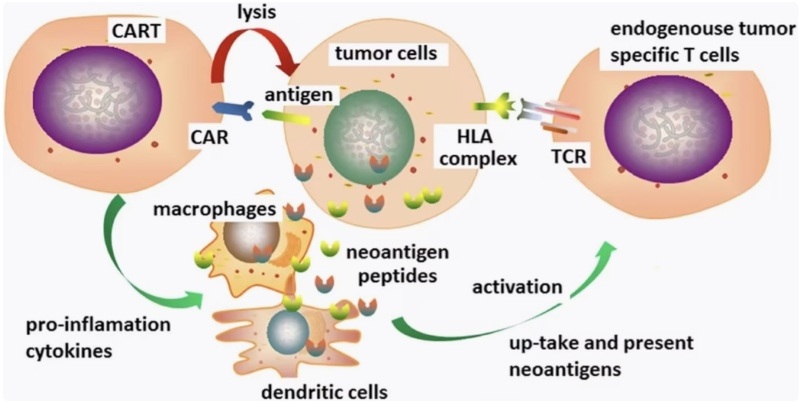 Fig.1 CAR-T cells can be engineered to trigger and enhance the endogenous tumor-specific immune response.1
Creative Biolabs' carcinoma-specific CAR construction service provides a comprehensive, end-to-end solution for developing highly effective Chimeric Antigen Receptors tailored to the unique complexities of solid tumors. We deliver meticulously designed and validated CAR constructs, functional CAR-T cells, and detailed data analyses, empowering your preclinical and clinical advancements. Our solutions are specifically engineered to address critical challenges such as tumor antigen heterogeneity, the immunosuppressive tumor microenvironment, and T cell persistence, offering a pathway to more potent and safer immunotherapies for carcinoma.
As a leading and reliable service provider, Creative Biolabs is well known worldwide for its breakthroughs in the CAR production system. Based on targeting carcinoma-specific antigens, our outstanding scientists have constructed diverse CAR-T cells or CAR NK cells targeting these antigens. In addition to these, Creative Biolabs can also customize the CAR product according to your special requirements.
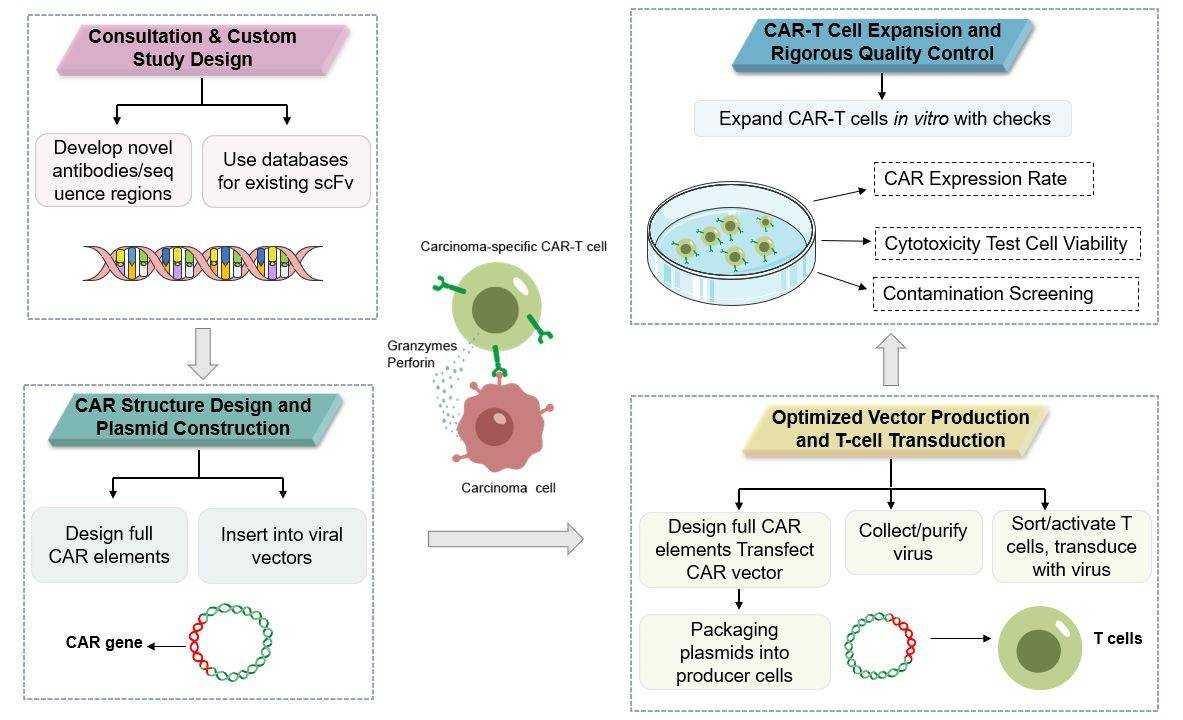
Q1: What types of carcinomas can your service target?
A1: Creative Biolabs' Carcinoma-Specific CAR Construction Service is highly versatile. We have extensive experience targeting a wide range of carcinomas, including but not limited to renal cell carcinoma, melanoma, lung malignancy, colorectal cancer, prostate cancer, breast cancer, adenocarcinomas, and cervical carcinoma. We can work with both established and novel carcinoma-specific antigens.
Q2: How do you address the immunosuppressive tumor microenvironment (TME) in solid tumors?
A2: We address the challenging TME through advanced CAR designs, including "armored" CARs that are engineered to secrete cytokines or express dominant-negative receptors. These modifications help remodel the TME, enhance T cell persistence, and recruit endogenous immune cells, thereby improving CAR-T cell efficacy in hostile solid tumor environments.
Q3: Can you work with both human and mouse T cells for CAR construction?
A3: Yes, our service is equipped to handle both human and mouse T cells. We utilize appropriate viral vectors (lentiviral for human T cells and retroviral for mouse T cells) and optimized protocols for T-cell sorting, activation, and transduction to ensure successful CAR expression and functionality in both species.
At Creative Biolabs, we are committed to accelerating your journey from scientific concept to therapeutic reality in carcinoma treatment. Our carcinoma-specific CAR construction service combines unparalleled scientific expertise with cutting-edge technology, delivering precise, potent, and safe CAR constructs designed to overcome the unique challenges of solid tumors. Partner with us to transform your research into groundbreaking cancer immunotherapies.
"The 4th-generation armored CARs constructed by Creative Biolabs have greatly facilitated our studies on T cell persistence in the harsh tumor microenvironment. We observed remarkably sustained anti-tumor activity, which was a significant improvement compared to our previous constructs." - 2025, Prof. JS Pr
"Creative Biolabs' comprehensive workflow, from scFv selection to final CAR-T cell validation, has streamlined our research process. Their detailed quality control and consistent deliverables have been invaluable in accelerating our preclinical development." - 2025, Dr. Sh Kr
Based on a great number of experiments, we are confident our first-class CAR products can greatly accelerate your project process. Please feel free to contact us at any time.
| Associated malignancy | Target antigen | Receptor type | Product |
|---|---|---|---|
| Renal cell carcinoma (RCC) | Carbonic anhydrase IX (CAIX) | scFv-CD28-41BB-CD3ζ | CAR-MZ204 |
| CSPG4 | scFv-CD28-CD3ζ | CAR-LC134 | |
| G250 epitope | iRGD-scFv-CD28-41BB-CD3ζ | CAR-LC371 | |
| VEGFR-2 | scFv-CD28-41BB-CD3ζ | CAR-LC132 | |
| scFv-CD28-CD3ζ | CAR-LC133 | ||
| Melanoma | EGFR | VHH-CD28-41BB-CD3ζ | XS-0323-LX9 |
| scFv-CD28-CD3ζ | CAR-LC098 | ||
| scFv-CD28-41BB-CD3ζ | CAR-LC100 | ||
| Trop2 | scFv-CD28-41BB-CD3ζ | CAR-LC190 | |
| PD-L1 | PD1-41BB-CD3ζ | CAR-LC282 | |
| Cs-1 | scFv (SLAMF7)-CD28-41BB-CD3ζ/scFv (FN)-cMYCmu | CAR-LC365 | |
| BCMA | scFv-CD28-41BB-CD3ζ | CAR-T-3-L335-2BZ | |
| CS1 | scFv-CD28-OX40-CD3ζ | CAR-NK-3-M329-2XZ | |
| CSH1 | scFv-CD28-41BB-CD3ζ | CAR-T-3-L349-2BZ | |
| HMW-MAA | scFv-CD28-41BB-CD3ζ | CAR-T-3-M318-2BZ | |
| NY-ESO-1 | scFv-CD28-41BB-CD3ζ | CAR-T-3-M323-2BZ | |
| GD3 | scFv-CD28-41BB-CD3ζ | CAR-T-3-M317-2BZ | |
| MART-1(DMF5) | scFv-CD28-41BB-CD3ζ | CAR-T-3-M310-2BZ | |
| CD56 | scFv-CD28-41BB-CD3ζ | CAR-T-3-M312-2BZ | |
| gp100 | VHH-41BB-CD3ζ | CAR-T-2-M552-BZ | |
| Lung malignancy | Mesothelin | scFv-CD28-41BB-CD3ζ | CAR-LC054 |
| 7H-YB-Fluc-EF1a-scFv-41BB-CD3ζ | XS-0822-YF8720 | ||
| scFv-CD28-CD3ζ | CAR-LC024 | ||
| ALK | scFv-CD28-41BB-CD3ζ | CAR-LC103 | |
| Fibroblast activation protein (FAP) | scFv-41BB-CD3ζ | CAR-LC224 | |
| CD87 | scFv-41BB-CD3ζ-IL12 | CAR-LC265 | |
| Tissue factor | Protein-41BB-CD3ζ | CAR-LC288 | |
| TF | scFv-CD28-OX40-CD3ζ | CAR-T-3-L406-2XZ | |
| Colorectal cancer | CEA | scFv-CD28-41BB-CD3ζ | CAR-T-3-M314-2BZ |
| EGP-2 | scFv-CD28-41BB-CD3ζ | CAR-T-3-M316-2BZ | |
| TAG-72 | scFv-CD28-41BB-CD3ζ | CAR-T-3-M325-2BZ | |
| CD276 | scFv-CD28-CD3ζ | CAR-LC162 | |
| EpCAM | scFv-CD28-41BB-CD3ζ | CAR-LC181 | |
| HLA-A2-WT1DB126 | scFv-CD28-FcγR1γ | CAR-LC266 | |
| Prostate cancer | PSMA | 7H-YB-IL15 SA-EF1a-scFv-CD28-CD3ζ | XS-0822-YF9698 |
| PSCA | scFv-CD28-CD3ζ | CAR-MZ157 | |
| Breast cancer | CD8 | scFv-41BB-CD3ζ-IL12 | CAR-LC265 |
| ErbB2 | scFv-CD28-41BB-CD3ζ | CAR-T-3-L337-2BZ | |
| MUC1 | scFv-CD28-41BB-CD3ζ | CAR-T-3-M322-2BZ | |
| TEM8 | scFv-CD28-41BB-CD3ζ | CAR-T-3-L343-2BZ | |
| SSEA4 | scFv-41BB-CD3ζ | CAR-LC001 | |
| CD33 | scFv-CD28-CD3ζ | CAR-LC155 | |
| HER2 | scFv-41BB-CD3ζ | CAR-LC172 | |
| NY-BR-1 | scFv-CD28-41BB-CD3ζ | CAR-LC220 | |
| CD44 | scFv-CD28-CD3ζ | CAR-LC226 | |
| CD47 | scFv (CD47)-CD28-41BB-CD3ζ/scFv (TAZ)-TET2 | CAR-LC364 |
Reference
For any technical issues or product/service related questions, please leave your information below. Our team will contact you soon.
All products and services are For Research Use Only and CANNOT be used in the treatment or diagnosis of disease.
 NEWSLETTER
The latest newsletter to introduce the latest breaking information, our site updates, field and other scientific news, important events, and insights from industry leaders
LEARN MORE NEWSLETTER NEW SOLUTION
CellRapeutics™ In Vivo Cell Engineering: One-stop in vivo T/B/NK cell and macrophage engineering services covering vectors construction to function verification.
LEARN MORE SOLUTION NOVEL TECHNOLOGY
Silence™ CAR-T Cell: A novel platform to enhance CAR-T cell immunotherapy by combining RNAi technology to suppress genes that may impede CAR functionality.
LEARN MORE NOVEL TECHNOLOGY NEW SOLUTION
Canine CAR-T Therapy Development: From early target discovery, CAR design and construction, cell culture, and transfection, to in vitro and in vivo function validation.
LEARN MORE SOLUTION