Creative Biolabs' Custom Factor Optimization Service delivers high-quality, footprint-free pluripotent stem cells via integration-free delivery and AI colony selection. We optimize donor cell selection and reprogramming microenvironments to solve partial reprogramming issues, ensuring trilineage differentiation potential, genetic stability, and phenotypic consistency. Backed by peer-reviewed benchmarks, our end-to-end solution enables safe therapeutic exploration, commercial scaling, and compliant downstream applications without insertional mutagenesis risks.
Discover How We Can Help - Request a Consultation
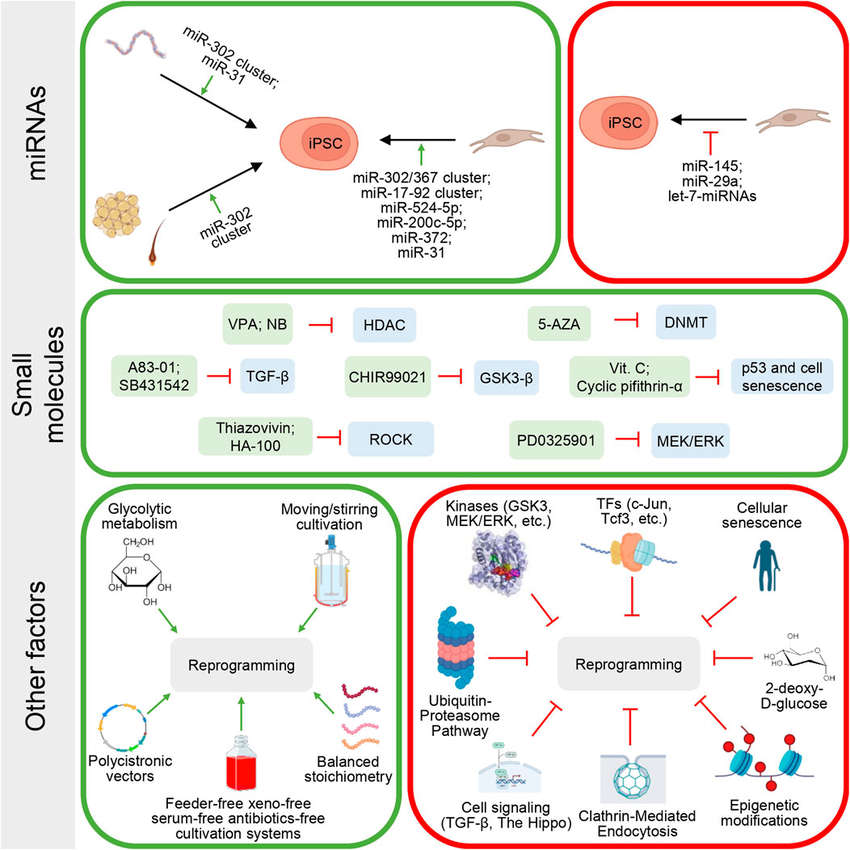 Fig.1 mRNA, small molecules, and other factors that affect cell reprogramming.1
| Category | Sub-factors | Core Details |
|---|---|---|
| Somatic Cell Source Traits | Cell type & developmental stage | Fibroblasts/blood cells/keratinocytes are common; neonatal cells > senescent adult cells in reprogramming efficiency. |
| Cell cycle state | G1/S phase cells are more responsive to reprogramming factor integration and epigenetic remodeling. | |
| Donor genetic background | Variations in chromatin modification/pluripotency genes affect reprogramming potential. | |
| Reprogramming Induction Conditions | Reprogramming factors | OSKM cocktail is mainstream; variants/small-molecule substitutes lower oncogenic risks. |
| Delivery vectors | Viral vectors: high efficiency but insertional mutagenesis risk; Non-viral vectors: safe but low efficiency. | |
| Induction duration & dosage | Optimal factor concentration/time avoids cell damage and boosts pluripotency induction. | |
| Culture Microenvironment Regulation | Medium components | Add bFGF/LIF and CHIR99021/valproic acid to promote reprogramming and suppress differentiation. |
| Feeder system | Feeder cells provide support; feeder-free systems (Matrigel) ensure clinical safety. | |
| Physical-chemical conditions | 5% O2, 37°C, 5% CO2 maintain cell viability and pluripotency establishment. |
Creative Biolabs leverages industrial-scale biotechnology expertise to provide a sophisticated suite of Custom Factor Optimization Service. We recognize that every research project has unique biological requirements; therefore, our platform is built on the principle of total customization to meet the exacting standards of biology experts worldwide.
One-stop service from laboratory-scale pilot derivation to large-scale industrial cell banking and expansion.
Custom optimization of codon usage for synthetic mRNA factors to maximize expression efficiency in specific donor cell types.
We ensure the long-term genetic and phenotypic stability of your iPSC strains through rigorous Master Cell Bank (MCB) and Working Cell Bank (WCB) procedures.
Reprogramming processes are conducted following the basic principles of Good Manufacturing Practice (GMP) and strict aseptic verification.
Implementation of Quality-by-Design (QbD) frameworks and real-time monitoring to minimize batch-to-batch variability.
Documentation quality and strain origin procedures are assessed and approved by our qualified QA service, following HACCP principles.
High-standard quality control tools are used to quantify pluripotency markers and evaluate the overall genomic health of every clone.
Experience the Creative Biolabs Advantage - Get a Quote Today
A: Non-integrating methods, such as synthetic mRNA or Sendai virus delivery, ensure that the host genome remains completely intact. Unlike retroviral or lentiviral vectors, these methods do not risk insertional mutagenesis or the activation of oncogenes. This genomic "cleanliness" is paramount for clinical safety and ensures that disease modeling data is not confounded by transgene interference or unpredictable genomic scarring.
A: Donor cells often retain molecular "scars" or methylation patterns from their tissue of origin, which can bias downstream differentiation. We employ high-potency small-molecule cocktails during the critical early windows of induction to actively "erase" these somatic signatures. This deep epigenetic resetting facilitates unbiased differentiation potential, allowing the resulting iPSCs to commit effectively to all three germ layers without lineage-specific resistance.
A: Yes, our end-to-end derivation and validation workflows are performed under strict GCLP-compliant quality controls. We provide detailed documentation for every characterization step, from initial donor screening to final karyotyping, ensuring that all generated data is robust enough for inclusion in regulatory dossiers such as IND or BLA submissions. Our transparent documentation serves as a certificate of reliability for your therapeutic pipeline.
A: We specialize in difficult-to-reprogram populations. By utilizing proprietary factor ratios and microenvironment modifiers, we can effectively overcome the stochastic barriers and reduced proliferative capacity often seen in aged or senescent cells. Our platform is optimized to boost the metabolic health of these cells during induction, ensuring high-quality colony formation where standard protocols typically fail.
A: Our clones are rigorously validated for long-term phenotypic and genotypic stability. Typically, our footprint-free iPSC lines maintain a stable diploid karyotype and high expression levels of pluripotency markers for over 50 passages. We provide optimized culture protocols to ensure that these cells maintain their trilineage potential throughout extended research timelines, preventing spontaneous differentiation or genomic drift.
Contact Our Team for More Information and to Discuss Your Project
Reference
For Research Use Only. Not For Clinical Use.