Creative Biolabs' Custom Protein based Induced Pluripotent Stem Cell (iPSC) Reprogramming Service uses advanced fusion technology for ectopic expression of transcription factors, thereby safely and efficiently reprogramming somatic cells into imprinted iPSCs. This DNA-free and non-integration approach avoids the risk of genomic integration and residual transgenic expression, which is supported by existing literature. As an integrated solution connecting basic research and translational medicine, we offer fully characterized clinical-grade iPSCs with validated pluripotency and three-lineage differentiation, making them an ideal choice for disease modeling, drug screening, and treatment development.
Discover How We Can Help - Request a Consultation
This four-protein combination is the most classic and widely adopted in most iPSC reprogramming methods, including virus-mediated and episomal vector-mediated approaches.
The primary Advantage of protein-based reprogramming is the total absence of genetic material, eliminating insertional mutagenesis and the risk of oncogene reactivation. Furthermore, the dose-titratable nature of protein delivery allows for precise control over the reprogramming kinetics.
Applications include:
To ensure the highest fidelity in cellular conversion, our workflow is meticulously standardized:
At Creative Biolabs, we extend our footprint-free expertise to include Reprogramming by Protein, providing a robust, non-integrating DNA-based alternative. Our industrial-grade platform ensures:
from initial vector design and pilot-scale optimization to large-scale iPSC production.
tailored to your specific donor cell type and downstream clinical requirements.
to maximize the yield of high-quality pluripotent colonies.
with strict aseptic verification procedures throughout the reprogramming and expansion phases.
integration, utilizing Quality-by-Design (QbD) and Process Analytical Techniques (PAT) to ensure batch-to-batch consistency.
and vector configurations to facilitate superior expression of reprogramming factors in diverse mammalian systems.
, including strain origin assessment and cell bank stability validation, was approved by qualified quality assurance services.
capable of meeting the demands of large-scale clinical trials with standardized quality control tools.
Experience the Creative Biolabs Advantage - Get a Quote Today
To evaluate the effect of BMP signaling activity on IM, we treated the cells with 0, 4, 25, and 100 ng/mL BMP4 and 3 μM CHIR99021 for 48 hours. We analyzed the IM markers OSR1, GATA3, and PAX2 using immunofluorescence and qPCR. Immunofluorescence analysis detected PAX2 and OSR1 in BMP4 treatment at doses of 4 ng/mL and 3 μM CHIR99021, respectively, and spherical cell formation was observed.
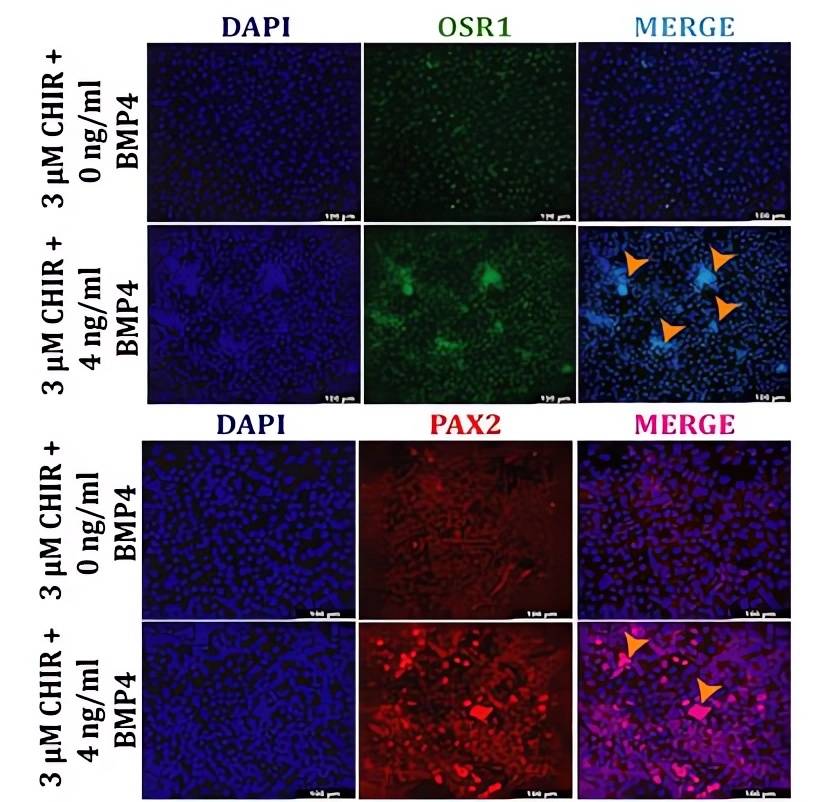 Fig.1 After the addition of BMP, iPSC will develop towards IM, expressing IM markers OSR1 and PAX2.1
A: Historically, protein-based methods suffered from lower efficiency due to poor protein stability and intracellular degradation. However, our specialized 30Kc19-enhanced system significantly narrows this gap. By protecting transcription factors from premature proteolysis and improving their localization to the nucleus, we achieve consistent colony formation rates that make this technology a highly viable, clinically safe alternative to traditional viral transduction.
A: No. One of the primary advantages of this platform is its transient nature. Proteins possess a natural biological half-life and are efficiently processed by the cell's endogenous proteasome system within a few days. By the time the iPSC colonies are harvested and expanded, the original reprogramming factors have been completely metabolized, leaving the resulting cell lines truly "footprint-free" and genetically indistinguishable from the donor's original genome.
A: Human dermal fibroblasts and Peripheral Blood Mononuclear Cells (PBMCs) are our most common starting materials due to their standardized reprogramming profiles. However, our scientific team has extensive experience in optimizing specialized protocols for more "stubborn" or rare somatic cell types. We encourage you to inquire about customized pilot studies for unique patient samples or specialized tissue-derived cells.
A: Yes. In fact, many researchers find that our protein-induced iPSCs demonstrate superior differentiation consistency. Because there are no integrated transgenes or residual vector DNA to randomly reactivate or interfere with lineage-specific signaling pathways, the cells respond more predictably to growth factors and small molecules during the differentiation process into neurons, cardiomyocytes, or hepatocytes.
A: The process begins with a thorough technical consultation where we discuss your donor material availability, specific research goals, and regulatory requirements. Following this, our team provides a tailored project plan that outlines the milestones, characterization assays, and expected timelines. We guide you through the logistics of sample shipment and project tracking to ensure a seamless experience from start to finish.
Creative Biolabs is your dedicated partner in advanced stem cell technologies. We provide the expertise and the proprietary platforms necessary to ensure your discovery moves safely from the lab to the clinic.
Contact Our Team for More Information and to Discuss Your Project
Reference
For Research Use Only. Not For Clinical Use.