Creative Biolabs is offering the most comprehensive services for antibody development projects. With strict regulation and effective execution, we are dedicated to providing the most valuable solutions to complete your projects.
HighlightsCreative Biolabs is offering the most comprehensive services for antibody development projects. With strict regulation and effective execution, we are dedicated to providing the most valuable solutions to complete your projects.
HighlightsCreative Biolabs has established a broad range of platforms for developing novel antibodies or equivalents. These cutting-edge technologies enable our scientists to meet your demands from different aspects and tailor the most appropriate solution that contributes to the success of your projects.
HighlightsWith deep understanding in antibody-related realms and extensive project experience, Creative Biolabs offers a variety of references to help you learn more about our capacities and achievements, including infographic, flyer, case study, peer-reviewed publications, and all kinds of knowledge that can assist your projects. You are also welcome to contact us directly for more specific solutions.
HighlightsGet a real taste of Creative Biolabs, one of the most professional custom service providers in the world. We are committed to providing highly customized comprehensive solutions with the best quality to advance your projects.
HighlightsMonoclonal antibodies (mAbs) are uniform immunoglobulins produced by a single B-cell clone which target a specific antigen epitope with consistent specificity and affinity. mAbs serve as essential instruments in immunotherapy applications as well as diagnostic procedures and specialized research because they exhibit exceptional specificity and reproducibility.
The two principal methodologies for mAb generation are:
Both systems offer distinct workflows, performance metrics, and scalability profiles.
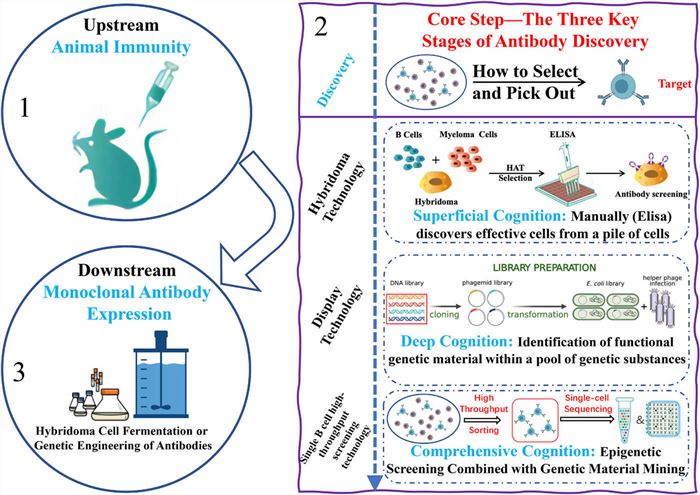 Fig. 1 Three critical phases of antibody discovery: i) superficial cognition: manually (Elisa) discovers effective cells from a pile of cells; ii) deep cognition: identification of functional genetic material within a pool of genetic substances; iii) comprehensive cognition: epigenetic screening combined with genetic material mining.1
Choosing the optimal production method is pivotal. Applications requiring rapid development, high diversity, or humanization favor phage display, while long-term stability and in vivo screening may benefit from hybridoma methods.
Developed in 1975 by Köhler and Milstein, hybridoma technology involves the fusion of antibody-producing B-cells with immortal myeloma cells, generating a hybrid that continuously secretes specific antibodies.
| Step | Description |
| Immunization | Host (typically mouse) is immunized with antigen. |
| Cell Fusion | Spleen B cells fused with myeloma cells using PEG. |
| Selection | HAT medium selects only fused hybridomas. |
| Screening | ELISA or immunoassays identify specific clones. |
| Expansion | Positive clones expanded for production. |
| Cryopreservation | Stable clones are stored for long-term use. |
Advantages:
Limitations:
Phage display involves displaying antibody fragments (e.g., scFv, Fab) on the surface of filamentous bacteriophages. The DNA encoding the antibody is packaged within the phage, linking genotype to phenotype.
| Step | Description |
| Library Construction | Gene library cloned into phage vector. |
| Biopanning | Antigen-specific phages are captured by immobilized antigens. |
| Washing | Non-binding phages are removed. |
| Amplification | Bound phages are amplified in E. coli. |
| Screening | ELISA or sequencing used for analysis. |
| Expression | Selected clones are expressed in bacteria or mammalian systems. |
Advantages:
Limitations:
Organizations aiming to create effective monoclonal antibody development pipelines can gain essential knowledge through thorough comparative analysis of hybridoma and phage display methods.
In research and therapeutic applications time-to-market stands as a critical element.
Conclusion: Phage display demonstrates superior performance compared to hybridoma regarding both speed of development and parallelization potential.
Antibody repertoires must have extensive breadth and depth to effectively target difficult or non-immunogenic antigens.
Conclusion: Phage display produces significant diversity and serves as the best method for targeting specific epitopes or rare antigens.
Therapeutic efficacy and manufacturability depend crucially on antibody affinity and biophysical stability.
Conclusion: Phage display stands as the optimal method when engineered optimization of binding kinetics and robustness is required.
Minimizing immunogenicity is critical for developing safe and efficacious human therapeutics.
Conclusion: Phage display enables the direct discovery of human or humanized antibodies, streamlining therapeutic development.
Long-term project viability hinges on cost-effective, scalable production systems.
While phage display requires initial investment in molecular biology infrastructure, the return on efficiency and throughput yields substantial cost savings in the medium and long term.
Conclusion: Phage display offers more favorable cost-efficiency, especially in high-throughput or therapeutic discovery settings.
Table 1. Key Performance Comparison of phage display and hybridoma technology.
| Parameter | Hybridoma | Phage Display |
| Development Time | 8–12 weeks | 3–6 weeks |
| Library Diversity | Limited (10⁴–10⁶) | Extensive (>10⁹) |
| Affinity Tuning | Natural (in vivo) | Directed (in vitro) |
| Humanization Need | Required for therapeutic use | Optional (fully human libraries available) |
| Cost Efficiency | Moderate to high | High (post-setup) |
While hybridoma technology remains a trusted approach, phage display offers unmatched speed, diversity, and adaptability—particularly for next-gen therapeutic and diagnostic development. Selection of the appropriate method depends on target complexity, application demands, and development timelines.
Learn more about Creative Biolabs custom phage display and hybridoma services:
All listed services and products are For Research Use Only. Do Not use in any diagnostic or therapeutic applications.