
Co-delivering therapeutic agents (drugs/genes) and diagnostic probes to tumors simultaneously.
Exosome-Metal Hybrid Nanoparticle for Targeted Drug Delivery
Exosomes-Metal Hybrid Nanoparticles accelerate therapeutic development and unlock new theranostic possibilities. Achieve this through the precise integration of engineered metal nanoparticles into the exosome membrane, creating a synergistic biomimetic delivery system with unmatched stability, targeting, and diagnostic capability, bypassing the limitations of traditional nanocarriers and native exosomes.
Click Here to View more about our Services
Introduction of Exosomes-Metal Hybrid Nanoparticles
Exosome-Polymer Hybrid Nanoparticles represent a revolutionary class of biomimetic delivery vehicles designed to harness the natural advantages of cell-derived vesicles while benefiting from the superior loading capacity and stability of synthetic materials.
What Are Exosomes-Metal Hybrid Nanoparticles?
Exosomes-Metal Hybrid Nanoparticles are sophisticated, bio-engineered nanocarriers created by conjugating or integrating inorganic metallic or organic nanoparticles (NPs)—such as Gold (Au) or Mesoporous Silica—onto or within the membrane of natural Exosomes (Extracellular Vesicles). This fusion combines the targeting and biocompatibility of the exosome with the payload capacity, stability, and intelligent functionality (e.g., magnetic or optical properties) of the engineered NP.
Application Scenarios
Cancer Theranostics
Blood-Brain Barrier (BBB) Penetration
Leveraging the exosome's natural ability to cross physiological barriers for Central Nervous System (CNS) drug delivery.
Vaccine and Gene Delivery
Enhancing the stability and targeted delivery of mRNA, siRNA, or plasmid DNA payloads to specific immune or diseased cells.
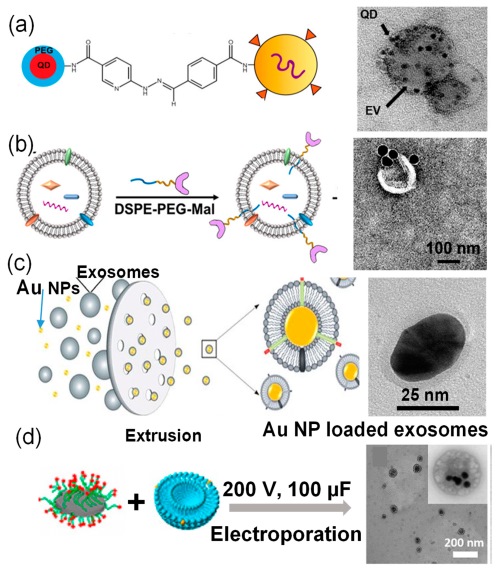 Fig.1 Illustrations and TEM images of inorganic nanoparticle-loaded exosomes formed post exosome creation.1
Why Choose Us?
The inherent design of hybrid nanoplatforms provides five critical advantages that overcome industry-wide challenges:
Immune Evasion
The exosome membrane camouflage significantly reduces rapid clearance by the Reticuloendothelial System (RES), extending circulation time in vivo.
Active Targeting
Native exosome surface proteins (e.g., ligands, integrins) provide superior tissue-homing ability compared to purely synthetic liposomes.
Versatile Payload
The integrated NP core allows for efficient loading of both hydrophilic and previously challenging hydrophobic drug molecules.
Triggered Release Potential
The metal components enable remote activation, such as Photothermal Therapy (PTT) under Near-Infrared (NIR) light, allowing for on-demand drug release at the disease site.
Manufacturing Control
The NP component introduces precision control over size, morphology, and cargo concentration, addressing the low yield and inconsistent loading of pure exosome isolates.

Key Technologies
Engineering Key Points: Demonstrating Precise Control
Precise control over the key influencing factors that ensure the stability and functionality of hybrid systems:

Utilize controlled conjugation methods to integrate NPs while preserving the natural exosome characteristics (size, morphology, protein markers) essential for immune evasion and cell recognition.
Precise synthetic protocols ensure optimal NP-to-Exosome ratios. This directly translates to higher drug loading efficiency for the therapeutic agent and reliable signal intensity for the diagnostic component.
Our platform is engineered to promote uptake predominantly via clathrin-mediated endocytosis, a pathway that maintains hybrid stability and avoids immediate degradation.
We carefully design NP surface chemistry to manage the hybrid's intracellular fate, steering it toward the desired target or maximizing its residence time before eventual lysosomal degradation.
Collaborate with Creative Biolabs to Leverage the Potential of Biomimetic Engineering.
Cutting-Edge Technology
The biological source of the exosome determines the targeting ligand expression, enablin the delivery vehicle for specific clinical applications.
| Exosome Source | Primary Targeting Advantage | Application Examples |
|---|---|---|
| Macrophage Exosomes | Inherent homing to sites of inflammation and tissue damage. | Delivery of anti-inflammatory drugs to treat colitis or rheumatoid arthritis; gene delivery for regenerative medicine. |
| Platelet Exosomes | Natural affinity for injured vascular endothelium and tumor vasculature/thrombotic sites. | Targeted delivery to solid tumors with highly vascularized or necrotic cores; inhibition of metastasis initiation. |
| Cancer Cell Exosomes | Expression of parent cell-specific markers; re-homing to the primary tumor or metastatic niches. | Highly specific delivery of chemotherapy or gene editing tools back to the originating tumor cells. |
| Mesenchymal Stem Cell (MSC) Exosomes | Immunomodulation and regenerative properties; homing to ischemic or fibrotic tissue. | Delivery of nucleic acids (miRNAs, mRNA) for myocardial repair post-infarction; neuroprotection in stroke models. |
QC Methods: Building Trust and Reliability
Reliability in nanomedicine is built on rigorous analytical validation. Every batch of Exosomes-Metal Hybrid Nanoparticles meets the highest standards of safety, stability, and function through a comprehensive QC Protocol.
Structural Integrity and Morphology
Transmission Electron Microscopy (TEM) and Atomic Force Microscopy (AFM) for high-resolution visualization of the NP conjugation and confirmation of the preserved exosomal morphology.
Size, Distribution, and Concentration
Nanoparticle Tracking Analysis (NTA) for measuring the mean size, size distribution uniformity, and total particle concentration.
Stability and Surface Charge
Zeta Potential Analysis to determine the stability and surface charge, which is crucial for predicting in vivo performance and avoiding aggregation.
Functional Validation
Confocal Laser Scanning Microscopy (CLSM) to confirm successful co-localization of the NP and the exosome, validating the successful internalization pathway.
Drug Loading and Release Kinetics
HPLC to precisely quantify the loaded drug payload and verify controlled release profiles under various simulated physiological conditions.
Key Benefits
Drastic Dose Reduction
Integrate high-capacity nanoparticle cores significantly boosts payload, achieving therapeutic results with doses, leading to reduced systemic toxicity and lower cost of goods (COG).
Superior Bioavailability
The exosome membrane provides biological protection, ensuring prolonged circulation time and superior delivery to hard-to-reach organs, including confirmed penetration of the Blood-Brain Barrier.
True Theranostic Capability
The integrated metal components allow for non-invasive, high-resolution tracking of the nanocarrier in vivo, enabling precise monitoring of accumulation and clearance, which is critical for personalized medicine.
Enhanced Stability
Hybrid systems show superior stability in complex biological media (e.g., plasma, cell culture medium) compared to native exosomes or simple synthetic liposomes, maintaining structural integrity for over 24 hours.
Programmable Release Control
PTT-enabled hybrids allow for precise, external control over the therapeutic window, minimizing off-target effects and maximizing local efficacy through Near-Infrared activation.
Explore the Benefits Offered by Creative Biolabs - Obtain a Quote Today!
Products
| Products | Description | Inquiry |
|---|---|---|
| Functionalized Lipid Products | Functional lipids like DSPE-PEG-TAT and DSPE-PEG-RGD for precision in therapeutic and imaging applications. | |
| Lipid Nanoparticle Products | LNPs, as a leading non-viral vector platform for nucleic acid delivery, are precisely engineered self-assembling systems designed to protect and deliver therapeutic payloads |
Frequently Asked Questions
How does the manufacturing process ensure the quality and scalability of these hybrid systems?
Utilize large-scale, controlled techniques like optimized membrane extrusion and controlled surface conjugation. Each batch undergoes rigorous QC—including NTA for size uniformity and Zeta Potential for stability—to ensure reproducibility, moving you smoothly toward preclinical studies.
Are these hybrid exosomes safe? How do they compare to purely synthetic nanoparticles in terms of in vivo toxicity?
Safety is the highest priority. By leveraging the natural exosome membrane, our hybrids exhibit significantly reduced immunogenicity and rapid clearance compared to purely synthetic materials. We prioritize components with established biocompatibility profiles, focusing on reduced systemic toxicity.
Can a hybrid system effectively encapsulate both my small-molecule drug and my diagnostic probe simultaneously?
Yes, this is a core capability. The integrated nanoparticle core provides distinct loading compartments—hydrophobic spaces for drugs and surfaces for probe conjugation. This allows for the precise co-delivery of multiple payloads for true theranostic application.
Creative Biolabs is dedicated to dismantling the barriers that limit therapeutic potential. Exosomes-Metal Hybrid Nanoparticles represent the pinnacle of biomimetic engineering, providing an integrated, intelligent platform for high-efficacy, low-toxicity drug and gene delivery. Contact our team of R&D specialists, who is standing by to help you design and customize the perfect hybrid nanoplatform for your therapeutic asset.
Reference
- Barjesteh, Taraneh, Shomit Mansur, and Yuping Bao. "Inorganic nanoparticle-loaded exosomes for biomedical applications." Molecules 26.4 (2021): 1135. Distributed under Open Access license CC BY 4.0, without modification. DOI: https://doi.org/10.3390/molecules26041135.
Our services are For Research Use Only. We do not provide services to individuals.
Online Inquiry