
Provides protection for the encapsulated drug from enzymatic degradation and clearance by the reticuloendothelial system (RES). Often, the liposome surface is modified with Polyethylene Glycol (PEG) chains to create "stealth" liposomes, prolonging circulation time.
Immunoliposome based Targeted Drug Delivery Solution
In the pursuit of groundbreaking therapies, the challenge of targeted delivery often dictates success. Our Immunoliposomes based Targeting Delivery Solution helps you maximize therapeutic efficacy and minimize off-target toxicity through advanced lipid formulation and highly specific antibody-nanoparticle conjugation techniques. This integrated solution is essential for transforming promising drug candidates—including small molecules, proteins, and nucleic acids—into precise, potent clinical agents.
Click Here to View more about our Services
Introduction of Immunoliposomes based Targeting Delivery Solution
Immunoliposomes are sophisticated drug nanocarriers created by coupling the structural versatility of liposomes with the highly specific recognition capabilities of antibodies or their fragments. A liposome is a spherical vesicle composed of one or more phospholipid bilayers that can encapsulate both hydrophilic payloads in its aqueous core and hydrophobic payloads within its lipid membrane.
Structure and Mechanism of Action
The core structure consists of:
Liposomal Vesicle
Targeting Ligand
Typically, a monoclonal antibody (mAb) or a single-chain variable fragment (scFv), covalently linked to the liposome surface, often via the terminus of a PEG chain. This ligand binds specifically to an overexpressed antigen on the target cell (e.g., tumor cells, infected cells, or inflamed tissues).
Upon systemic administration, the long-circulating PEGylated immunoliposomes accumulate passively in tumor or inflammation sites due to the Enhanced Permeability and Retention (EPR) effect. Subsequently, the surface-conjugated antibody provides active targeting, binding to the specific receptor on the target cell surface and triggering receptor-mediated endocytosis. This internalizes the nanocarrier, leading to the efficient release of the drug cargo directly into the cell's cytosol or endolysosomal compartment, ensuring highly localized therapeutic action. Immunoliposomes have shown significant promise in overcoming challenges associated with traditional chemotherapy and next-generation therapeutics like nucleic acids. By combining passive accumulation with active homing, they offer a dual-targeting mechanism that greatly enhances selectivity, a finding supported by preclinical studies focusing on targets like the Transferrin Receptor (TfR) and HER2/neu receptor overexpression in various cancers.
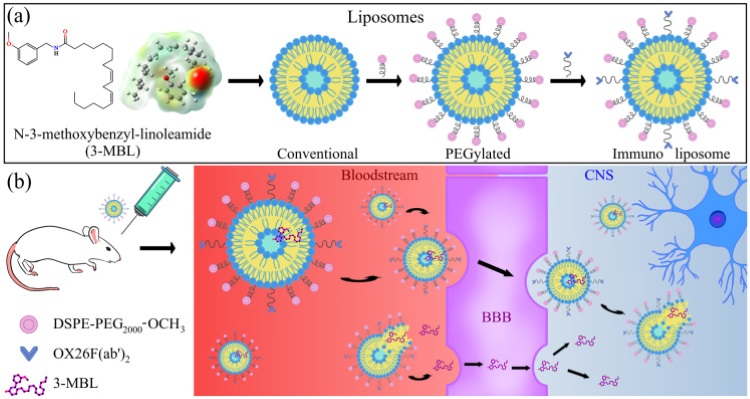 Fig.1 Mechanisms of action of immunoliposomes in the human brain.1
Applications of Targeted Immunoliposome Technology
The precision offered by immunoliposomes unlocks critical applications across several major therapeutic areas, enabling the effective delivery of agents previously limited by poor bioavailability or systemic toxicity.
Oncology (Cancer Therapeutics)
Immunoliposomes are predominantly used in oncology to deliver cytotoxic agents (e.g., Doxorubicin, Paclitaxel) directly to tumor cells overexpressing specific antigens. This approach dramatically increases drug concentration at the tumor site, enhances anti-tumor efficacy, and significantly reduces dose-limiting systemic side effects, such as cardiotoxicity associated with free Doxorubicin. Targeted delivery systems can also be formulated to bypass mechanisms of multi-drug resistance (MDR) that often hinder cancer treatment success.
Infectious and Inflammatory Diseases
Beyond cancer, immunoliposomes are vital for delivering antimicrobial agents or anti-inflammatory drugs.
- Infectious Diseases: They can be engineered to target infected host cells or specific pathogen surface proteins, facilitating the delivery of high concentrations of antibiotics or antiviral drugs intracellularly to sites where microorganisms reside, such as within macrophages in tuberculosis.
- Autoimmune and Inflammatory Conditions: By targeting overexpressed adhesion molecules (e.g., ICAM-1) or immune cells in inflamed tissues (e.g., in Rheumatoid Arthritis), immunoliposomes can deliver immunosuppressants or anti-inflammatory agents with high precision, minimizing systemic immune suppression.
Gene Therapy and Nucleic Acid Delivery
Immunoliposomes are powerful vectors for gene therapy, allowing the cell-specific delivery of genetic material such as siRNA, mRNA, or plasmid DNA. The conjugated antibody ensures the nucleic acid payload reaches the correct cell type, enabling controlled gene silencing or expression modulation for the treatment of genetic disorders or infectious diseases.
What We Can Offer in Immunoliposome Development
Immunoliposomes represent the pinnacle of active drug targeting, overcoming the inherent limitations of conventional (passive) liposomes. At Creative Biolabs, we specialize in engineering these complex nanocarriers to match your unique payload and biological target. We directly address key bottlenecks in drug development, such as poor pharmacokinetic profiles, rapid degradation, and non-specific biodistribution.
Our assistance is focused on delivering a fully optimized, stable, and highly specific immunoliposome product ready for preclinical testing. We manage the complexity of:
Target Selection and Validation
Identifying and validating overexpressed surface antigens (e.g., HER2, folate receptor, CD markers) on diseased cells to ensure maximum targeting potential.
Ligand Integration Chemistry
Employing robust and high-yield conjugation methods (e.g., maleimide-thiol coupling, click chemistry) to attach full antibodies or antibody fragments (Fab', scFv) while preserving their critical binding affinity.
Formulation Optimization
Customizing the lipid composition (DSPC, Cholesterol, PEGylated lipids) and size (typically 50–200 nm) for optimal stability, circulation time, and controlled release kinetics.
The result is a targeted delivery system that concentrates the therapeutic payload precisely where it is needed, drastically improving the therapeutic index of your drug candidate.
FAQs
How do I select the most appropriate antibody or targeting ligand for my immunoliposome project?
The ideal ligand must demonstrate high specificity and affinity for an antigen that is significantly overexpressed on the target cell surface but minimally present on healthy tissues. Furthermore, selecting a ligand that promotes receptor-mediated internalization upon binding is crucial for maximizing drug payload release inside the cell. We recommend validating several candidates against your specific cell lines to determine the best internalization profile before committing to nanocarrier integration.
What are the main challenges in formulation stability, and how can they be mitigated for systemic administration?
Primary stability issues include drug leakage, aggregation, and rapid clearance by the immune system (RES). Mitigation involves crucial steps like optimizing the cholesterol and saturated phospholipid content of the bilayer to increase rigidity, and incorporating high-density PEGylation on the surface to create a 'stealth' effect, which delays opsonization and extends circulation time. Proper selection of the hydration buffer and storage conditions is also vital.
How does targeted delivery with immunoliposomes compare to using passive liposomes (non-conjugated) alone?
Passive liposomes rely solely on the Enhanced Permeability and Retention (EPR) effect for accumulation at pathological sites, which is often heterogeneous and insufficient. Immunoliposomes, by adding an active targeting ligand, achieve both the passive accumulation benefits and cell-specific binding and internalization. This dual mechanism drastically increases local drug concentration, resulting in a higher therapeutic index and superior clinical potential compared to passive formulations.
Can immunoliposomes be used to deliver complex payloads like multiple siRNAs or large therapeutic proteins?
Absolutely. The large aqueous core of the liposome is ideally suited for encapsulating macromolecules like nucleic acids, while the lipid bilayer can accommodate hydrophobic small molecules. By carefully adjusting the lipid-to-drug ratio and ensuring sufficient stabilizing charge, immunoliposomes can be co-loaded with multiple agents to achieve synergistic therapeutic effects, making them versatile carriers for complex combination therapies.
What are the critical quality attributes (CQAs) that should be measured to ensure the successful development of a targeted liposome?
Key CQAs include vesicle size and polydispersity index (PDI) for uniform biodistribution, encapsulation efficiency (EE%) for maximized payload delivery, surface charge (zeta potential) for stability, and, most critically for immunoliposomes, the ligand density and the retained binding affinity of the conjugated antibody. These characteristics collectively determine the in vivo performance and therapeutic effectiveness.
The development of successful targeted therapeutics hinges on the precision and stability of the delivery system. Creative Biolabs' Immunoliposomes based Targeting Delivery Solution offers a verified, high-precision path to unlocking the full potential of your therapeutic pipeline, delivering customized, stable, and highly effective nanocarriers ready for immediate application.
Reference
- Vera-López, Karin J et al. "Using Immunoliposomes as Carriers to Enhance the Therapeutic Effectiveness of Macamide N-3-Methoxybenzyl-Linoleamide." Neurology international vol. 17,3 38. 3 Mar. 2025, Distributed under Open Access license CC BY 4.0, without modification. https://doi.org/10.3390/neurolint17030038.
Our services are For Research Use Only. We do not provide services to individuals.
Online Inquiry