
Penetrating the Blood-Brain Barrier (BBB) for the delivery of neurological drugs, antibodies, and genetic material.
Exosome-Silica Hybrid Nanoparticle for Targeted Drug Delivery
Are you currently facing challenges in achieving safe, efficient delivery across biological barriers like the Blood-Brain Barrier (BBB), or struggling with the low stability of traditional liposomes? Exosomes-Silica Hybrid Nanoparticles help you achieve superior targeting and therapeutic efficacy through an advanced, biomimetic platform that combines the high payload capacity of mesoporous silica with the biological recognition of exosomal membranes. This next-generation platform is designed to revolutionize the delivery of complex therapeutic payloads.
Click Here to View more about our Services
Introduction of Exosomes-Silica Hybrid Nanoparticles
What Are ESHNs?
Exosomes-Silica Hybrid Nanoparticles (ESHNs) represent a cutting-edge fusion of synthetic materials science and biomimetic engineering. They consist of a robust, customizable inorganic core—typically Mesoporous Silica Nanoparticles (MSNs) known for their high surface area and tunable pore size—that is encapsulated or fused with an outer shell derived from natural Exosomes (Extracellular Vesicles) or other cell membranes. This biomimetic structure leverages the high drug-loading capacity and stability of the silica core while benefiting from the superior biocompatibility and cellular targeting mechanisms inherent to the exosomal membrane.
Application Scenarios
Targeted Neuro-Delivery
Systemic Oncology
Improving tumor-specific accumulation and cellular internalization in difficult-to-treat solid tumors and cancer stem cells.
Vaccine and Gene Therapy
Protecting and delivering sensitive nucleic acids or protein antigens with enhanced endosomal escape capability.
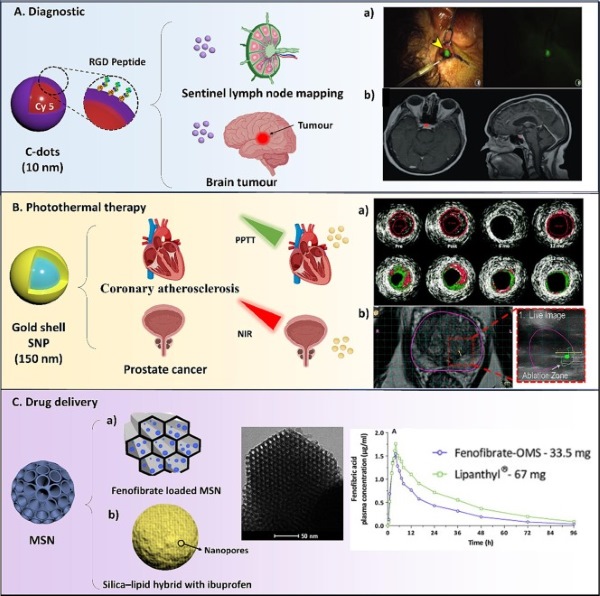 Fig.1 Investigations in humans utilizing various silica nanoparticles (SNP) for diagnostic, tumor ablation, and drug delivery applications.1
Why Choose Us?
Specialized approach to hybrid nanoparticle development offers critical advantages that synthetic systems cannot match:
Natural Stealth & Targeting
The exosomal membrane coating provides natural immune evasion, extending systemic circulation time and offering passive or active targeting through native membrane proteins.
Superior Drug Protection
The mesoporous silica core physically protects sensitive payloads (e.g., siRNA, peptides, unstable small molecules) from enzymatic degradation in the bloodstream.
High Payload Density
Unlike natural exosomes, the MSN core allows for significantly higher loading concentrations, making therapeutics more dose-efficient.
Versatile Surface Engineering
The inner silica surface and the outer exosomal membrane can both be chemically modified for dual-targeting or multi-functional theranostic applications.
Key Technologies
Engineering Key Points: Achieving Precise Control Over Hybrid Systems
Successful fabrication of a functional Exosomes-QDs Hybrid requires precise control over both components, especially the synthesis and integration process:

Utilize advanced methods for synthesizing highly monodisperse MSNs with tight control over particle size (typically 50-150 nm) and pore size, which directly dictates drug release kinetics.
Proprietary ultra-centrifugation and purification methods ensure high-purity exosome/cell membrane isolation, preserving native targeting ligands and reducing non-specific protein contamination.
Employ controlled extrusion or sonication techniques to ensure uniform, stable fusion of the silica core with the exosomal membrane, creating a robust, single-shell coating without aggregation.
The remaining exposed silica/membrane surface areas are modified with polyethylene glycol (PEG) or specific targeting ligands to further optimize biodistribution and cellular uptake.
Ready to Innovate Your Research? - Discuss Your Project Specifications.
Cutting-Edge Technology
The source cell for the membrane directly dictates the hybrid nanoparticle's tropism and biological function.
| Cell Membrane Source | Primary Targeting Advantage | Application Examples |
|---|---|---|
| Macrophage/Immune Cells | Intrinsic targeting to inflamed or infected tissues; evasion of reticuloendothelial system (RES) uptake. | Anti-inflammatory drug delivery, targeting atherosclerotic plaques, treating inflammatory bowel disease. |
| Platelets | Targeting exposed endothelium at sites of injury, thrombosis, or tumor vasculature disruption. | Hemostasis regulation, targeted delivery to cardiovascular injury sites, inhibiting metastasis. |
| Cancer Cells (Homotypic) | Homotypic targeting (e.g., breast cancer cell membrane targets breast tumors) due to shared cell surface markers. | Delivering chemotherapy or nucleic acid therapeutics directly to homologous tumor types. |
| Endothelial Cells | Facilitating transcytosis and promoting interactions with the Blood-Brain Barrier (BBB). | CNS drug delivery, treatment of vascular injury and stroke recovery promotion. |
QC Methods: Building Trust and Reliability
The synergistic properties of ESHNs translate directly into superior therapeutic outcomes:
High Therapeutic Index
Enables effective delivery of otherwise toxic or unstable payloads, maximizing therapeutic effect while minimizing systemic side effects.
Barrier Penetration
Confirmed ability to cross complex biological barriers, including the Blood-Brain Barrier and dense tumor stroma.
Multi-Modal Capability
The platform supports co-delivery of small molecule drugs, imaging agents (e.g., iron oxide in the core), and biological therapeutics (e.g., mRNA on the surface) in a single vehicle.
Scalability & Reproducibility
Established protocols ensure scalable production of GMP-grade materials with batch-to-batch consistency required for clinical translation.
Key Benefits
The Exosomes-Quantum Dots Hybrid platform represents a significant leap forward in nanomedicine, offering unmatched versatility and performance.
Integrated Theranostic Capability
Simultaneously diagnoses and treats diseases, enabling rapid assessment of therapeutic efficacy using the integrated QD fluorescent label.
Overcoming Biological Barriers
The exosomal shell enhances the crossing of challenging physiological barriers, including the blood-brain barrier (BBB), making it invaluable for neurological applications.
Long-Term Photo-stability
QDs possess superior resistance to photobleaching compared to traditional organic dyes, allowing for extended imaging periods and longitudinal studies.
Customizable Payload Capacity
The system can be designed to co-load both hydrophobic drugs (QD core) and hydrophilic agents (exosomal interior), accommodating diverse therapeutic molecules.
Discover the Benefits with Creative Biolabs – Obtain Your Quote Today!
Products
| Products | Description | Inquiry |
|---|---|---|
| Functionalized Lipid Products | Functional lipids like DSPE-PEG-TAT and DSPE-PEG-RGD for precision in therapeutic and imaging applications. | |
| Lipid Nanoparticle Products | LNPs, as a leading non-viral vector platform for nucleic acid delivery, are precisely engineered self-assembling systems designed to protect and deliver therapeutic payloads |
Frequently Asked Questions
Are Exosomes-Silica Hybrid Nanoparticles suitable for large biomolecules like full-length antibodies or plasmids?
ESHN excels at delivering a diverse range of cargo. While MSNs are optimized for smaller molecules and nucleic acids, larger-pore Hybrid MSNs have been successfully engineered to accommodate plasmids and larger protein complexes. The size limit is dictated by the MSN pore diameter, which can be tune.
How does the stability of ESHNs compare to traditional liposomes or natural exosomes during storage?
ESHNs offer significantly enhanced stability. By utilizing the physically robust mesoporous silica core, the structural integrity is maintained much better than with lipid-only systems. This translates to longer shelf life and improved performance during in vivo circulation. Our QC ensures minimal aggregation and membrane degradation over time.
What is the risk of an immune reaction to the exosome membrane component of the hybrid particle?
This is a crucial safety consideration. The natural origin of the exosome membrane provides inherent immuno-stealth properties, often leading to lower immunogenicity than fully synthetic systems. Furthermore, utilize patient-derived (autologous) or engineered membranes to minimize recognition.
Exosomes-Silica Hybrid Nanoparticle represents the pinnacle of biomimetic drug delivery technology. By unifying the high capacity and stability of inorganic nanomaterials with the intrinsic targeting and biocompatibility of natural exosomes, we offer a powerful solution for overcoming the toughest biological barriers in drug development, particularly the BBB and tumor microenvironments. Contact us and our experts are standing by to discuss your specific therapeutic goals.
Reference
- Janjua, Taskeen Iqbal, et al. "Silica nanoparticles: a review of their safety and current strategies to overcome biological barriers." Advanced Drug Delivery Reviews 203 (2023): 115115. Distributed under Open Access license CC BY 4.0, without modification. DOI: https://doi.org/10.1016/j.addr.2023.115115.
Our services are For Research Use Only. We do not provide services to individuals.
Online Inquiry