
Solving the solubility crisis for hydrophobic drugs by creating a stable, injectable formulation suitable for parenteral administration.
Polymeric Hybrid Micelle for Targeted Drug Delivery
Are you currently facing poor water solubility, rapid systemic clearance, and limited tumor targeting for your promising drug candidates? Polymeric Hybrid Micelles platform helps you streamline complex formulation and enhance therapeutic index through advanced amphiphilic block copolymer synthesis and precision self-assembly.
Click Here to View more about our Services设计美化效果,现在暂无这两个页面,先预留入口
Introduction of Polymeric Hybrid Micelles
What Are Polymeric Hybrid Micelles?
Polymeric Hybrid Micelles are next-generation nanocarriers that spontaneously self-assemble from amphiphilic components, combining synthetic block copolymers with other functional moieties—such as lipids, targeting ligands, or inorganic imaging agents—to create superior stability and multi-functionality. This core-shell structure features a hydrophobic core capable of encapsulating large quantities of poorly soluble drugs, shielded by a hydrophilic shell that ensures stealth circulation and biocompatibility.
Application Scenarios
Enhanced Bioavailability
Targeted Cancer Therapy
Utilizing the Enhanced Permeability and Retention (EPR) effect for passive tumor accumulation, or incorporating specific ligands for active targeting to minimize systemic toxicity.
Gene & Combination Delivery
Developing multi-functional carriers for the synergistic co-delivery of small molecule drugs alongside nucleic acids to overcome multi-drug resistance and enhance therapeutic efficacy.
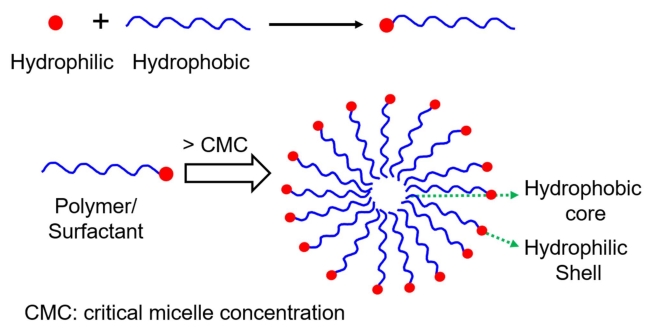 Fig.1 Depiction of the polymer or surfactant self-organizing into a spherical micelle.1
Why Choose Us?
Polymeric Hybrid Micelles offer fundamental advantages that accelerate your development timeline and maximize drug performance:
Superior Stability
Micelles exhibit a significantly lower Critical Micellar Concentration (CMC) compared to traditional surfactants, ensuring robust stability upon intravenous injection and systemic dilution.
Optimal Size for EPR
Our process is fine-tuned to achieve particle sizes predominantly in the 20–80 nm range, which is optimal for evading renal clearance while maximizing accumulation in leaky tumor vasculature via the EPR effect.
Versatile Drug Loading
The hydrophobic core can be chemically tailored to match the polarity and structure of diverse therapeutic agents, ensuring high drug loading capacity and minimal premature leakage.
Key Technologies
Engineering Key Points: Precision Control in Nanocarrier Design
The performance of any polymeric micelle is defined by our precise control over several critical engineering factors.

Select and synthesize amphiphilic block copolymers with optimized chain lengths and compositions. This controls the CMC, micelle rigidity, and drug retention characteristics.
Employ scalable, high-yield preparation methods, including Solvent Evaporation and Freeze-Drying (Lyophilization), ensuring batch-to-batch reproducibility and long-term stability crucial for pharmaceutical products.
Precisely manage the hydrophilic/hydrophobic volume fraction to control the final micelle morphology, creating spherical, cylindrical, or vesicular shapes tailored to specific administration routes and tissue penetration requirements.
Uncover How We Can Assist - Book a Consultation!
Cutting-Edge Technology
The specialization in Polymeric Hybrid Micelles enables the incorporation of advanced functionalities into a unified nanocarrier system, transcending basic solubilization to accomplish precise targeted delivery and multi-modality.
| Hybridization Feature | Targeting/Release Advantage | Application Example |
|---|---|---|
| Active Targeting Ligands | Molecular recognition and enhanced cellular uptake via surface-conjugated ligands overexpressed on cancer cells. | Ligand-functionalized micelles for Doxorubicin delivery to improve receptor binding and internalization. |
| Stimuli-Responsive Elements | Triggered, on-demand drug release in pathological environments. | pH-sensitive systems for rapid drug release in acidic endosomes or the tumor microenvironment. |
| Theranostic Integration | Simultaneous encapsulation of drug and imaging agent in the core/shell for concurrent diagnosis and therapy. | MRI contrast agent-integrated micelles for real-time monitoring of drug accumulation and treatment efficacy. |
| Polyion Complex (PIC) Formation | Simple, solvent-free self-assembly driven by electrostatic interactions between charged polymers and oppositely charged biomacromolecules. | Delivery of highly sensitive siRNA or plasmid DNA for gene therapy and gene silencing applications. |
QC Methods: Building Trust and Reliability
Building trust in nanomedicine relies on rigorous quality control (QC).
Dynamic Light Scattering (DLS)
Used to determine the hydrodynamic size, size distribution (polydispersity index, PDI), and batch-to-batch consistency. Precise size control (20–80 nm) is non-negotiable for successful in vivo application.
Transmission Electron Microscopy (TEM) / Atomic Force Microscopy (AFM)
Provides high-resolution visual confirmation of the micelle morphology and core-shell structure integrity.
Critical Micellar Concentration (CMC) Determination
Essential for verifying the thermodynamic stability of the micelle structure. A low CMC confirms the micelles will remain intact upon significant dilution in the bloodstream.
Drug Loading Content (DLC) & Encapsulation Efficiency (EE)
Quantified using HPLC/UV-Vis spectroscopy to ensure high drug payload and minimal surface-bound drug, which impacts release kinetics.
In Vitro Release Kinetics
Assays are performed in simulated physiological and pathological conditions (e.g., low pH buffers) to confirm the desired release profile, especially for stimuli-responsive systems.
Key Benefits
Polymeric Hybrid Micelles offer decisive advantages that translate directly into clinical and commercial success for your project.
Exceptional Bioavailability Enhancement
We consistently solve formulation challenges for hydrophobic molecules, achieving high loading and solubility profiles not possible with conventional methods.
Reduced Systemic Toxicity
The PEG shell significantly lowers the risk of immunogenicity and non-specific distribution, as demonstrated by the successful mitigation of cardiotoxicity in preclinical models using co-delivery micelle systems.
Synergistic Combination Therapy
Advanced systems are specifically engineered to co-deliver two agents simultaneously, achieving therapeutic synergy at the tumor site.
Proven Translational Success
Polymer chemistries are based on scaffolds that have successfully advanced through clinical trials for agents, de-risking your path to regulatory submission.
Unveil the Creative Biolabs Advantage - Inquire for a Quote Today!
Products
| Products | Description | Inquiry |
|---|---|---|
| Functionalized Lipid Products | Functional lipids like DSPE-PEG-TAT and DSPE-PEG-RGD for precision in therapeutic and imaging applications. | |
| Lipid Nanoparticle Products | LNPs, as a leading non-viral vector platform for nucleic acid delivery, are precisely engineered self-assembling systems designed to protect and deliver therapeutic payloads |
Frequently Asked Questions
How do Polymeric Hybrid Micelles provide better stability than traditional liposomes or surfactant micelles?
Micelles offer exceptional stability due to their low Critical Micellar Concentration (CMC). Unlike traditional surfactant micelles, which rapidly dissociate upon dilution, our polymeric systems form highly stable, covalently-linked or strongly interacting core structures. This ensures the integrity of the nanocarrier and prevents premature drug leakage after intravenous injection, giving your therapeutic agent the maximum circulation time needed to reach the target site.
What is the optimal particle size, and how does Creative Biolabs control it?
The optimal particle size for passive tumor targeting is generally 20 to 80 nanometers. Our engineering precision controls this size primarily through the ratio and molecular weight of the hydrophilic and hydrophobic polymer blocks, along with the specific self-assembly method. This precise size is crucial for maximizing the EPR effect (tumor accumulation) and minimizing filtration by the spleen and kidney.
My current formulation faces high systemic toxicity; how do your Hybrid Micelles specifically mitigate this risk?
By encapsulating your drug within the hydrophobic core and shielding it with a biocompatible PEG shell, we dramatically reduce the drug's direct contact with healthy tissues. For example, in Doxorubicin formulations, this process successfully reduces the drug's exposure to cardiac tissue while enhancing its concentration in the tumor, leading to a much improved therapeutic index.
Creative Biolabs is your dedicated partner in advanced drug delivery, specializing in the design, synthesis, and characterization of Polymeric Hybrid Micelles. Our platform solves critical industry problems—from overcoming poor solubility to enabling highly specific, multi-functional drug and gene delivery—using clinically validated polymer scaffolds and cutting-edge stimuli-responsive technology. Contact our expert team, who is prepared to custom-engineer a Polymeric Hybrid Micelle system tailored to your unique compound and therapeutic goals.
Reference
- Perumal, Suguna, Raji Atchudan, and Wonmok Lee. "A review of polymeric micelles and their applications." Polymers 14.12 (2022): 2510. Distributed under Open Access license CC BY 4.0, without modification. DOI: https://doi.org/10.3390/polym14122510.
Our services are For Research Use Only. We do not provide services to individuals.
Online Inquiry