
Development of LDHN systems for carrying antibiotics to combat drug-resistant bacterial infections, offering sustained release and reduced systemic toxicity.
Lipid-Dendrimer Hybrid Nanoparticle for Targeted Drug Delivery
Are you currently facing challenges in achieving stable, targeted, or sustained release for small molecules, nucleic acids, or peptides? Lipid-Dendrimer Hybrid Nanoparticles (LDHNs) help you accelerate drug discovery and optimize therapeutic outcomes through a novel self-assembled architecture that combines the robust stability of liposomes with the precise, multifunctional surface chemistry of dendrimers.
Click Here to View more about our Services
Introduction of Lipid-Dendrimer Hybrid Nanoparticles
What are LDHNs?
Lipid-Dendrimer Hybrid Nanoparticles (LDHNs) represent a cutting-edge class of nanoscale carriers formed through the molecular self-assembly of lipid components and dendritic polymers (dendrimers). This powerful synergistic association leverages the distinct advantages of both systems: the biocompatible, cell-membrane-mimicking structure of lipids provides a stable shell, while the highly branched, geometrically precise structure of the dendrimers offers a tunable core and surface functionality. The resulting particle is typically ultra-small, exhibits excellent uniformity, and allows for complex controlled release kinetics.
Application Scenarios
Targeted Antibiotic Delivery
Tumor Penetration and Drug Resistance Reversal
Designing size-shrinkable hybrid nanoassemblies that can efficiently penetrate the dense tumor microenvironment, enhance accumulation in the lesion, and effectively reverse multidrug resistance in challenging cancer therapies.
Gene/Nucleic Acid Delivery
Utilizing the high-density charge pockets available in the dendrimer component, the platform is ideal for the stable and efficient encapsulation and delivery of challenging payloads for gene editing and therapy.
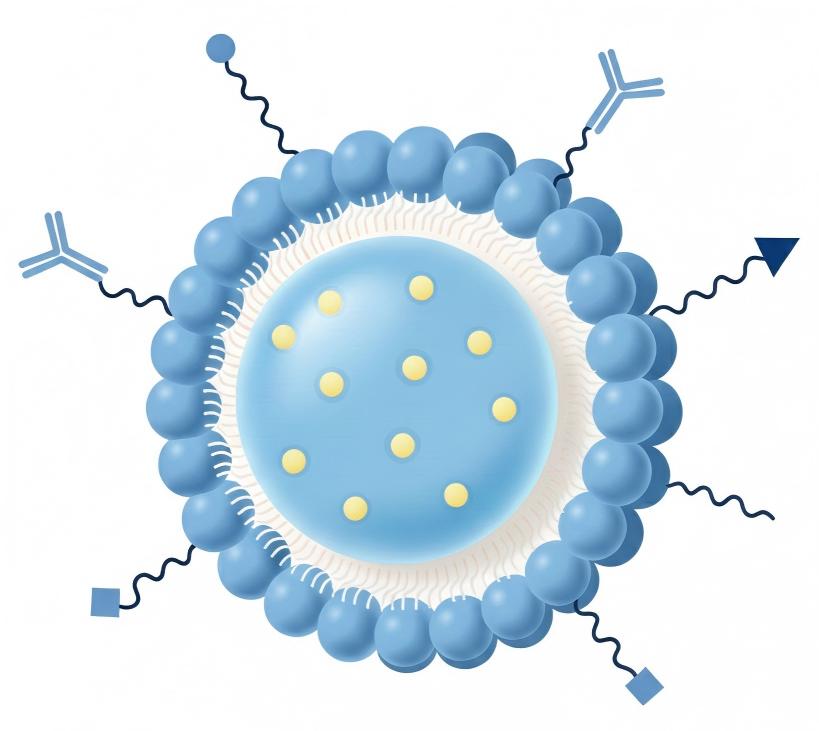 Fig.1 Structure of LDHNs.1
Why Choose Us?
LDHN has key advantages over conventional single-component carriers:
Enhanced Physiochemical Stability
The lipid outer layer provides a robust physical barrier that minimizes payload leakage and prevents premature degradation in circulation, enhancing the longevity of the therapeutic agent.
Precision Surface Functionality
The highly controllable dendritic structural design offers a defined, high-density platform for subsequent chemical modifications, allowing for superior precision in ligand conjugation for active targeting.
Controllable Payload Release
The hybrid structure is uniquely engineered to enable sophisticated, multi-stage release mechanisms, including pH responsive or size-shrinkable strategies for triggered, site-specific drug liberation.
Dual Payload Accommodation
The combination of the lipid-based environment and the dendritic core allow for high encapsulation efficiency of both hydrophobic and hydrophilic molecules simultaneously.
Key Technologies
Engineering Key Points: Achieving Functional Superiority
LDHN get advanced hybrid performance:

Select and control the generation (G) of the dendrimer, which directly dictates the final particle's core charge density, internal void volume, and overall size, ensuring optimal payload capacity.
The choice of lipid constituents is meticulously optimized to control the fluidity, curvature, and phase transition temperature of the hybrid shell, which is critical for systemic stability, endosomal escape, and cell fusion mechanisms.
Rigorously validated methods to drive the efficient, spontaneous self-assembly between the components, leading to highly uniform and scalable spherical assemblies.
We precisely adjust the density of surface-conjugated targeting ligands to maximize receptor recognition while minimizing detrimental non-specific interactions or steric hindrance that could reduce stability.
Learn How We Can Support - Schedule a Consultation!
Cutting-Edge Technology
Advanced development in biomimetic hybrid systems, where synthetic carriers are coated with natural cell membranes to gain unique targeting and immune-modulating capabilities.
| Cell Membrane Source | Targeting Advantages | Application Examples |
|---|---|---|
| Macrophages | Immune Evasion, Active Homing to Inflammatory Sites and Scavenger Receptor targeting. | Delivery of therapeutics to treat chronic inflammation, Drug delivery to treat atherosclerosis. |
| Platelets | Injury/Lesion Targeting, Endothelial Barrier Penetration, Reduced Immunothrombosis Risk. | Delivery of agents to damaged blood vessels, Anti-metastatic therapy (since platelets assist in tumor cell survival). |
| Cancer Cells (Homotypic) | Homotypic Targeting (Cancer Cell to Cancer Cell), Immune Checkpoint Evasion (Camouflage). | Highly specific delivery of chemotherapy or immunotherapy agents to metastatic tumors, Reversal of tumor drug resistance. |
QC Method: Building Trust and Reliability
Creative Biolabs ensures the highest quality and batch-to-batch consistency for all our hybrid nanoparticle carriers through rigorous QC analysis. Core assays including:
Size and Uniformity Analysis
Dynamic Light Scattering is used to determine the average hydrodynamic diameter and Polydispersity Index, guaranteeing nanoscale size and narrow size distribution for reliable in vivo behavior.
Surface Charge Characterization
Zeta Potential measurements are critical for predicting colloidal stability and cellular interaction. Surface charge is tuned for optimal circulation time and target-cell uptake.
Encapsulation and Loading Efficiency
HPLC or UV-Vis spectrophotometric methods to accurately quantify the total payload and the unentrapped payload, ensuring high drug loading efficiency and minimal payload loss.
Structural and Morphological Integrity
TEM provides visual confirmation of the spherical morphology, particle size, and structural integrity of the LDHN assembly, verifying the successful hybrid formation.
Key Benefits
Creative Biolabs' Lipid-Dendrimer Hybrid Nanoparticles are engineered for maximum performance and impact across drug and gene delivery platforms.
Versatile Payload Integration
Accommodates a wide range of payloads: hydrophilic small molecules, hydrophobic drugs, and sensitive genetic materials.
Biomimetic Synergy
Combines the inherent biocompatibility of lipids with the high surface functionality of dendrimers for superior biological interaction.
Sustained Release Kinetics
Optimized to provide extended circulation and controlled release profiles, leading to prolonged therapeutic windows.
Scalability & Reproducibility
Developed using streamlined, scalable synthesis methods suitable for easy transition from R&D to large-scale preclinical production.
Enhance Your Advantage with Creative Biolabs - Get a Quote Now!
Products
| Products | Description | Inquiry |
|---|---|---|
| Functionalized Lipid Products | Functional lipids like DSPE-PEG-TAT and DSPE-PEG-RGD for precision in therapeutic and imaging applications. | |
| Lipid Nanoparticle Products | LNPs, as a leading non-viral vector platform for nucleic acid delivery, are precisely engineered self-assembling systems designed to protect and deliver therapeutic payloads |
Frequently Asked Questions
How do LDHNs compare to standard liposomes in terms of stability and targeting capability?
Standard liposomes excel in biocompatibility, but LDHNs offer significantly enhanced stability and superior targeting precision. By incorporating the dendrimer, we gain a highly ordered, multifunctional surface for ligand attachment, dramatically boosting targeting specificity and minimizing premature payload release, which can be a limitation of conventional liposomes.
Are Lipid-Dendrimer Hybrid Nanoparticles safe for in vivo use, considering the potential toxicity of dendrimers?
Yes, safety is a priority. We specifically utilize biocompatible and often degradable lipid components and carefully selected dendrimer generations and surface modifications. The lipid layer effectively shields the dendrimer core, mitigating any potential surface-charge-related cytotoxicity, ensuring the final LDHN is highly suitable for in vivo applications.
Can LDHN be customized to deliver both a small molecule drug and a plasmid DNA simultaneously?
Absolutely. One of the greatest strengths of the hybrid architecture is its versatility. The lipid shell can encapsulate hydrophobic drugs, while the dendrimer's core and branching can efficiently complex with nucleic acids. This combination is perfectly suited for sophisticated, combination therapies.
Creative Biolabs is your trusted partner for creating advanced nano-assembly solutions. Our expertise in Composite Hydrogels (Hybrid Systems) Development and Hybrid Drug Delivery Systems leverages the synergistic power of Lipid-Dendrimer Hybrid Nanoparticles to overcome delivery challenges and drive therapeutic breakthroughs. Reach out to our expert team to begin designing your customized LDHN delivery system.
Reference
- Jain, Shweta, et al. "Lipid–polymer hybrid nanosystems: a rational fusion for advanced therapeutic delivery." Journal of Functional Biomaterials 14.9 (2023): 437. Distributed under Open Access license CC BY 4.0, without modification. https://doi.org/10.3390/jfb14090437.
Our services are For Research Use Only. We do not provide services to individuals.
Online Inquiry