
Combining QD-based imaging (e.g., fluorescence, MRI compatibility via magnetic QDs) with drug/gene delivery from the exosomal core for real-time monitoring of treatment efficacy.
Exosome-Quantum Dot (QD) Hybrid Nanoparticle for Targeted Drug Delivery
Are you currently facing long drug development cycles, poor drug stability and bioavailability, or challenges in achieving precise theranostic delivery to disease sites? Exosomes-Quantum Dots (QDs) Hybrid Platform helps you accelerate targeted diagnostics and therapy development through innovative biohybrid engineering that leverages the natural targeting capabilities of exosomes and the superior optical properties of QDs. This synergy enhances both imaging and therapeutic efficacy.
Click Here to View more about our Services
Introduction of Exosomes-Quantum Dots Hybrid
The convergence of natural biological nanocarriers and advanced inorganic nanomaterials creates a powerful new class of therapeutic and diagnostic agents.
What Are Exosomes-Quantum Dots (QDs) Hybrid?
Exosomes-Quantum Dots (QDs) Hybrids are sophisticated biohybrid nanomaterials created by integrating synthetic semiconductor nanocrystals (Quantum Dots) with naturally secreted extracellular vesicles (Exosomes). Exosomes, small membrane vesicles (30-150 nm), are crucial mediators of intercellular communication, carrying proteins, lipids, and nucleic acids reflective of their parent cell. By coating QDs with exosomal membranes or encapsulating them within the vesicle, the hybrid system gains the superior, size-tunable fluorescence and photostability of the QDs, coupled with the inherent biocompatibility, low immunogenicity, and specific homing ability of the exosome.
Application Scenarios
Dual-Modality Theranostics
Highly Targeted Drug Delivery
Utilizing the exosome's natural surface ligands and membrane proteins (e.g., tetraspanins, adhesion molecules) to achieve highly selective accumulation in diseased tissues, such as tumors or inflamed regions, minimizing off-target toxicity.
Real-Time Biosensing and Diagnostics
Leveraging the high quantum yield and photostability of QDs within the exosomal structure for enhanced visualization of cellular uptake, trafficking, and biodistribution in vivo.
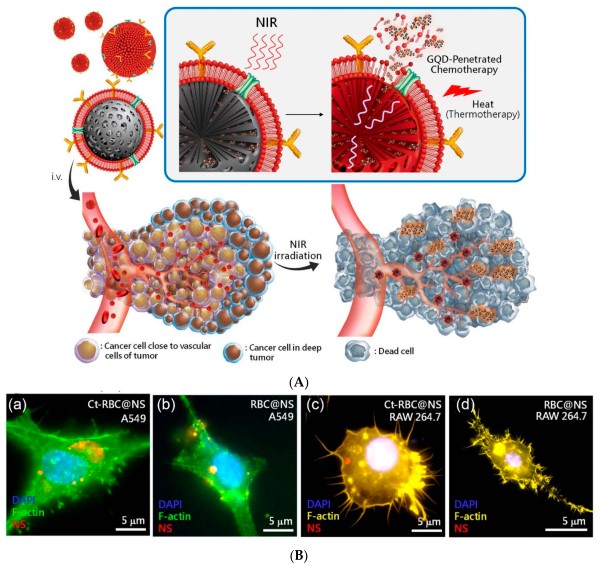 Fig.1 Diagrammatic representation of hybrid graphene Quantum Dots (GQDs) penetration and accumulation for RBC-membrane coated nanosponge-mediated tumor-targeted delivery.1
Why Choose Us?
The Exosomes-QDs Hybrid systems offer distinct advantages over traditional liposomes, polymeric nanoparticles, or standalone exosomes:
Enhanced Stability
The lipid bilayer of the exosome protects the QD core and encapsulated cargo from enzymatic degradation and clearance, promoting longer circulation times.
Targeting Specificity
Inherited surface proteins from the source cell provide natural targeting ligands, enabling superior cell-specific delivery compared to passive targeting methods.
Multifunctionality
The system acts as both a therapeutic carrier (exosome) and a highly efficient diagnostic probe (QD), facilitating true theranostic applications.
Reduced Immunogenicity
Being derived from natural cell membranes, the exosome shell significantly reduces the acute immune response associated with synthetic inorganic nanoparticles.
Key Technologies
Engineering Key Points: Achieving Precise Control Over Hybrid Systems
Successful fabrication of a functional Exosomes-QDs Hybrid requires precise control over both components, especially the synthesis and integration process:

Ligand exchange is essential to ensure the QDs are hydrophilic and functionalized (e.g., with PEG or specific peptides) to minimize aggregation and facilitate efficient integration with the exosomal membrane.
We employ multi-step isolation protocols, including ultracentrifugation followed by size exclusion chromatography (SEC) or immunoaffinity capture, to ensure the retrieved exosomes possess high purity and consistent structural integrity.
The method of loading the QD payload (e.g., freeze-thaw cycles, sonication, extrusion, or electroporation) is optimized based on the QD size, surface charge, and the specific exosome source to achieve maximum loading efficiency without compromising exosome viability or function.
We rigorously verify the orientation and integration of the QD, ensuring the exosomal membrane components (like tetraspanins) remain exposed and functional for subsequent cellular recognition and targeting.
Prepared to Transform Your Research? - Consult on Your Project Details.
Cutting-Edge Technology
Establishing the structural and functional integrity of the Exosomes-QDs Hybrid is paramount. Stringent Quality Control (QC) methodology validates both the biophysical properties and the bioactivity of the final vector.
| Cell Membrane Source | Targeting Advantages | Application Examples |
|---|---|---|
| Macrophage | Anti-inflammatory properties, inherent tropism for inflamed tissues, efficient phagocytosis evasion. | Delivery to Rheumatoid Arthritis sites, Atherosclerosis therapy, CNS inflammation. |
| Platelet | Express high levels of adhesion proteins, excellent homing to vascular injury sites, thrombotic regions, and some tumor vasculature. | Targeting of tumor metastasis, delivery to injured myocardium, wound healing and tissue regeneration. |
| Cancer Cell | Display parent tumor antigens and specific receptors, allowing for homologous targeting (homotypic binding) back to the original tumor tissue. | Highly specific cancer theranostics, overcoming chemoresistance, image-guided tumor resection. |
QC Methods: Building Trust and Reliability
Establishing the structural and functional integrity of the Exosomes-QDs Hybrid is paramount. Stringent Quality Control (QC) methodology validates both the biophysical properties and the bioactivity of the final vector.
Morphology and Size Distribution Analysis
Use Nanoparticle Tracking Analysis (NTA) for quantitative measurement of size and concentration, ensuring polydispersity remains low. TEM is employed to confirm the characteristic spherical morphology and successful integration of the QD core within the exosomal structure.
Purity and Identity Assessment (Western Blot/Flow Cytometry)
Confirm the presence of established exosomal markers and the absence of non-exosomal contaminants, certifying the biological identity of the carrier shell.
QD Integrity and Optical Functionality
Measure the emission spectrum and Quantum Yield (QY) of the final hybrid product using fluorimetry to ensure that the conjugation or encapsulation process did not quench the intrinsic fluorescence of the QDs, guaranteeing reliable imaging output.
Zeta Potential and Stability
Zeta potential measurement is performed to assess the surface charge and colloidal stability of the hybrid formulation across various physiological pH and buffer conditions, predicting stability in vivo.
Key Benefits
The Exosomes-Quantum Dots Hybrid platform represents a significant leap forward in nanomedicine, offering unmatched versatility and performance.
Integrated Theranostic Capability
Simultaneously diagnoses and treats diseases, enabling rapid assessment of therapeutic efficacy using the integrated QD fluorescent label.
Overcoming Biological Barriers
The exosomal shell enhances the crossing of challenging physiological barriers, including the blood-brain barrier (BBB), making it invaluable for neurological applications.
Long-Term Photo-stability
QDs possess superior resistance to photobleaching compared to traditional organic dyes, allowing for extended imaging periods and longitudinal studies.
Customizable Payload Capacity
The system can be designed to co-load both hydrophobic drugs (QD core) and hydrophilic agents (exosomal interior), accommodating diverse therapeutic molecules.
Discover the Benefits with Creative Biolabs – Obtain Your Quote Today!
Products
| Products | Description | Inquiry |
|---|---|---|
| Functionalized Lipid Products | Functional lipids like DSPE-PEG-TAT and DSPE-PEG-RGD for precision in therapeutic and imaging applications. | |
| Lipid Nanoparticle Products | LNPs, as a leading non-viral vector platform for nucleic acid delivery, are precisely engineered self-assembling systems designed to protect and deliver therapeutic payloads |
Frequently Asked Questions
What is the primary advantage of using a QD-Exosome hybrid over just QDs alone?
QDs alone often face challenges like clearance by the immune system and non-specific biodistribution. By coating them with an exosomal membrane, the hybrid system gains inherent biocompatibility and natural targeting ability. This dramatically improves stability in vivo and directs the QDs specifically to the diseased tissue, leading to more accurate imaging and safer therapy.
Are the size and emission wavelength of the Quantum Dots adjustable in the hybrid system?
Absolutely. QDs are prized for their size-tunable optical properties. A wide range of cadmium-free QDs (Silicon, Carbon, Indium Phosphide) is offered, whose emission wavelengths can be precisely adjusted from the visible to the near-infrared spectrum to suit your imaging needs.
How do I ensure the Exosomes-QD hybrid will specifically target my cell line of interest?
Target specificity is a key feature. Firstly, source exosomes from cell lines known to possess specific homing ligands for your target. For enhanced specificity, then offer surface engineering services to display custom targeting moieties (e.g., peptides, antibodies) on the exosomal membrane, ensuring highly selective uptake by your desired cell type.
Creative Biolabs' Exosomes-Quantum Dots (QDs) Hybrid Platform offers a powerful synthesis of nature and nanotechnology, delivering highly stable, targeted, and multifunctional nanocarriers for advanced theranostic applications. Contact us now, our expert team is prepared to support your customized needs.
Reference
- Ahmad, Javed, et al. "Hybrid quantum dot as promising tools for theranostic application in cancer." Electronics 12.4 (2023): 972. Distributed under Open Access license CC BY 4.0, without modification. DOI: https://doi.org/10.3390/electronics12040972.
Our services are For Research Use Only. We do not provide services to individuals.
Online Inquiry