
Provides a stable, biocompatible matrix for high-efficiency encapsulation of both hydrophilic and hydrophobic drugs, offering protection against enzymatic degradation.
Lipid-Chitosan Hybrid Nanoparticle for Targeted Drug Delivery
Are you currently facing low drug bioavailability in oral or ocular formulations, or non-specific systemic toxicity in cancer therapy? Lipid-Chitosan Hybrid Nanoparticle (LCHNP) helps you maximize therapeutic efficacy and accelerate pipeline advancement through the synergistic combination of lipid stability and chitosan's superior mucoadhesion and functionalization capability.
Click Here to View more about our Services
Overview of Lipid-Chitosan Hybrid Nanoparticles
What are LCHNPs?
Lipid-Chitosan Hybrid Nanoparticles (LCHNPs) represent a cutting-edge class of core-shell drug delivery vehicles that leverage the strengths of two distinct material families:
Lipid Core
Chitosan Shell
A naturally-derived, cationic polysaccharide that forms an outer layer via electrostatic interaction. This shell imparts crucial properties, including superior mucoadhesion, enhanced cellular uptake, and surface functionalization capabilities.
Application Scenarios
Oral Bioavailability Enhancement
Converting injectable small molecules or biologics into stable, orally bioavailable formulations.
Sustained Local Delivery
Developing long-acting topical formulations for mucosal surfaces to improve patient compliance and therapeutic retention.
Active Oncological Targeting
Engineering smart nanocarriers with surface ligands for precision delivery of chemotherapy agents to tumor cells.
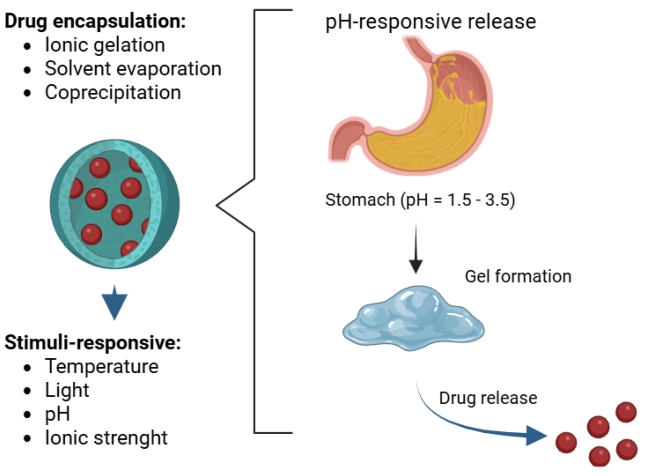 Fig.1 Decomposition of chitosan nanoparticles into gels and drug release at acidic pH.1
Why Choose Us?
The LCHNP system is an irreplaceable tool for overcoming major formulation hurdles.
Synergistic Stability
The lipid core protects the drug from degradation (acid, enzymes), while the chitosan coat acts as a functional and stabilizing layer.
Exceptional Mucoadhesion
Chitosan's positive charge ensures strong interaction with negatively charged mucin in the eye, GI tract, and nasal cavity, leading to extended retention time and superior absorption.
High Translational Potential
LCHNPs are formulated using established, biocompatible, and regulatory-friendly materials.
Tunable Release Kinetics
Precisely adjust the core-to-shell ratio to control drug release, achieving either burst release or, more commonly, sustained release over 24 hours for chronic treatments.
Key Technologies
Engineering Key Points: Achieving Predictable Performance
Successful LCHNP development depends on precise control over three critical physicochemical parameters:

To control the manufacturing process (e.g., ionic gelation method, high-shear homogenization) to achieve narrow size distributions, typically in the 200-250 nm range. This range is ideal for enhanced permeation and retention (EPR) effects in tumors and successful mucosal uptake.
The cationic charge of the chitosan shell is essential for mucoadhesion. We optimize formulation to ensure a strong positive zeta potential, maximizing electrostatic attraction to the negatively charged mucosal surfaces.
The ratio of lipid to chitosan is precisely modulated to dictate stability, drug release profile, and cellular toxicity. This fine-tuning is what allows us to achieve tailored functional outcomes.
Learn How We Can Support - Schedule a Consultation!
Cutting-Edge Technology
LCHNPs is capable of implementing both passive and active targeting strategies:
| Targeting Strategy | Core Application Area | LCHNP Function/Ligand Used | Proven Benefits |
|---|---|---|---|
| Active Targeting | Colon, Breast, Lung Cancer | Surface-Conjugated Ligands | Enhanced cellular uptake via receptor-mediated endocytosis, leading to superior tumor cell cytotoxicity. |
| Mucosal Bioadhesion | Ocular, Oral, Nasal Delivery | Cationic Chitosan Layer | Extended retention time, resisting rapid clearance, and trans-epithelial transport enhancement. |
| Stealth Functionality | Systemic Administration, Ocular | Outer polymer layer | Provides anti-fouling effect to reduce non-specific protein binding and opsonization, improving systemic circulation time. |
QC Method: Building Trust and Reliability
Reliable characterization is the cornerstone of nanomedicine development. The quality and reproducibility of every LCHNP batch using a rigorous set of core analytical methods for validating our vectors:
Size and Surface Charge Analysis
Utilize Dynamic Light Scattering (DLS) to determine the average hydrodynamic diameter and Zeta Potential to confirm the required cationic surface charge for optimal mucoadhesion and stability.
Morphological Confirmation
Transmission Electron Microscopy (TEM) and Atomic Force Microscopy (AFM) are employed to confirm the distinct spherical core-shell morphology and visualize the surface characteristics of the hybrid particles.
Encapsulation and Loading Efficiency (EE & LE)
HPLC is used to precisely quantify the drug content, ensuring high payload capacity.
In Vitro Release Studies
Perform time-dependent dissolution testing under simulated physiological conditions to verify the targeted sustained or controlled release kinetics.
Key Benefits
Enhanced Oral Bioavailability
The optimized lipid/chitosan ratio has been shown to achieve an increase in the oral bioavailability of challenging anticoagulant drugs in vivo, demonstrating the potential to convert injectables into convenient oral treatments.
Sustained Ocular Efficacy
The mucoadhesive chitosan coating drastically extends the retention time of therapeutics on the eye surface, enabling a once-daily or less frequent dosing regimen, a major advantage over traditional eye drops.
Active Tumor Targeting
Surface functionalization leads to highly specific receptor-mediated endocytosis by overexpressing cancer cells, increasing local drug concentration and improving the therapeutic index of chemotherapies.
Biocompatibility and Safety
Chitosan is a highly regarded, natural biopolymer, minimizing systemic toxicity concerns and promoting better patient tolerance.
Enhance Your Advantage with Creative Biolabs - Get a Quote Now!
Products
| Products | Description | Inquiry |
|---|---|---|
| Functionalized Lipid Products | Functional lipids like DSPE-PEG-TAT and DSPE-PEG-RGD for precision in therapeutic and imaging applications. | |
| Lipid Nanoparticle Products | LNPs, as a leading non-viral vector platform for nucleic acid delivery, are precisely engineered self-assembling systems designed to protect and deliver therapeutic payloads |
Frequently Asked Questions
Can Creative Biolabs' LCHNPs encapsulate both small molecules and biologics (peptides/proteins)?
Absolutely. Our LCHNP design is intrinsically versatile. The lipid core is ideal for hydrophobic small molecules (like 5-fluorouracil), while the electrostatic interactions enabled by the cationic chitosan shell are particularly effective for stabilizing and delivering negatively charged macromolecules like nucleic acids, peptides, and proteins (such as enoxaparin).
How does the LCHNP system compare to traditional liposomes or simple chitosan nanoparticles (CNPs)?
LCHNPs offer a major improvement. While liposomes can lack stability and simple CNPs can suffer from low encapsulation efficiency for certain drugs, the hybrid structure provides the best of both worlds: the high payload capacity and stability of the lipid core, combined with the superior mucoadhesion and cellular permeability enhancement provided by the chitosan shell.
Is the LCHNP platform scalable for clinical manufacturing?
Yes, the components (lipids, chitosan) and the processes (e.g., ionic gelation) are based on established pharmaceutical manufacturing principles. We prioritize translational robustness and can consult on scaling up your final, optimized formulation.
Lipid-Chitosan Hybrid Nanoparticle is the proven, multi-functional tool for overcoming the major delivery barriers in modern pharmacology. We provide the technical expertise, robust QC methods, and scalable solutions necessary to move your challenging molecules from bench to patient. To begin the transformation of your therapeutic compound, please reach out to our dedicated team of nanomedicine specialists.
Reference
- Stefanache, Alina, et al. "Chitosan Nanoparticle-Based Drug Delivery Systems: Advances, Challenges, and Future Perspectives." Polymers 17.11 (2025): 1453. Distributed under Open Access license CC BY 4.0, without modification. https://doi.org/10.3390/polym17111453.
Our services are For Research Use Only. We do not provide services to individuals.
Online Inquiry