
Delivering challenging hydrophobic cancer drugs directly to the tumor microenvironment (TME) while minimizing systemic side effects.
Lipid Coated Mesoporous Silica Hybrid Nanoparticle for Targeted Drug Delivery
Are you currently facing poor systemic toxicity profiles, inadequate in vivo drug retention, or limited solubility for high-potential hydrophobic candidates? Lipid-Coated Mesoporous Silica Hybrid Nanoparticles (LMSN) helps you achieve targeted delivery, maximize therapeutic windows, and unlock the full potential of your pipeline through morphologically optimized, stimuli-responsive hybrid nanocarriers.
Click Here to View more about our Services
Overview of Lipid-Coated Mesoporous Silica Hybrid Nanoparticles
What Are LMSNs?
LMSNs represent the next generation of nanomedicine, combining the physical strength and high drug capacity of inorganic mesoporous silica nanoparticles (MSNs) with the superior biocompatibility and cellular affinity of a lipid bilayer shell. This core-shell architecture creates a stable, high-payload delivery vessel designed to overcome the limitations of traditional small-molecule drugs and unstable liposomal formulations. The silica core provides vast internal pore volume for high-capacity drug loading, while the outer lipid layer acts as a protective shield, preventing premature drug leakage in systemic circulation.
Application Scenarios
Targeted Chemotherapeutic Delivery
Localized Anti-inflammatory Therapy
Engineering tissue-specific nanocarriers to release anti-inflammatory agents precisely at sites of chronic inflammation.
Theranostic Development
Integrating both a therapeutic drug and a diagnostic imaging agent into a single particle for simultaneous treatment and real-time monitoring.
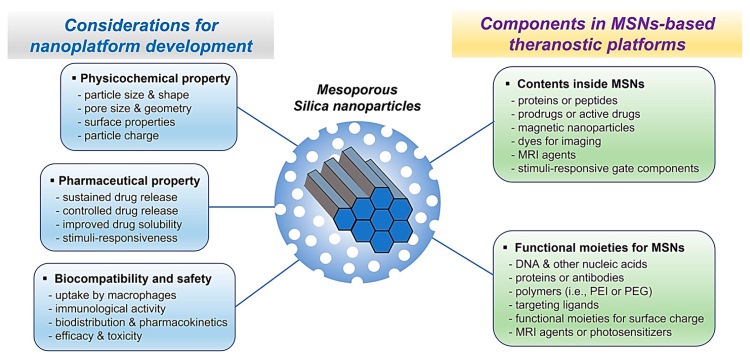 Fig.1 Diagram of mesoporous silica nanoparticle (MSN) platforms for drug delivery.1
Why Choose Us?
Traditional drug carriers are often plagued by instability, rapid clearance, and non-specific payload release. LMSN offers a decisive competitive edge, moving your candidates faster toward clinical success.
Superior Biostability and Retention
The protective lipid shell dramatically increases in vivo stability, sustaining drug containment for up to 72 hours in complex biological fluids, compared to rapid clearance seen with unstable alternatives.
High, Morphologically Optimized Drug Loading
Our proprietary engineering focuses on optimizing nanoparticle morphology to maximize internal surface area and porosity, achieving drug loading capacities that significantly outperform standard spherical carriers.
Precision Triggered Release
LMSNs enable true "on-demand" dosing. The system is designed to respond exclusively to pathological cues within the diseased tissue, ensuring the cargo is released where it is needed most.
Broad Therapeutic Application Range
The customizable surface chemistry allows for seamless integration into diverse therapeutic pipelines, from oncology and cardiovascular disease to musculoskeletal and autoimmune disorders.
Key Technologies
Engineering Key Points: Precision Control in Nanocarrier Design
Control over nanocarrier synthesis ensures maximum performance, addressing the critical factors that influence drug efficacy and safety.

We precisely control the structure of the mesoporous silica core, moving beyond standard spheres to geometrically optimized forms. This advanced morphological engineering is proven to significantly enhance internal pore volume and surface area, directly resulting in the highest possible drug loading percentage for your hydrophobic candidates.
To attract and stabilize hydrophobic drugs within the core, the internal silica surface is chemically modified using compounds like alkyl chain hydrocarbons. This specialized functionalization ensures a strong, stable drug affinity, preventing pre-leakage before the lipid shell is applied.
The pH-sensitive lipid overlayer is fused using optimized dispersion techniques. This shell not only provides stealth properties and biocompatibility but also acts as the primary gatekeeper, ensuring the drug is only released upon activation by a specific trigger in the diseased site.
Discover How We Can Assist - Arrange a Meeting!
Cutting-Edge Technology
The core innovation of the LMSN platform is its stimuli-responsive release capability, by engineering the system to recognize and respond to the unique microenvironment of a disease.
| Disease Microenvironment Trigger | Targeting Advantage | Application Example |
|---|---|---|
| Acidic pH (Tumor Microenvironment) | Stimuli-responsive cleavage of the lipid shell or internal linkers in low pH conditions. | Selective release of high-potency chemotherapeutics like Paclitaxel in solid tumor tissues. |
| Elevated Glutathione (GSH) Levels (Redox) | Response to the higher reducing potential found inside cancer cells and inflammatory sites. | Targeted drug delivery for sustainable cancer or chronic inflammation therapies. |
| Overexpressed Ligand Receptors | Active targeting via surface functionalization (e.g., with lectin, peptides, or antibodies). | Enhanced cellular uptake and drug internalization in specific, overexpressed cells (e.g., tumor cells, activated immune cells). |
| Enzyme Overexpression | Degradation of specific capping agents or linkers by matrix metalloproteinases or phospholipases. | Precise drug activation localized to areas of high tumor invasiveness or pathological remodeling. |
QC Method: Building Trust and Reliability
Comprehensive QC process provides the reliability necessary for seamless clinical translation.
Structural and Morphological Verification
Utilize TEM and SEM to visually confirm the uniform, high-quality core-shell architecture and verify the precise morphology and structural integrity of the mesoporous silica framework.
Physicochemical Characterization
Dynamic Light Scattering (DLS) is employed to accurately measure the particle size distribution and Polydispersity Index (PDI), guaranteeing narrow uniformity. Zeta Potential analysis confirms the appropriate surface charge for optimal in vivo circulation stability and cellular interaction.
Performance Metrics
HPLC is the gold standard for accurately measuring the actual drug loading percentage and encapsulation efficiency.
Key Benefits
LMSN offers unique features engineered to accelerate your pipeline and redefine patient outcomes.
Maximum Payload Capacity
Our focus on morphological optimization ensures high-potential candidates are loaded at industry-leading concentrations, maximizing the therapeutic dose delivered per nanoparticle.
Extended Systemic Circulation
The biostable lipid coating prevents opsonization and rapid clearance, providing a longer half-life and greater Area Under the Curve (AUC).
Minimized Off-Target Toxicity
The highly precise, stimuli-responsive release mechanism confines drug action exclusively to the diseased microenvironment, significantly improving the therapeutic index and reducing the systemic side effects that plague traditional chemotherapies.
Versatile Application Across Disease States
LMSNs have demonstrated efficacy in oncology (bone and solid tumors), cardiovascular disease (reducing local inflammation), and musculoskeletal disorders (anti-inflammatory effects in rheumatoid arthritis).
Experience the Creative Biolabs Advantage - Get a Quote Today!
Products
| Products | Description | Inquiry |
|---|---|---|
| Functionalized Lipid Products | Functional lipids like DSPE-PEG-TAT and DSPE-PEG-RGD for precision in therapeutic and imaging applications. | |
| Lipid Nanoparticle Products | LNPs, as a leading non-viral vector platform for nucleic acid delivery, are precisely engineered self-assembling systems designed to protect and deliver therapeutic payloads |
Frequently Asked Questions
How does the LMSN system handle the poor solubility of my highly hydrophobic drug candidates?
The LMSN platform is specifically engineered to address this challenge. The vast, stable internal pore volume of the silica core provides an ideal, high-capacity reservoir for hydrophobic molecules, while the external lipid coating allows the entire construct to circulate safely in aqueous environments. This dual approach ensures your drug is solubilized and delivered efficiently.
My current delivery system suffers from rapid drug leakage. How stable is the LMSN platform in vivo?
That's a common limitation with conventional systems. Our LMSNs feature a protective lipid shell over the silica core, which acts as a robust seal. Rigorous in vitro testing demonstrates our capability to sustain drug containment for up to 72 hours, drastically minimizing premature release and maximizing the amount of therapeutic agent that reaches the target site.
Can LMSN technology be adapted for both passive (EPR effect) and active targeting?
Absolutely. The LMSN design inherently leverages passive targeting via the Enhanced Permeability and Retention (EPR) effect in tumors. For active targeting, the external lipid surface is easily functionalized with targeting ligands, peptides, or antibodies, enabling highly selective recognition and cellular uptake in specific disease microenvironments.
Creative Biolabs is dedicated to providing scientifically validated, high-performance nanomedicine solutions that accelerate research and overcome the fundamental limitations of traditional pharmacology. LMSN offers an unprecedented combination of stability, payload capacity, and stimuli-responsive targeting across a wide range of therapeutic applications, please reach out to our specialist team today.
Reference
- Djayanti, Krismala, et al. "Mesoporous silica nanoparticles as a potential nanoplatform: therapeutic applications and considerations." International Journal of Molecular Sciences 24.7 (2023): 6349. Distributed under Open Access license CC BY 4.0, without modification. https://doi.org/10.3390/ijms24076349.
Our services are For Research Use Only. We do not provide services to individuals.
Online Inquiry