
CRISPR mediated Epigenetic Gene Knockout Screening Service
Introduction
Creative Biolabs' CRISPR Mediated Epigenetic Gene Knockout Screening Service accounts for epigenetic landscapes, integrating chromatin accessibility profiling (ATAC-seq) to overcome closed chromatin barriers for high-fidelity knockout. It enables tunable gene expression control and cell product optimization. The service delivers high editing efficiency by incorporating target cell epigenetic status, solves Cas9 access issues in repressed regions, and supports precise modulation of therapeutic genes for diverse applications.
Discover How We Can Help - Request a Consultation
CRISPR Mediated Epigenetic Gene Knockout Screening Service
Background
Epigenetic Gene Editing refers to the targeted modulation of gene expression without altering the underlying DNA sequence. This is achieved by fusing a DNA-targeting system (like nuclease-dead Cas9, or dCas9) to epigenetic effector domains (e.g., histone acetyltransferases or DNA methyltransferases). This powerful technique allows for tunable and often reversible repression or activation of target genes, providing a safer, more nuanced therapeutic option compared to permanent genomic cuts, especially for dominant neurological diseases or complex regulatory networks.
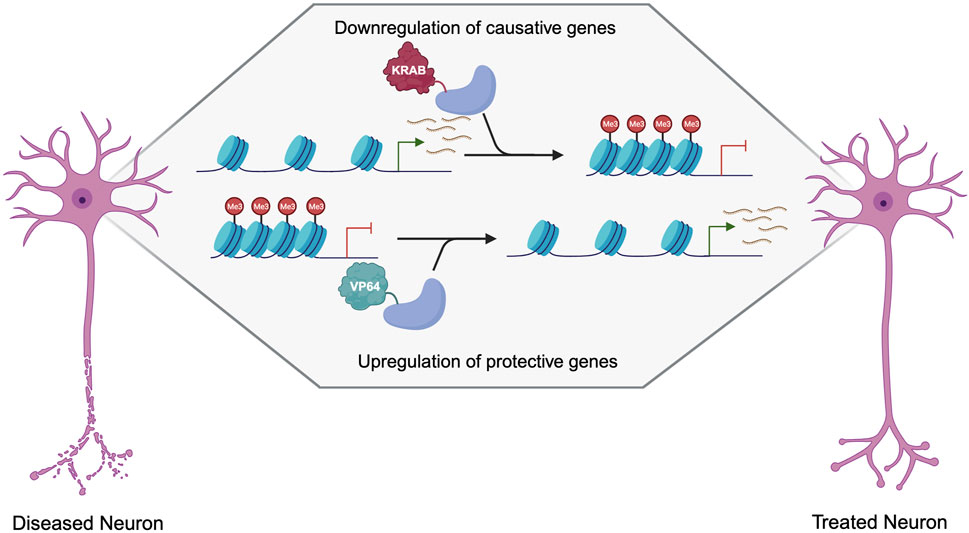 Fig.1 A treatment method for neurodegenerative diseases using CRISPR epigenetic editing technology.1
Screening Purpose
The core purpose of our screening service is predictive optimization. We eliminate the costly and time-consuming random testing of gRNAs by directly incorporating the target cell's epigenetic status. The screening is designed to:
- Identify gRNA targets within open chromatin for high-efficiency nuclease-based knockout (e.g., for CAR-T optimization).
- Validate the efficacy of dCas9-epigenetic editor fusions for controllable gene knockdown.
- Design and test multiplexed gRNA strategies to access stubborn, closed chromatin regions.
Subsequent Application
The outputs of this service directly accelerate clinical translation in several high-value areas:
- Next-Generation Cell Therapy: Creation of enhanced cell products (CAR-T, TILs, NK cells) with superior anti-tumor function due to high-level knockout of inhibitory receptors or T-cell exhaustion markers.
- Neuroscience and Gene Therapy: Development of novel therapies for Autosomal Dominant Neurological Disorders (e.g., Huntington's Disease, certain Ataxias) by achieving targeted, allele-specific silencing of the toxic mutant gene.
- Disease Modeling: Generation of precise, high-fidelity disease models in iPSCs or primary cells for robust in vitro drug screening.
Workflow
Our comprehensive workflow is structured for transparency and maximum scientific rigor, ensuring seamless project execution.
| Stage | Description |
|---|---|
| Required Starting Materials | Client provides Cell Model/Type (e.g., primary human T cells, iPSC-derived neurons), Target Gene(s) of Interest, and Project Goals (e.g., full KO vs. allele-specific downregulation). |
| Epigenetic Profiling (ATAC-seq) | We perform Assay for Transposase-Accessible Chromatin using sequencing (ATAC-seq) on the client's specific cell type to map open and closed chromatin regions across the genome. |
| gRNA Design & Optimization | Integrating the ATAC-seq data with sequence-based tools, we design and screen epigenetically optimized guide RNAs (gRNAs) and, where necessary, multiplex gRNA pairs to target closed regions. |
| Editing & Validation | Delivery of Cas9-RNP complex via electroporation (or dCas9-effector fusion for epigenetic repression) into the target cells, followed by deep sequencing (Indel frequency) and expression analysis (RT-qPCR, Western blot). |
| Final Deliverables | Comprehensive report detailing all steps, optimized gRNA sequences, and validated efficiency data. |
Estimated Timeframe: The typical timeframe for this service ranges from 8 to 14 weeks, depending on the complexity of the cell type, the number of targets, and the availability of validated antibodies/primers for the final validation stage.
What We Can Offer
Customized Epigenetic Profiling (ATAC-seq)
We deliver project-specific, high-resolution chromatin accessibility maps on your critical cell line (e.g., primary T cells, iPSC-derived neurons), ensuring the editing strategy is optimized for your precise biological context.
Precision gRNA Selection & Optimization
Our service integrates this proprietary epigenetic data with sequence tools to identify chromatin-guided gRNAs that guarantee superior on-target efficiency, drastically reducing screening time and failure rates.
High-Efficiency Primary Cell Editing
We offer validated, end-to-end protocols for achieving high-fidelity gene knockout crucial for manufacturing potent, next-generation cell therapy products (e.g., enhanced CAR-T).
Access to Intractable Genomic Targets
Our specialized multiplexing strategies are custom-designed to successfully overcome the barrier of heterochromatin, unlocking previously "closed" or silent genomic regions for essential therapeutic modifications.
Tunable Epigenetic Repression
Provision of custom CRISPR-dCas9 effector systems to achieve reversible and allelic-specific gene downregulation, a non-permanent solution ideal for toxic gain-of-function neurological disorders.
Comprehensive Quality-by-Design (QbD) Validation
Robust quality control using deep sequencing for indel frequency, combined with rigorous expression analysis, confirming minimal off-target activity and maximum editing success before moving to the clinic.
Full Pipeline Integration
Creative Biolabs provides a seamless, customized workflow from initial feasibility assessment and design through final validated cell products, accelerating your pipeline from discovery to therapeutic validation.
Customer Reviews

Experience the Creative Biolabs Advantage - Get a Quote Today
FAQs
How does your service compare to standard in silico gRNA prediction tools?
Standard tools rely only on sequence features, often leading to failure in real-world cells due to chromatin inaccessibility. Our service integrates real-time ATAC-seq data from your specific cell line to map accessible regions, increasing on-target knockout efficiency by up to 75% compared to traditional methods. This epigenetic-guided design is the key difference.
My therapeutic target is in a highly repressed region. Can you still guarantee a knockout?
Targeting closed regions is a genuine challenge. Our solution involves a proprietary multiplexing strategy, where we design two or more gRNAs in adjacent regions to synergistically open the chromatin, as supported by published data. While no biological process is 100% guaranteed, this technique significantly maximizes the probability of successful editing in previously intractable targets.
Is your epigenetic approach only for permanent knockout, or can it be used for controlled knockdown?
We offer both. For permanent knockout (e.g., T-cell engineering), we use the standard CRISPR/Cas9 nuclease system guided by our epigenetic data. For controlled, tunable knockdown (e.g., dominant neurological targets), we employ the dCas9-effector fusion system, enabling reversible, dose-dependent gene repression without permanent DNA breaks.
What are the necessary precautions when submitting primary cells for this service?
The quality of the input cell material is paramount. We require high-viability, early-passage cells with clear authentication data. Crucially, the cells should represent the functional state you intend to edit. For example, T cells should ideally be minimally manipulated or in a consistent pre-activation state, which we can further optimize using factors like IL-7 pre-treatment if necessary.
I am developing an in vivo gene therapy. How is this service relevant to me?
Our service is highly relevant. If your therapy involves AAV delivery of a Cas9/gRNA cassette, the gRNA must function effectively in vivo within a quiescent cell's chromatin state. Our predictive epigenetic mapping ensures that the gRNA you use for your final therapeutic vector is the absolute most efficient one for the target tissue, greatly reducing the risk of in vivo failure.
Creative Biolabs is your expert partner for navigating the complexity of the genome and the epigenome. We provide more than a service; we offer a predictive platform that integrates cutting-edge chromatin accessibility analysis (ATAC-seq) with gene editing to deliver unparalleled efficiency in both cell therapy optimization and gene therapy development. Stop wasting resources on gRNAs that fail due to biological context.
Contact Our Team for More Information and to Discuss Your Project
Reference
- Wang, Dingding, et al. "Kinome-wide CRISPR-Cas9 screens revealed EXOSC10 as a positive regulator of TGF-β signaling." Biochemistry and Biophysics Reports 40 (2024): 101864. https://doi.org/10.1016/j.bbrep.2024.101864. Distributed under Open Access license CC BY 4.0, without modification.
