
CRISPR mediated Transcription Factor Knockout Screening Service
Introduction
Creative Biolabs' CRISPR mediated Transcription Factor (TF) Knockout Screening Service deciphers regulatory genomes via advanced functional genomics and high-throughput CRISPR-Cas9 screening. It identifies high-impact TF targets and optimizes cell differentiation protocols, delivering functional causal data beyond gene expression profiling. As a functional genomics specialist, we prioritize research speed and purity, moving beyond correlative data to map TF-controlled biological outcomes, empowering precision medicine with robust targets and protocols.
Discover How We Can Help - Request a Consultation
CRISPR mediated Transcription Factor Knockout Screening Service
Background of Transcription Factors (TFs)
Transcription Factors are sequence-specific DNA-binding proteins that act as global integrators and decoders of cellular signals. They govern the gene expression programs that define a cell's identity, function, and response to external stimuli. For example, specific TFs determine the transition of a multipotent precursor cell into a defined lineage, or dictate the cell's initial, rapid defense mechanism against a viral infection. Their critical role at the nexus of signaling and gene expression makes them highly attractive targets for therapeutic intervention and core components for controlled cell engineering.
Screening Purpose: From Correlation to Causation
The primary purpose of the CRISPR mediated TF Knockout Screening Service is to move beyond observational science. While gene expression data (RNA-seq) can show correlation, CRISPR-Cas9 knockout screening provides definitive causation. By using a comprehensive library of sgRNAs to systematically eliminate the function of TFs in a parallel, high-throughput manner, we can directly identify which TF's loss or gain of function causes the measurable, desired phenotype. This approach is essential for identifying novel factors that were previously overlooked by traditional methods, ensuring that resources are focused on the highest-impact targets.
Subsequent Applications: Translating TFs into Therapeutics
The validated TFs and their regulatory pathways identified through our screening service have immediate, high-value translational applications:
- Advanced Cell Manufacturing: The identified TFs become the crucial factors for chemically defined, high-purity differentiation media. Modulating these factors (e.g., through small molecules or defined recombinant protein cocktails) allows for scalable production of high-quality therapeutic cells, solving a critical bottleneck in cell therapy development.
- Novel Drug Target Development: TFs that strongly regulate disease-relevant phenotypes (such as chronic inflammation, viral suppression, or tumor growth) are immediately prioritized as high-value targets for pharmaceutical partners. Understanding the regulatory network allows for the development of small molecules that either inhibit or activate the TF's function with unprecedented precision.
Workflow
Our process is designed for maximum clarity and efficiency, providing a clear path from initial question to actionable scientific data.
| Component | Description |
|---|---|
| Required Starting Materials |
Client Cell Line/iPSC: A well-characterized cell model (e.g., iPSCs, primary T-cells, or relevant immortalized line). Target Phenotypic Assay: A quantifiable readout for your biological question (e.g., flow cytometry markers for cell lineage, viral titer readout, specific protein translation levels). Candidate Gene List: A custom list of 50 to 5,000 TFs and/or chromatin regulators for perturbation. |
| Library Design & Construction | Design of a highly optimized single-guide RNA (sgRNA) library targeting your TFs of interest. The library is cloned into the robust CRISPR-Cas9 vector system. |
| Cell Transduction & QC | Stable delivery of the sgRNA library into your cell model at a low multiplicity of infection (MOI) to ensure single-cell perturbation. |
| Functional Phenotypic Screening | Application of high-throughput screening (HTS) methods like Fluorescence-Activated Cell Sorting (FACS) or specialized assays (such as a translation-readout screen) to isolate cells with the desired functional phenotype. |
| gRNA Enrichment Analysis (Bioinformatics) | Deep sequencing of the enriched and unenriched cell populations, followed by sophisticated analysis (e.g., using MAGeCK-like algorithms) to determine which TF knockouts are statistically driving the phenotype. |
| Candidate Validation & MoA Study | Independent knockout generation of the top hits (e.g., generating double-knockout lines) and in-depth mechanistic studies to confirm function and pathway engagement. |
| Final Deliverables |
High-Confidence Hit List: A prioritized list of validated TF genes and the specific sgRNAs used. Functional Omics Data: Gene expression or scRNA-seq data on the pathways modulated by the hit TFs. Comprehensive Technical Report: A detailed report including screening parameters, sequencing statistics, enrichment scores, and validation data. |
| Estimated Timeframe | The typical timeframe for this service ranges from 8 to 14 weeks, depending on the complexity of the cell model (e.g., primary cells vs. established lines) and the number of library cycles required. |
What We Can Offer
Our CRISPR mediated Transcription Factor Knockout Screening Service is not a generic platform—it is a custom-designed functional genomics solution built to answer your most specific and challenging biological questions. For biology experts seeking definitive, causal data, Creative Biolabs offers:
Customized sgRNA Library Design
Targeting your precise set of 50 to 5,000 Transcription Factors and/or epigenetic regulators for maximum biological relevance and signal-to-noise ratio. We prioritize the TFs that matter most to your unique pathway.
Flexible Cell Model Integration
Seamlessly deploy the screen in your proprietary, challenging cell lines (e.g., iPSCs, primary T-cells) or utilize our suite of validated, optimized Creative Biolabs host lines to ensure high-efficiency editing and robust results.
Deep Functional Readouts
Leveraging advanced, specialized techniques, including FACS-based sorting and the proprietary CRISPR-Translate method, to identify TFs based on complex functional changes like specific lineage commitment or antiviral translation arrest, moving beyond simple viability assays.
Tiered Validation Services
Offering independent knockout generation and MoA studies, including complex combinatorial (double-knockout) analysis, to confirm function and pathway engagement. This guarantees you receive a high-confidence, actionable list of validated candidates.
Proprietary Bioinformatic Pipeline
Our refined algorithms (including MAGeCK-like tools) are optimized to handle the complexities of pooled screening data, delivering statistically significant and high-confidence hit lists that simplify downstream resource allocation.
End-to-End Project Management
We provide a single point of accountability from initial library construction through to the final Functional Omics Data and a detailed technical report, allowing your team to focus solely on the therapeutic implications of the discovery.
Case Study
Through genome-wide CRISPR-Cas9 knockout screening, host factors that may regulate HIV gene expression and affect latency were systematically identified. The cells stably expressing Cas9 screened out were transfected with HIV-blue fluorescent protein (BFP) lentivirus, and the cells were divided into latent HIV infected cells and active HIV-infected cells. The results of next-generation sequencing showed that ATF1 was one of the most significant candidate genes for sgRNA enrichment in cells carrying latent HIV.
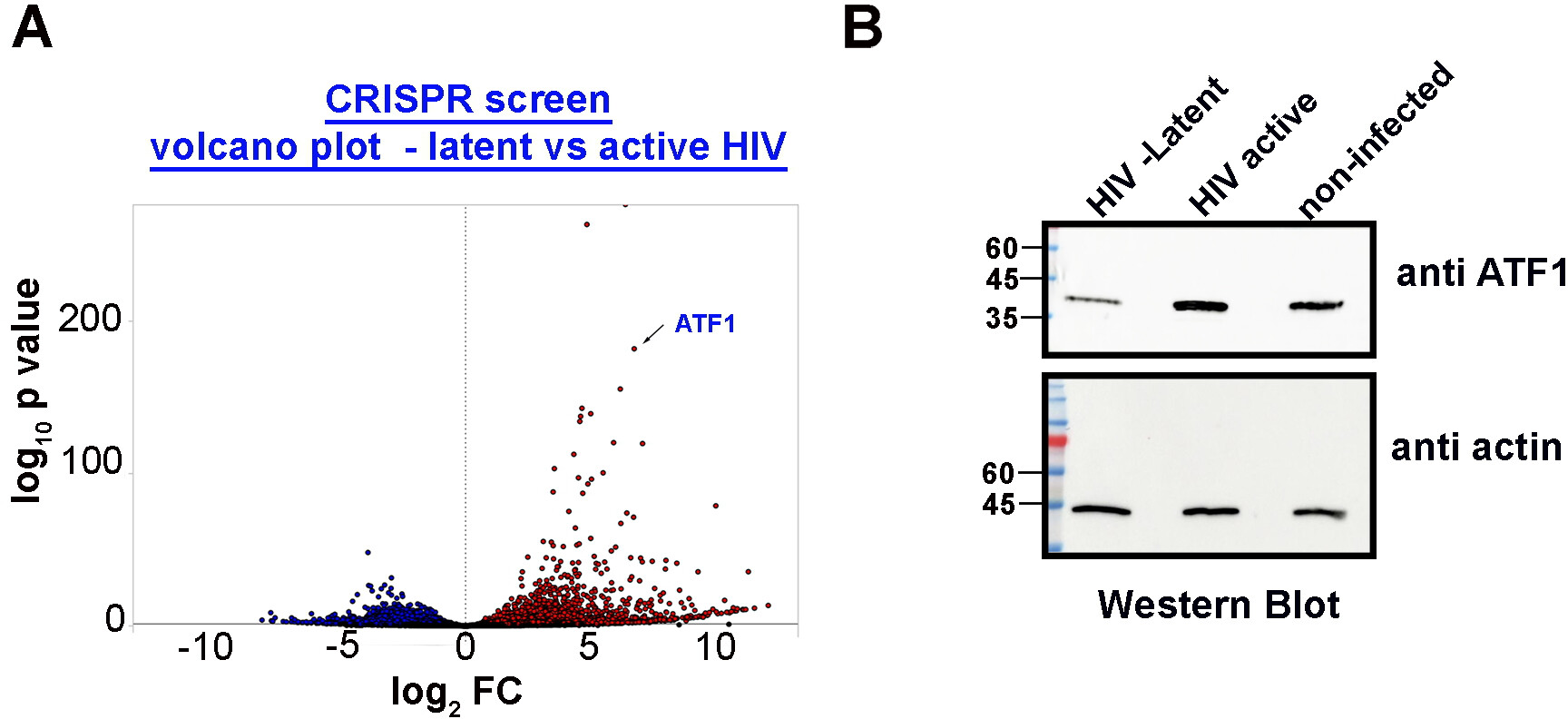 Fig.1 The CRISPR analysis algorithm was applied to analyze the gene enrichment in HIV transcription-active cells and latent infected cells.1
Experience the Creative Biolabs Advantage - Get a Quote Today
Customer Reviews

FAQs
How does this screening method compare to traditional RNA interference (RNAi) screening?
Our CRISPR-Cas9 Knockout Screening provides a permanent and near-complete gene perturbation, leading to much cleaner and more reliable functional data compared to the transient and often incomplete knockdown achieved by RNAi. This higher confidence in our hits drastically reduces the validation burden and accelerates your timeline.
How can I ensure the biological relevance of the TFs identified in the screen?
Relevance is guaranteed by the functional readout. Unlike simple viability screens, Creative Biolabs utilizes complex, physiologically relevant phenotypic assays—such as precise FACS sorting based on specific lineage markers or functional viral load analysis—meaning the TFs identified are directly responsible for the critical biological function you are studying.
What level of complexity can the screening handle, such as multi-gene interactions?
Our service is designed to address complex biology. While the initial screen targets single gene knockouts, the "Candidate Validation & MoA Study" step can be extended to include combinatorial (double- or triple-) knockout analysis, allowing you to map synergistic or antagonistic TF interactions. This is critical for understanding intricate processes like cell fate commitment.
Is this service only for academic research, or is it suitable for industrial drug discovery?
This service is explicitly engineered for industrial applications, translating to high-confidence targets that fit immediately into preclinical development. The data generated provides the robust causality evidence required for patent filing and preclinical candidate selection.
Creative Biolabs delivers the industry-leading CRISPR mediated Transcription Factor Knockout Screening Service, translating complex functional genomics into actionable drug targets and optimized cell production pathways. We are committed to accelerating your path from discovery to therapy by providing clear, causal, and high-impact data.
Contact Our Team for More Information and to Discuss Your Project
Reference
- Kuzmina, Alona, et al. "Genome-wide CRISPR knockout screen identifies activating transcription factor (ATF1) as an activator of HIV gene expression." mBio (2025): e00557-25. https://doi.org/10.1128/mbio.00557-25. Distributed under Open Access license CC BY 4.0, without modification.
