Protect the duplex
Reduce nuclease degradation and preserve intact RNA long enough to support productive intracellular exposure.

Learn how position-specific sugar, backbone, terminal, and conjugate modifications can improve siRNA stability, specificity, delivery, and therapeutic performance while preserving RNAi activity.
Chemical modification is a central part of siRNA development because an unmodified RNA duplex must overcome several problems before it can function as a practical therapeutic molecule. A useful design combines sufficient nuclease resistance with retained RNAi activity, favors the intended guide strand, limits passenger-strand and seed-mediated effects, and remains compatible with the selected delivery format. Modification patterns should be evaluated as integrated designs rather than as isolated chemical features. Creative Biolabs can prepare position-defined candidates through custom siRNA synthesis and compare their activity through siRNA in vitro screening.
Reduce nuclease degradation and preserve intact RNA long enough to support productive intracellular exposure.
Favor the intended guide while limiting passenger-strand loading and unwanted seed-dependent regulation.
Use sequence- and position-aware chemistry to lower selected innate RNA-sensing responses.
Ensure that the chemistry remains compatible with conjugation, formulation, uptake, release, and dosing route.
An siRNA duplex is not chemically uniform from a functional perspective. The two ends influence strand selection, the guide seed region contributes strongly to early target recognition, central guide positions support extended pairing and catalytic geometry, and terminal regions can be especially exposed to exonuclease attack. The passenger strand has a different job: it must support duplex formation and loading while being disfavored as the retained guide.
For that reason, modification patterns are usually interpreted by position and strand. A stabilizing group that is well tolerated near one terminus may reduce activity when placed at a position required for Argonaute interaction or target pairing. Likewise, a modification that improves the passenger strand may be useful only if it does not increase passenger loading. The correct design question is therefore not simply “Which chemistry is best?” but “Which chemistry is appropriate at this position, on this strand, for this delivery format?”
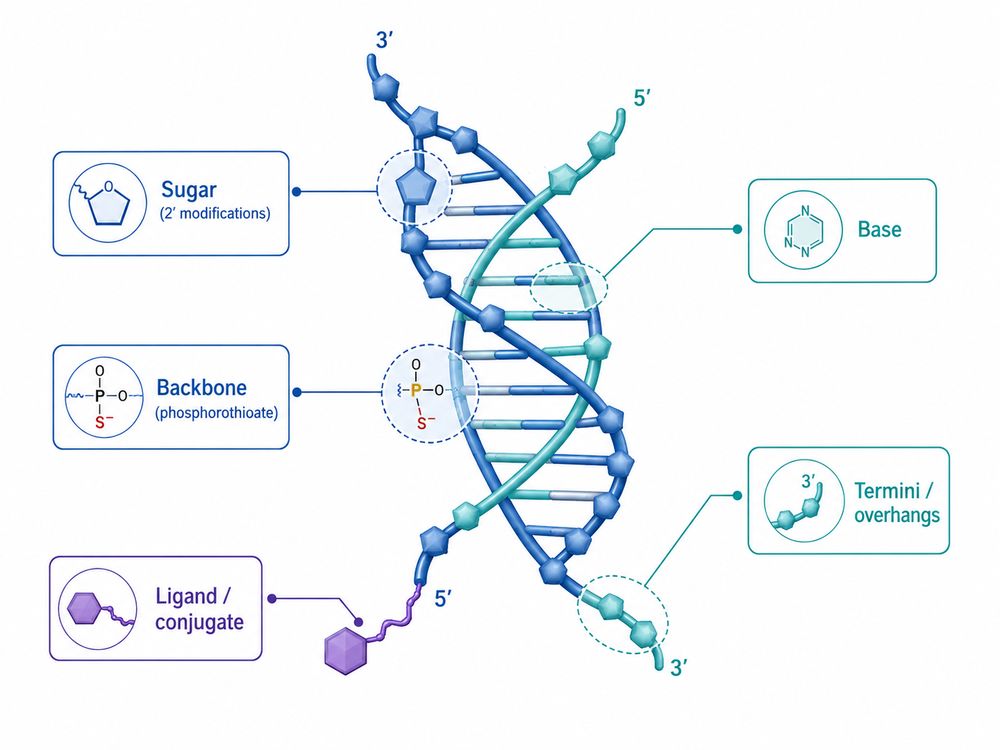
Different modification classes solve different development problems. In practice, several types are often combined in one duplex so that stability, potency, specificity, and delivery can be optimized together.
2′-O-methyl substitutions can increase resistance to nuclease attack while reducing selected sequence-dependent immune responses. Their value is highly position dependent. They may also be used to tune guide-seed behavior or passenger-strand activity, but excessive or poorly placed substitution can reduce silencing if it interferes with productive RNA-protein or RNA-RNA interactions.
2′-fluoro residues often contribute strong duplex stabilization and nuclease resistance while retaining an RNA-like geometry. They can be useful in regions where high affinity is desirable, but the overall pattern should still be tested for potency, strand preference, and tolerability. Alternating or position-selective use can provide a better balance than blanket substitution.
Replacing selected non-bridging backbone oxygens with sulfur can increase resistance to exonucleases and alter interactions with proteins. Because phosphorothioate content can also affect physicochemical behavior, protein binding, and tolerability, these linkages are commonly evaluated in limited, strategically selected positions rather than treated as a universal backbone replacement.
Terminal protection can reduce degradation at vulnerable duplex ends, alter end stability, and create handles for conjugation. End chemistry can also influence which strand is preferentially selected. Terminal design should therefore be considered together with thermodynamic asymmetry, intended guide orientation, and the attachment point of any delivery ligand.
Selected nucleobase changes can alter pairing strength, mismatch discrimination, immune recognition, or other sequence-dependent properties. Because base pairing directly determines target recognition, nucleobase modifications should be assessed carefully against both on-target potency and off-target profiles rather than judged only by stability gains.
GalNAc, antibody-siRNA conjugates, peptides, aptamers, lipids, and other targeting or delivery moieties can change tissue exposure, receptor-mediated uptake, endosomal trafficking, and overall pharmacokinetics. Conjugation is therefore not independent of RNA chemistry. The attachment site, linker, duplex stability, and intracellular release requirements should be evaluated as one product architecture.
The same chemical group can be beneficial, neutral, or disruptive depending on where it is placed. Position-specific design helps preserve RNAi function while protecting vulnerable parts of the duplex.
The seed region contributes strongly to initial transcript recognition. Chemistry here may influence affinity, mismatch discrimination, and seed-mediated off-target regulation. Candidate patterns should be compared for both intended knockdown and unintended transcript effects rather than optimized on potency alone.
Central positions participate in extended complementarity and catalytic alignment. These sites should retain sufficient conformational and pairing compatibility for productive Argonaute-mediated cleavage. A modification that produces excellent serum stability can still be unsuitable if it weakens catalytic performance.
Terminal chemistry can protect against exonucleases and influence end stability. Because relative duplex-end stability contributes to strand choice, terminal modifications should be evaluated together with sequence asymmetry and the desired guide orientation.
The passenger strand should support duplex stability and loading without becoming a competing functional guide. Modifications can be used to reduce unwanted passenger activity, but over-stabilization or poorly placed chemistry may change duplex unwinding or strand-selection behavior.
A ligand or linker should be attached where it does not block loading, recognition, or cleavage. The selected terminus should also tolerate manufacturing and purification while preserving the intended receptor-binding or carrier-association function.
Regions that are especially vulnerable to serum or intracellular nuclease attack may justify additional protection. Stability mapping can help identify whether degradation is localized and whether a targeted change can solve the problem without increasing total chemical complexity.
The guide and passenger strands do not have identical functional requirements. Their modification patterns should reflect what each strand must do after the duplex reaches the cytosol.
| Design feature | Guide strand | Passenger strand | Development implication |
|---|---|---|---|
| Primary role | Must be retained by Argonaute and direct recognition of the intended transcript. | Supports duplex formation and loading but ideally does not become the active guide. | Guide chemistry should preserve catalytic function, whereas passenger chemistry can be used more actively to suppress unwanted strand activity. |
| Seed-region sensitivity | Changes can affect on-target recognition, mismatch discrimination, and seed-mediated off-target effects. | Passenger seed activity is undesirable if that strand enters RISC. | Strand-specific activity assays help determine whether a modification improves specificity by changing loading or seed behavior. |
| Terminal design | Should support favorable strand selection and sufficient nuclease resistance. | Can be designed to make passenger loading less favorable while maintaining duplex integrity. | End chemistry should be considered together with thermodynamic asymmetry rather than optimized independently, particularly when the final architecture includes oligonucleotide conjugation. |
| Modification density | Must remain compatible with Argonaute loading, target pairing, and cleavage. | May tolerate a different pattern because its retained activity is not required. | Using identical modification density on both strands is simple, but it may not be the best functional design. |
| Conjugation | Attachment must not compromise guide loading or target recognition. | May provide an alternative attachment site depending on the delivery architecture. | Conjugation position should be verified experimentally in the final product format. |
Every stabilization strategy should be tested against the biological function it is intended to preserve. A highly stable duplex is not useful if it cannot load efficiently or silence the target.
Measure intact RNA under conditions relevant to the intended route, formulation, and biological matrix. Stability testing should identify whether the duplex remains intact long enough to support delivery rather than simply demonstrate resistance under one artificial challenge condition.
Confirm that increased chemical protection does not prevent productive Argonaute loading or alter guide positioning. Comparing molecular stability with knockdown activity helps distinguish a genuinely improved design from a duplex that is merely harder to degrade.
Measure guide and passenger behavior where possible. A modification pattern that improves total duplex stability but increases passenger loading can create a second activity profile and complicate interpretation of both potency and safety.
Potent target suppression should be interpreted together with sequence-dependent off-target readouts. Modifications that alter seed pairing or intracellular guide abundance may change the off-target landscape even when the target mRNA response appears unchanged.
Innate immune effects can depend on sequence, structure, chemistry, concentration, and delivery vehicle. Matched controls help determine whether reduced inflammatory signaling is caused by the RNA modification itself or by differences in cellular exposure.
A chemistry pattern selected after transfection should be retested in the intended delivery system. Conjugates and nanoparticles can change uptake, endosomal trafficking, release, and intracellular concentration, potentially changing the relative performance of two otherwise similar duplexes.
The best modification pattern depends partly on how the siRNA will reach its target. Chemistry that performs well as a transfected duplex may not be optimal after receptor-targeted conjugation or nanoparticle delivery.
| Delivery format | Key chemistry question | What should be evaluated |
|---|---|---|
| Direct or local administration | Is the duplex sufficiently stable in the local biological environment without unnecessary chemical burden? | Local stability, tissue retention, cellular uptake, target engagement, tolerability, and recovery after dosing; RNAi delivery method development can be used when local exposure remains a limiting variable. |
| GalNAc conjugation | Does the RNA chemistry remain compatible with ligand attachment, receptor-mediated uptake, intracellular trafficking, and guide release? | Conjugate integrity, uptake, intracellular availability, dose response, target knockdown, and duration. Creative Biolabs can integrate chemistry with GalNAc-based RNAi development. |
| Antibody-siRNA conjugates | Does conjugation preserve antibody binding while keeping the RNA accessible after internalization? | Conjugation ratio, binding, uptake, intracellular processing, RNA integrity, target silencing, and cell-selective activity. |
| Lipid nanoparticles | Does the modification pattern affect encapsulation, particle stability, intracellular release, or RISC availability? | Encapsulation, particle properties, RNA stability, uptake, endosomal escape, functional knockdown, and formulation-associated tolerability. |
A staged comparison can separate synthesis quality, intrinsic sequence activity, stabilization, strand behavior, delivery performance, and safety. This prevents one strong endpoint from masking a weakness elsewhere in the development chain.
| Evaluation stage | Primary question | Recommended evidence |
|---|---|---|
| Analytical confirmation | Was the intended sequence and chemical pattern prepared correctly? | Identity, purity, mass, duplex integrity, concentration, strand ratio, and confirmation of the intended modification or conjugation state. |
| Biological stability | Does the modification pattern protect the duplex under relevant conditions? | Serum or plasma stability, nuclease challenge, formulation stability, intact-RNA recovery, and time-dependent degradation mapping where needed. |
| Intrinsic potency | Does stabilization preserve or improve target silencing? | Matched concentration-response testing, target mRNA reduction, protein suppression, onset, maximum effect, and recovery. |
| Strand bias | Is the intended guide preferentially active? | Guide- and passenger-specific activity, strand-selective reporter assays, or direct assessment of loaded guide species when appropriate. |
| Specificity | Does the chemistry change seed-mediated or mismatch-dependent activity? | Independent guide controls, mismatch testing, selected transcript profiling, rescue experiments, concentration dependence, and off-target detection and analysis where deeper specificity assessment is required. |
| Immune and cellular response | Does the pattern reduce unwanted biological responses without masking toxicity through lower uptake? | Cell viability, cytokine or innate-response markers, matched exposure controls, comparison with vehicle-only treatment, and nucleic-acid safety assessment when appropriate. |
| Delivery context | Does the selected pattern remain effective in the final formulation or conjugate? | Uptake, intracellular availability, target engagement, protein reduction, phenotype, and delivery-system tolerability. |
| Candidate selection | Which pattern provides the best overall development balance? | Integrated ranking of potency, stability, specificity, strand bias, delivery compatibility, tolerability, and manufacturing complexity. |
Creative Biolabs supports siRNA chemical-modification programs from position-defined duplex preparation through potency, stability, delivery, and safety comparison. Projects can begin with a small matched panel to test a specific design question or expand into integrated sequence–chemistry–delivery optimization when multiple variables must be resolved together, with downstream oligonucleotide DMPK or toxicity assessment available when the program advances.
| Development need | Related Creative Biolabs service | Potential project support |
|---|---|---|
| Prepare position-defined modified duplexes | Custom siRNA Synthesis | Preparation of sequence-defined siRNA candidates with selected sugar, backbone, terminal, labeling, and conjugation features for matched development studies. |
| Compare potency across chemistry patterns | siRNA In Vitro Screening Service | Concentration-response testing, mRNA and protein readouts, strand activity, phenotype, viability, and candidate ranking under controlled conditions. |
| Combine chemistry with hepatocyte targeting | Custom GalNAc Service for RNAi | Integration of siRNA chemistry with GalNAc conjugation, linker selection, uptake evaluation, intracellular activity, and functional silencing studies. |
| Assess chemistry in an antibody-directed format | Antibody-siRNA Conjugates | Antibody selection, oligonucleotide conjugation, binding, cellular uptake, intracellular processing, and target knockdown assessment. |
| Integrate modified siRNA into nanoparticles | Lipid Nanoparticle Development | RNA encapsulation, particle characterization, formulation stability, release, uptake, intracellular delivery, and functional activity testing. |
Creative Biolabs can help compare sequence–chemistry combinations and identify a modification pattern that balances stability, potency, specificity, and delivery.
Tell us about your project, and our experts will get back to you with a customized quote and proposal.
