Electrophysiological characterization is key to assessing excitable cell function, revealing real cellular activity beyond genomic profiling. Creative Biolabs' service uses Patch-Clamp and high-throughput MEA to provide high-fidelity functional data on iPSC-derived models, quantifying excitability and network dynamics. Leveraging optimized protocols and comprehensive assays, it bridges transcriptomic and clinical gaps, delivering rigorous data to guide pipeline decisions and boost drug development success.
Discover How We Can Help - Request a Consultation
Electrophysiological characterization via multi-electrode array (MEA) is a non-invasive, label-free, high-throughput technique for evaluating the electrophysiological activity and functional connectivity of induced pluripotent stem cell-derived excitable cells, including neurons, cardiomyocytes, and other electrically active cell types.
MEA systems consist of microelectrode arrays integrated on the bottom of cell culture dishes. When iPSC-derived excitable cells are seeded and mature on the array surface, their spontaneous or stimulus-induced electrical signals (action potentials, field potentials, or ion channel currents) are directly detected and recorded by the microelectrodes. The system converts these electrical signals into digital data, which can be further analyzed to quantify parameters such as firing rate, spike amplitude, burst duration, and synchronicity of cell populations.
Our streamlined process is designed for maximum transparency and scientific accuracy, moving from initial material intake to deep-dive data interpretation.
At Creative Biolabs, we understand that every research project has unique requirements. We provide highly flexible and customized High-Resolution Electrophysiological Characterization Service tailored to your specific disease models and drug discovery goals. Our offerings include:
from single-ion channel recording to large-scale network synchrony analysis.
and protocol optimization for rare or difficult-to-culture iPSC-derived lineages.
utilizing multi-well plates (up to 384 wells) for simultaneous evaluation of extensive compound libraries.
incorporating real-time signal monitoring and rigorous biostatistical validation.
facilitated by proprietary coating technologies to support chronic neurotoxicity and neurodegeneration studies.
following strict internal quality assurance guidelines to ensure all data is publication-ready.
including acute pharmacology, chronic exposure, and activity-dependent plasticity assays.
Experience the Creative Biolabs Advantage - Get a Quote Today
Motor neuron particles (MNPs) were dissociated and re-inoculated onto PEI-coated 48-well microelectrode array (MEA) plates at a density of 50,000 cells per well. During the entire culture process, the adhesion of neurons on the MEA plate was closely monitored. MNs cultured in PEI-coated Wells showed no obvious cell clusters on the 30th day and no large aggregates on the 48th day. The number of active electrodes coated with PEI gradually increased and tended to stabilize around the 40th to 48th day.
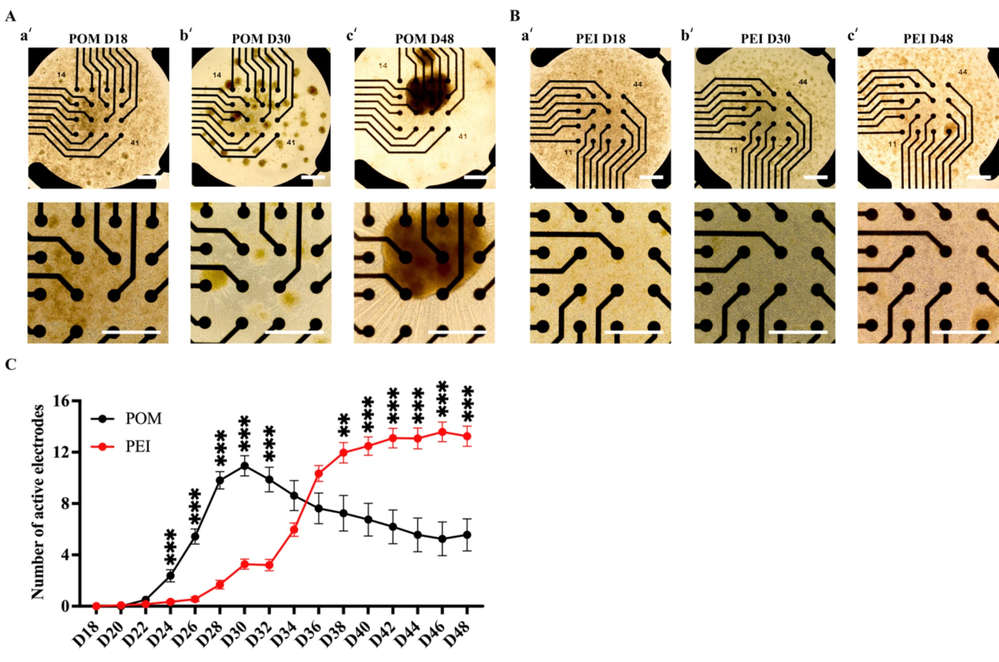 Fig.1 The adhesion and functional maturation of iPSC-MN were studied by electrophysiological characterization using MEA culture plates coated with different coatings.1
A: MEA allows for non-invasive, high-throughput recording of entire cell populations over weeks, whereas Patch-Clamp offers high-resolution data on a single-cell basis. We often recommend a dual approach for the most complete dataset.
A: We utilize a proprietary PEI-based coating protocol that significantly enhances cell adherence, ensuring stable recordings for up to 7 weeks.
A: Yes, we provide specialized protocols for BLCs, measuring "Slow Potentials" and electrical coupling to validate glucose-stimulated insulin secretion (GSIS) pathways.
A: Yes. Our platform is sensitive enough to detect functional shifts caused by specific protective or risk-associated alleles, supporting precision medicine initiatives.

A: We encourage you to reach out for a technical consultation. Our specialists will review your cell type and goals to design the most cost-effective and scientifically robust assay plan.
Creative Biolabs is dedicated to providing the high-end functional data you need to move your project forward. Our team of PhD-level scientists is ready to assist with your most complex electrophysiological challenges.
Contact Our Team for More Information and to Discuss Your Project
Reference
For Research Use Only. Not For Clinical Use.