
Allergic Disease related Vaccine Solution

Creative Biolabs offers custom design and development of world-leading allergic disease vaccines (ADVs). We use innovative technology to create highly effective and safe therapeutic/prophylactic vaccines aimed at fundamentally curing immune responses to specific allergens. Our solution covers target antigen selection, vaccine construction, and immunogenicity evaluation, helping partners accelerate next-generation desensitization vaccine development.

Schematic diagram or related content of the first solution for vaccines associated with allergic diseases.

Key Concepts of Allergic Disease Vaccines

Allergen Immunotherapy (AIT), or the Allergic Disease Vaccine, is the only treatment that fundamentally alters allergic disease by reprogramming the immune system—shifting the response from sensitizing Th2 cells toward tolerance mediated by Th1 or regulatory T cells (T reg ). Because traditional AIT is long and risky, next-generation vaccines use advanced antigen engineering and adjuvant technologies to significantly shorten treatment and enhance safety and efficacy. Core Concepts & Challenges:

Traditional AIT lasts several years and carries the risk of inducing severe allergic reactions (e.g., anaphylactic shock). New vaccine designs must significantly improve safety while maintaining or enhancing efficacy.

The key is to select and optimize antigen variants that possess low allergenicity (weak IgE binding capacity) and high immunogenicity (able to effectively induce protective IgG or regulatory T cells).

Excellent adjuvants and delivery systems are crucial for guiding the immune response toward a non-allergic (Th1/Treg) direction, a critical factor determining vaccine success.

Allergens are diverse, and targeted development requires highly precise capabilities in identifying and designing antigenic epitopes.

How We Solve Your Core Challenges


Target-Ag™ Platform-Driven Antigen Engineering

  • Hypoallergen Design and Modification: Utilizing our proprietary Target-Ag™ Platform, we design and modify hypoallergens by precisely removing or altering allergenic epitopes using genetic engineering or chemical modification.
  • Safety Enhancement: Aims to maximize the reduction of IgE binding capacity, thereby significantly lowering the risk of allergic reactions during treatment, ensuring high safety for vaccine candidates.
  • Potency Preservation and Enhancement: By preserving or optimizing T-cell activation epitopes, we ensure the modified antigen can still efficiently induce the immune system to shift from a Th2 response to a Th1/Treg immune tolerance response, guaranteeing high immunogenicity and efficacy.

Customized Vector and Adjuvant Screening

  • Strategy Customization: We customize the screening of the most suitable adjuvants and delivery systems by matching the route of administration with the allergen type, ensuring the local immune effectiveness of the vaccine.
  • Adjuvant Innovation and Optimization: Creative Biolabs screens TLR agonists (e.g., CpG-ODNs) and novel adjuvants/delivery systems to promote APC maturation, drive Th1 differentiation, and uses specific adjuvants/targeted delivery to boost Treg generation for long-term immune tolerance.
  • In-Depth Delivery System Optimization: Our optimized delivery systems include nanoparticle design/formulation, enabling efficient APC targeting, antigen stability, controlled release, and sustained safe immune stimulation.

Immune Response Mechanism Evaluation

  • Multi-Dimensional Preclinical Model Application: Comprehensive and in-depth in vivo evaluation of vaccine candidates' efficacy and safety is conducted in established preclinical animal models.
  • Antibody Titer and Function Analysis: We evaluate sensitization reversal and allergic reaction inhibition by measuring serum total/specific IgE and quantitatively analyzing vaccine-induced IgG blocking antibody function.
  • Immune Cytokine Profile Analysis: We utilize flow cytometry and ELISA techniques to monitor changes in Th1/Th2 cytokine and Treg marker profiles to validate the vaccine-induced immune deviation and tolerance mechanism.
  • Functional Desensitization Verification: Through allergen challenge tests, we evaluate the practical function of the vaccine in inhibiting allergic symptoms in animals, directly verifying the desensitization efficacy.
Innovative Technology Platforms

Allergic Disease Vaccine Development Process

Target Antigen Identification and Acquisition

Identify core allergens and obtain high-purity, high-activity antigen proteins or peptides through recombinant expression or synthetic methods.

Target-Ag™ Platform-Driven Antigen Modification and Engineering

Utilize the Target-Ag™ Platform to perform epitope mutation, fusion, or truncation on natural antigens, designing hypoallergen vaccine candidates.

Adjuvant and Delivery System Screening

Screen and optimize suitable immune adjuvants (e.g., CpG, Alum) and delivery vectors (e.g., liposomes, viral vectors) based on the desired immune response to enhance immune modulation.

Vaccine Formulation and Quality Control

Optimize the vaccine formulation and stability, conducting rigorous in vitro activity, purity, and batch consistency (QC) testing.

Preclinical Immunogenicity and Safety Evaluation

Evaluate vaccine-induced changes in IgG/IgE, cytokine profiles (Th1/Th2), and potential allergic reaction risks in mouse, guinea pig, or non-human primate models.

Partner with Creative Biolabs Now!

Creative Biolabs' Core Strengths

Proprietary Target-Ag™ Platform

We possess unique antigen modification technology that can systematically reduce allergenicity while preserving immunomodulatory potential, significantly enhancing vaccine safety and efficacy.

Comprehensive Allergen Library

Our database and experimental capabilities cover dozens of major food, environmental, and insect venom allergens, enabling us to handle the most complex customized project needs.

One-Stop Solution

Providing a complete service chain from antigen engineering to preclinical immunological evaluation, minimizing your R&D cycle and reducing project risk.

Exceptional Immunology Expertise

Our team has deep expertise and extensive project experience in Regulatory T cell (Treg) induction and Th1-biased immune response design.

Presentation of Creative Biolabs' core competitive advantages and key capabilities in the research and development of vaccines for allergic diseases.

Case Study

Recombinant Peanut Allergen Ara h 2 Production via Lactococcus lactis

Background

Peanut allergy is severe (0.6% prevalence in UK/USA/Australia), with Ara h 2 as the key allergen (recognized by >90% patients). Natural allergen extracts are complex, batch-variable, and risky for immunotherapy. This study aimed to use Lactococcus lactis (food-grade, endotoxin-free, secretory) to produce recombinant Ara h 2 (rAra h 2) for safer, standardized immunotherapeutics/diagnostics.

Solution

A codon-optimized synthetic ara h 2 gene was cloned into pAMJ399 (with P170 promoter/SP310mut2 signal peptide) and transformed into L. lactis strains (CHW4/CHW9). Batch fermentation (1L, LM3-30 medium) was done; rAra h 2 was purified via hydrophobic exclusion and size separation. It was characterized via MALDI-TOF, N-terminal sequencing, and ELISA (rabbit anti-native Ara h 2 sera).

Result

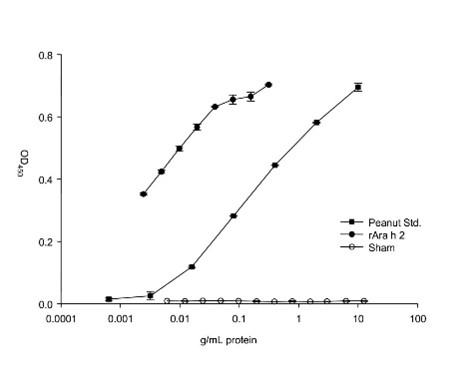
L. lactis CHW9 yielded 40 mg/L secreted, full-length rAra h 2 (17 kDa, correct molecular weight via MS, precise signal peptide cleavage). ELISA showed rAra h 2 had comparable immunoreactivity to native Ara h 2, supporting its use for peanut allergy immunotherapy and component-resolved diagnostics.

Experimental data or analytical results showing the immune reactivity of recombinant Ara h2 (rAra h 2) in the context of allergic disease-related vaccine research.

Immune Reactivity of rAra h 2.
Glenting, Jacob, et al. "Production of recombinant peanut allergen Ara h 2 using Lactococcus lactis." Microbial cell factories 6.1 (2007): 28. Distributed under Open Access license CC BY 4.0, without modification. https://doi.org/10.1186/1475-2859-6-28.

Customer Reviews

"Creative Biolabs' Target-Ag™ Platform performed exceptionally well on our peanut allergy project. Their designed hypoallergen candidates showed extremely low IgE reactivity in animal models and successfully induced high levels of blocking IgG. This saved us significant time in advancing preclinical studies. Their professionalism and responsiveness were impressive."

- R&D Director

Biotechnology Company

"We collaborated with Creative Biolabs to develop a novel house dust mite vaccine. Their adjuvant screening strategy was highly precise, successfully guiding the immune response toward our desired Th1 pathway, effectively alleviating asthma symptoms. It was an efficient and highly productive collaboration."

- Immunology Professor

European University

"In the tree nut allergy vaccine project, we faced complex antigen cross-reactivity issues. The Creative Biolabs team provided an innovative multivalent peptide vaccine design solution that perfectly resolved this challenge. Their reports are detailed, and their data is reliable—a truly trustworthy partner."

- Project Manager

North American Pharmaceutical Company

Frequently Asked Questions

How does Creative Biolabs' Target-Ag™ Platform differ from other antigen modification technologies?

The unique feature of the Target-Ag™ Platform lies in its highly systematic and high-throughput epitope engineering capability. We focus not only on reducing IgE binding but also on optimizing the T-cell activation profile to ensure effective immune deviation from Th2 to Th1/Treg, which is critical for achieving long-term immune tolerance.

Can you design vaccines for rare or non-standard allergens?

Absolutely. We possess strong capabilities in customized recombinant protein expression and peptide synthesis. Even if the client's target is a rare animal/plant toxin or an occupational allergen, we can initiate the process from scratch, including antigen identification, cloning, expression, purification, and subsequent hypoallergen design.

How long does the allergic disease vaccine development cycle typically take?

The development cycle depends on the project's complexity and starting stage. Generally, the time required from antigen engineering to preclinical Proof of Concept (POC) is approximately 6 to 12 months. We provide a detailed project timeline based on your specific needs and budget.

What types of allergens can Creative Biolabs' platform handle?

Our technology platform is highly flexible and widely applicable. We can handle almost all types of allergens, including major food allergens (e.g., peanut, milk, seafood), environmental allergens (e.g., pollen, dust mites, animal dander), and insect venom allergens. We can customize the antigen based on the client's specific requirements.

How do you ensure the stability of the final vaccine formulation?

During the Vaccine Formulation and Quality Control stage, we conduct stability studies on vaccine candidates under multiple conditions (e.g., temperature, pH sensitivity) and utilize state-of-the-art analytical techniques (e.g., HPLC, SEC-MALS) to ensure the long-term activity and integrity of the formulation, providing a reliable solution for storage and transportation.

Launch Your Allergic Vaccine Innovation Project

Tired of traditional therapies that only manage symptoms? It’s time to achieve a fundamental cure for allergic diseases through immune system reprogramming.

Consult Creative Biolabs today!
Online Inquiry

All of our products can only be used for research purposes. These vaccine ingredients CANNOT be used directly on humans or animals.

Name:
Phone:
*E-mail Address:
*Products or Services Interested:
Project Description:

This site is protected by reCAPTCHA and the Google Privacy Policy and Terms of Service apply.