Autoimmune Disease related Vaccine Solution

Creative Biolabs is dedicated to providing researchers and pharmaceutical companies worldwide with a one-stop, high-standard autoimmune disease vaccine R&D and design service. We focus on developing innovative vaccine strategies that can re-establish immune tolerance, specifically target pathogenic immune cells or molecules, and minimize systemic side effects. Whether addressing systemic lupus erythematosus, rheumatoid arthritis, or multiple sclerosis, our expert team provides customized vaccine solutions, covering target screening, antigen design, vector construction, and preclinical testing, accelerating your innovative drug project from concept to preclinic.

Fig.1: Autoimmune-Disease-Related Vaccine.

Challenges and Prospects of Autoimmune Disease Vaccines

Autoimmune disease vaccines represent a highly promising innovative therapeutic strategy. Their core objective is to move beyond conventional systemic immunosuppression and, instead, re-establish immune balance through specific mechanisms. This aims to achieve long-term treatment or prevention for autoimmune diseases like RA and SLE.

Core Challenges and Considerations:

The key lies in safely and effectively breaking the pathogenic immune loop without compromising normal immune defense functions.

The vaccine must highly specifically target autoreactive T cells or B cells to avoid non-specific immunosuppression, which is crucial for success.

Careful design and optimization are required for selecting appropriate adjuvants to direct the immune response towards a tolerogenic (Th2/Treg rather than Th1/Th17) pathway, rather than an inflammatory one.

An effective delivery system (such as nanoparticles, viral vectors, or cell carriers) is essential for the correct presentation of the antigen and the induction of the desired immune response.

Core Problems We Help Clients Solve

Creative Biolabs offers comprehensive autoimmune disease vaccine design and optimization services, aimed at solving clients' core problems in target validation, immunogenicity assessment, and preclinical model establishment.

Precise Antigen and Epitope Screening

  • Immunoinformatics: Utilizing advanced computational models and AI algorithms to predict, screen, and optimize pathogenic or tolerogenic T/B cell epitopes.
  • High-throughput Screening Platform: Rapidly verifying the in vitro immune response and specificity of a large number of potential antigens to accelerate candidate target confirmation.

Customized Tolerogenic Strategy Design

  • We offer innovative vaccine designs in various formats, including DNA, peptide, protein, and cell-based approaches, and evaluate their capability to induce tolerogenic T cells (Treg) or reverse pathogenic T cell responses in vivo.

Optimized Delivery System Development

  • Nanoparticles (NPs) Delivery: Utilizing liposomes, polymers, and other nanocarriers to achieve stable protection of the antigen and targeted delivery to lymphoid tissues.
  • Viral Vectors Delivery: Employing safe vectors such as adenoviruses and lentiviruses to achieve efficient expression and persistent presentation of the antigen in host cells in vivo.
  • Cell Delivery Strategy: Using engineered dendritic cells (DC) or other immune cells as carriers to precisely present the antigen to target immune cells, specifically inducing immune tolerance.
Our Services for Developing Autoimmune Disease related Vaccine

Core Technology Platforms

Autoimmune Disease Vaccine R&D Process

Project Initiation and Target Confirmation

In-depth analysis of the pathological mechanism of the target autoimmune disease and collaborative confirmation of core autoantigens or key immunoregulatory targets.

Antigen and Epitope Design

Utilizing immunoinformatics prediction and customized synthesis techniques to design and optimize peptides or protein antigens with high tolerance-inducing potential.

Vector and Delivery System Development

Selecting or customizing the design of appropriate delivery carriers (e.g., DNA vectors, nanoparticles, or cell carriers) for scaled-up preparation.

In Vitro Functional Validation

Evaluating the vaccine's ability to induce Treg cells, suppress pathogenic T cells, or regulate cytokine secretion in In Vitro immune cell models.

Preclinical In Vivo Validation

Assessing the safety and therapeutic/preventive efficacy of the vaccine in disease animal models (e.g., EAE model, Collagen-Induced Arthritis CIA model).

Toxicology and CMC Support

Providing necessary toxicological study data and CMC (Chemistry, Manufacturing, and Controls) optimization support for subsequent clinical trials.

Partner with Creative Biolabs Now!

Creative Biolabs Service Benefits

Deeply Customized Design

We offer 100% customized vaccine design solutions, rather than generic templates, ensuring the strategy perfectly matches your project's unique scientific needs.

Rich Autoimmunology Experience

Our team of scientists possesses over a decade of experience in the pathogenesis research and tolerance induction of autoimmune diseases.

Leading Platform Technologies

Integration of AI-driven epitope prediction, innovative nano-delivery technology, and advanced cell engineering platforms keeps us at the forefront of the industry.

One-Stop Service Flow

Providing seamless, end-to-end solutions from target discovery to preclinical proof of concept, significantly shortening the R&D cycle.

Fig.6: Creative Biolabs Service Benefits in autoimmune disease vaccine development.

Case Study

Type 1 Diabetes Insulin Mimetope Vaccine Candidates

Background

A study aimed to develop Type 1 diabetes (T1D) vaccine candidates by inducing human Foxp3⁺ regulatory T (Treg) cells—key for suppressing autoreactive T cells that destroy pancreatic β-cells. It focused on HLA-DQ8-restricted insulin mimetopes, given T1D's link to impaired tolerance and insulin as a critical autoantigen.

Solution

Using human haematopoietic stem cell-engrafted NSG-HLA-DQ8 mice, researchers tested four insulin-B-chain mimetopes (e.g., ins.mim.1=14E-21G-22E, ins.mim.4=14E-21E-22E). They assessed agonistic activity, in vitro/in vivo Treg induction, and used flow cytometry, tetramer staining, and suppression assays.

Result

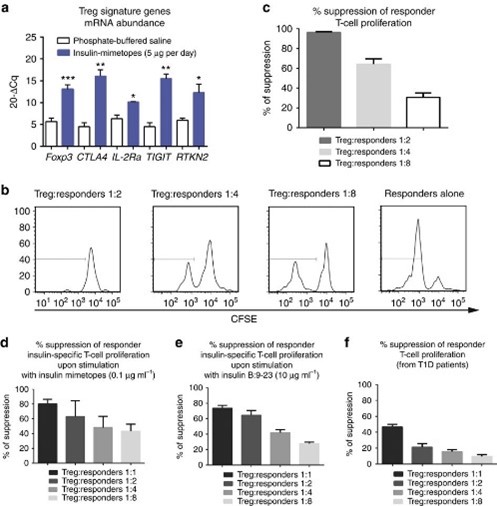
Top mimetopes (ins.mim.1+ins.mim.4) induced stable, functional Foxp3⁺ Tregs (high Foxp3/CTLA4/IL-2Ra/TIGIT) that suppressed effector T cells without triggering them. Mice had increased Treg frequencies; children with long-term autoimmunity also showed higher Treg levels, supporting these candidates for T1D prevention.

Fig.7: Results of Treg signatures and suppressive potential in humanized nsg-hla-dq8 transgenic mice.

Treg Signatures and Suppressive Potential in Humanized NSG-HLA-DQ8 Transgenic Mice.
Serr, Isabelle, et al. "Type 1 diabetes vaccine candidates promote human Foxp3+ Treg induction in humanized mice." Nature communications 7.1 (2016): 10991. Distributed under Open Access license CC BY 4.0, without modification. https://doi.org/10.1038/ncomms10991.

Customer Reviews

"The Creative Biolabs team demonstrated exceptional professionalism in our T1DM peptide vaccine project. They successfully designed a highly effective tolerogenic peptide and significantly suppressed insulitis in the mouse model. Their attention to detail was key to the project's success."

- Prof. Smith

Institute of Immunology

"We are highly satisfied with the autoimmune disease vaccine delivery system optimization services provided by Creative Biolabs. Their nanoparticle platform helped us resolve the stability issues of our antigen in vivo, greatly enhancing the vaccine's bioavailability."

- Dr. Vance

R&D Director

"Their SLE vaccine design service was outstanding. During the target screening phase, they utilized bioinformatic tools to precisely identify novel autoantigen epitopes, laying a solid foundation for our subsequent development."

- Researcher Tanaka

Autoimmunity Project

Frequently Asked Questions

Q1: What types of autoimmune disease vaccines does Creative Biolabs design?

A: Our services cover various vaccine types, including peptide vaccines, recombinant protein vaccines, DNA/mRNA vaccines, viral vector vaccines, and cell-based (e.g., engineered DC) tolerogenic vaccines. We select the best type based on the disease mechanism and client needs.

Q2: How do you ensure the induction of immune tolerance rather than an inflammatory response in vaccine design?

A: We ensure tolerance induction by carefully selecting non-inflammatory or tolerogenic adjuvants, optimizing antigen presentation methods (such as targeting apoptotic cells or using nanoparticles), and designing modified autoantigenic peptides to specifically deviate the immune response and promote Treg cell differentiation.

Q3: Which animal models do you use for preclinical validation in autoimmune disease vaccine projects?

A: We provide various classical models, including the EAE (Experimental Autoimmune Encephalomyelitis) model for MS, the CIA (Collagen-Induced Arthritis) model for RA, and the NOD mouse model for T1DM, to assess vaccine efficacy and safety.

Q4: How long does an autoimmune disease vaccine project typically take to complete?

A: The project timeline depends on the specific scope of work. A complete project, from target design to preclinical proof of concept, usually requires 8 to 15 months. The detailed schedule will be determined during the project kick-off meeting.

Q5: How do you handle autoantigens with high homology to normal self-tissues?

A: For autoantigens with high homology to normal self-tissue, we utilize the AI platform for epitope switching or de-immunization design. This allows us to retain the tolerance-inducing capacity while mitigating the potential inflammatory risk.

Start Your Autoimmune Disease Vaccine Innovation Journey

Are you seeking a breakthrough therapeutic solution for autoimmune diseases? Creative Biolabs is your most trusted partner, backed by leading vaccine design technology, profound immunological expertise, and rigorous quality control systems.

Contact Us
Online Inquiry

All of our products can only be used for research purposes. These vaccine ingredients CANNOT be used directly on humans or animals.

Name:
Phone:
*E-mail Address:
*Products or Services Interested:
Project Description:

This site is protected by reCAPTCHA and the Google Privacy Policy and Terms of Service apply.