Creative Biolabs has a tradition of commitment. To achieve efficient execution and regulatory approval, we offer careful considerations of your program for the development of a cellular or gene therapy product – now and in the future.
EXPLORE MORE HighlightsWe focus on unmet needs and develop novel cellular and gene drugs and solutions that offer significant benefits over existing options.
EXPLORE MORE HighlightsThe advent of Chimeric Antigen Receptor T-cell (CAR-T) therapies has revolutionized the field of oncology, providing new avenues for treating various forms of cancer. Our 20 years of experience in the biotechnology sector have equipped us with the expertise and technological capabilities to support the entire lifecycle of CAR-T products, from early development to commercialization.
EXPLORE MORETo accelerate advanced breakthroughs of your projects, we offer broad range of platforms which enable our clients be free to tackle problems with cutting-edge technologies from different angles and in different methods.
EXPLORE MORE HighlightsUse the resources in our library to help you understand your options and make critical decisions for your study. We offer oncolytic virus, CAR-T, and dendritic cell related documents, as well as newsletter. If you don't find the answers you're looking for, contact us for additional assistance.
EXPLORE MORE HighlightsGet a real taste and understanding of the business and culture of one of the world's great research-based cellular and gene therapy discovery and development companies.
EXPLORE MORE
CAR-T cell therapy has made great achievements in the past decade, while conventional CAR-T cell therapy also has some obstacles to overcome, such as the CRS and ICANS toxicity, and the expensive and complex manufacturing process. The in-vivo CAR-T cell engineering by nanoparticles carrying CAR genes and gene-editing tools has shown potential breakthroughs in overcoming the above obstacles of traditional CAR-T cell therapies. Therefore, there is more urgent to develop safe and simple in-vivo CAR-T cell engineering solutions.
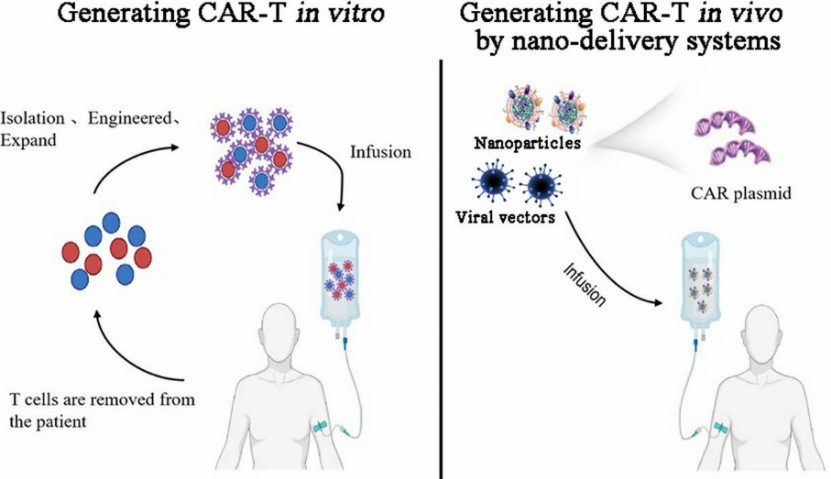 Fig.1 Comparison of generating CAR-T in-vitro and CAR-T in-vivo. (Xin, et al., 2022)
To overcome the limitations of current CAR-T therapy, Creative Biolabs has developed one-stop in vivo CAR-T cell engineering services to support global customers. Our in vivo CAR-T cell engineering carries engineered CAR genes through delivery systems (such as non-viral or viral systems) characterized by multiple functions to overcome the obstacles of current CAR-T, such as CRS & ICANS toxicities, immunosuppressive microenvironments, and complex manufacturing processes.
The delivery system is a critical determinant of targeted and efficient in vivo T cell transduction, directly enhancing both the generation and antitumor efficacy of CAR-T cells. To address varied therapeutic demands, our Comprehensive In vivo CAR-T Development Solutions provide two complementary engineering platforms, non-viral and viral-based services. Each approach supports streamlined manufacturing and enables effective, direct in vivo production of functional CAR-T cells.
This service focuses on non-viral vector-based approaches for directly engineering CAR-T cells within the body. These services enable targeted delivery of CAR transgenes using advanced non-viral platforms such as lipid nanoparticles (LNPs) or polymer-based carriers, eliminating the need for ex vivo manipulation.
Achieve transient, high-efficiency CAR expression directly in vivo using optimized lipid nanoparticles for safe and scalable T cell programming.
Learn More →Leverage circular RNA's inherent stability for sustained CAR production within the body, enabling prolonged antitumor activity without genomic integration.
Learn More →Utilize self-amplifying RNA to drive robust and durable CAR expression from a single low-dose administration, enhancing therapeutic potency.
Learn More →Employ DNA-encapsulated LNPs for more stable and prolonged CAR transgene expression, supporting durable in vivo T cell engineering.
Learn More →Apply biodegradable PBAE nanocomplexes for targeted and efficient T-cell transfection, combining low cytotoxicity with high in vivo delivery performance.
Learn More →Deploy clinically validated LNP platforms to selectively deliver CAR-encoding nucleic acids into T cells, accelerating translation from bench to bedside.
Learn More →Design custom synthetic nanocarriers for controlled and tissue-specific CAR-T cell generation, offering flexibility across diverse therapeutic applications.
Learn More →Utilize engineered delivery vesicles to achieve precise CAR knock-in at desired genomic loci, enabling stable and durable in vivo CAR-T cell formation.
Learn More →Utilize fusion nanovesicles to efficiently co-deliver CAR constructs and functional proteins directly into T cells, enabling rapid and multifunctional in vivo engineering.
Learn More →This service highlights the use of viral vectors,such as lentiviral or adeno-associated viral (AAV) systems, for direct in vivo CAR-T cell generation. The platform supports efficient, stable CAR gene integration into T cells through systemic or localized vector administration, leveraging natural viral transduction mechanisms.
Leverage the favorable safety profile and tissue tropism of AAV vectors for targeted, non-integrating CAR delivery to T cells in vivo, supporting controlled and durable therapeutic expression.
Learn More →Utilize lentiviral vectors for efficient, stable CAR gene integration into dividing and non-dividing T cells, enabling sustained in vivo CAR-T cell persistence and long-term antitumor activity.
Learn More →This service utilizes a dual-vector platform combining EDV and AAV technologies to achieve precise, site-specific CAR transgene integration into T cell genomes directly in vivo. By separating delivery and editing components, this approach enables targeted CAR insertion at desired genomic loci, minimizing off-target risks while ensuring stable and durable CAR expression.
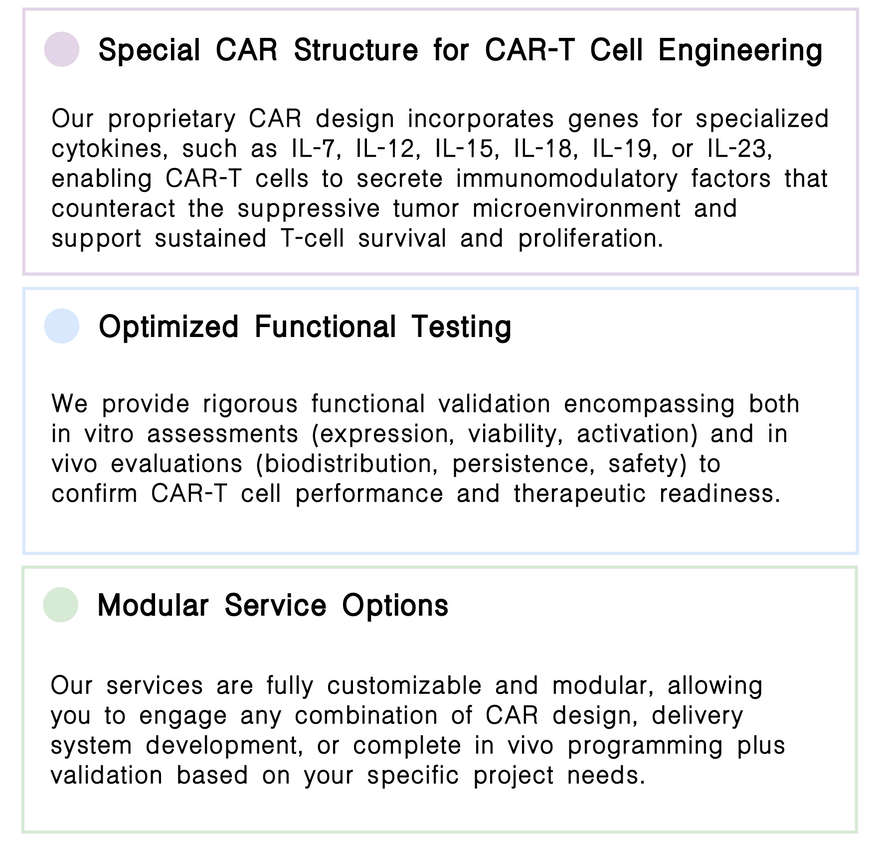
Our platform delivers an integrated suite of capabilities designed to accelerate your program from concept to validation. We offer rigorous functional testing, fully modular service options, and proprietary CAR architectures engineered to overcome immunosuppressive barriers.
Discover How We Can Help - Request a Consultation
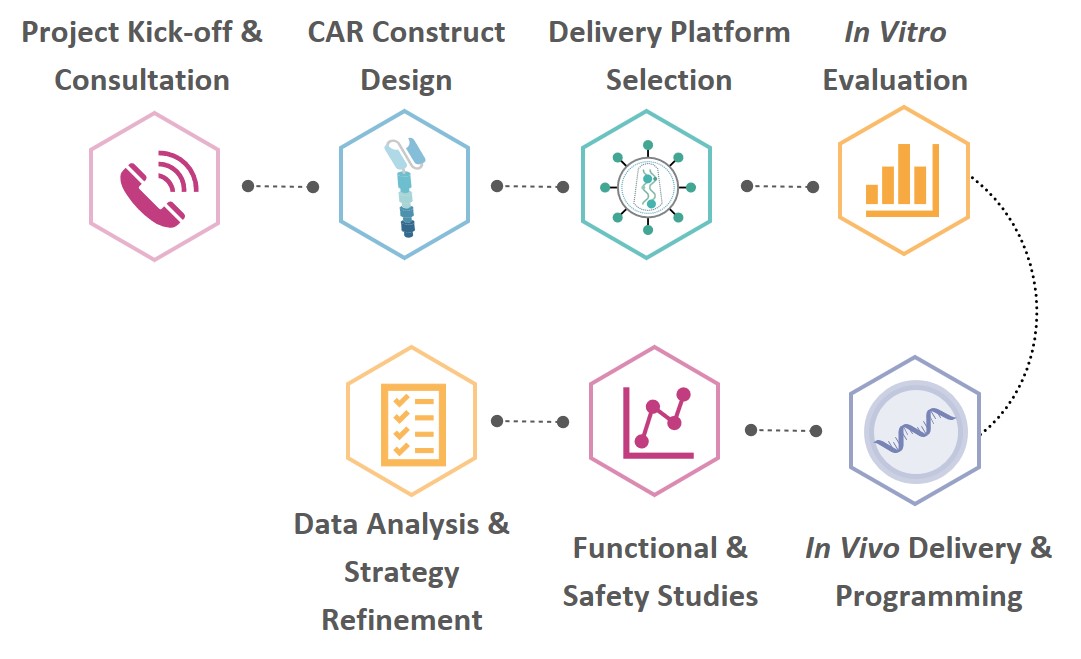
We follow a structured and comprehensive workflow to guide your in vivo CAR‑T project from initial concept to functional validation, ensuring clarity, efficiency, and reliable results at every step.
Paper title: Preclinical proof of concept for VivoVec, a lentiviral-based platform for in vivo CAR T-cell engineering
Summary: Researchers established a lentiviral vector-based platform for in vivo CAR-T cell engineering: UB-VV100. Which encodes a 2nd CD19-targeted CAR displayed an anti-CD3 scFv on the surface with a rapamycin-activated cytokine receptor (RACR) system additionally designed for the treatment of B-cell malignancies. The study found that this strategy produced functional CAR-T cells with favorable biodistribution characteristics in vivo.
Technology: lentiviral-based CD19 CAR vector for in vivo CAR T-cell engineering;
Tumor Type: B-cell malignancy;
Whether your project is preclinical research or translational development, our modular services can adapt to your needs.
We support in-depth functional and safety testing in physiologically relevant models, giving you confidence in the performance of your in vivo engineered CAR-T cells.
We work closely with clients, providing strategic input, data-driven insights, and continuous communication throughout the project lifecycle.
For in vivo CAR-T engineering development, which stage is more challenging and important in the development?
In the development, CAR design & construction, the selection of a modified delivery system seems to be critical to the overall development, optimized CAR construction and the modified delivery system could achieve specific and efficient in vivo T cell transduction, greatly enhancing the in vivo CAR-T generation and anti-tumor activity. Based on these factors, we offer several choices for our customers, such as surface-engineered vectors, and modified mRNA delivery systems.
If you are interested in our CellRapeutics™ in vivo CAR-T cell engineering services, please feel free to contact us to learn more.
With extensive experience in in vivo CAR‑T engineering, we provide modular, flexible solutions covering CAR design, delivery optimization, and functional validation. Our platform ensures efficiency, safety, and robust performance evaluation, supporting both preclinical and translational research. Partner with us to accelerate your project. Contact our team today to discuss your in vivo CAR‑T needs and explore tailored solutions.
References
For any technical issues or product/service related questions, please leave your information below. Our team will contact you soon.
All products and services are For Research Use Only and CANNOT be used in the treatment or diagnosis of disease.
 NEWSLETTER
The latest newsletter to introduce the latest breaking information, our site updates, field and other scientific news, important events, and insights from industry leaders
LEARN MORE NEWSLETTER NEW SOLUTION
CellRapeutics™ In Vivo Cell Engineering: One-stop in vivo T/B/NK cell and macrophage engineering services covering vectors construction to function verification.
LEARN MORE SOLUTION NOVEL TECHNOLOGY
Silence™ CAR-T Cell: A novel platform to enhance CAR-T cell immunotherapy by combining RNAi technology to suppress genes that may impede CAR functionality.
LEARN MORE NOVEL TECHNOLOGY NEW SOLUTION
Canine CAR-T Therapy Development: From early target discovery, CAR design and construction, cell culture, and transfection, to in vitro and in vivo function validation.
LEARN MORE SOLUTION