We provide rigorous quantitative assessments across a broad spectrum of cell lines and clinical tissues, utilizing validated Western Blotting (WB), high-sensitivity ELISA, and multiplexed IHC to determine absolute protein levels.
As a premier global CRO, Creative Biolabs leverages years of expertise to provide comprehensive AMOT analysis through our high-throughput singleplex biomarker platform. Our services offer versatile strategic options, helping clients navigate the complexities of cardiovascular and oncological research with standardized profiling, competitive pricing, and industry-leading turnaround times.
Introduction of AMOT
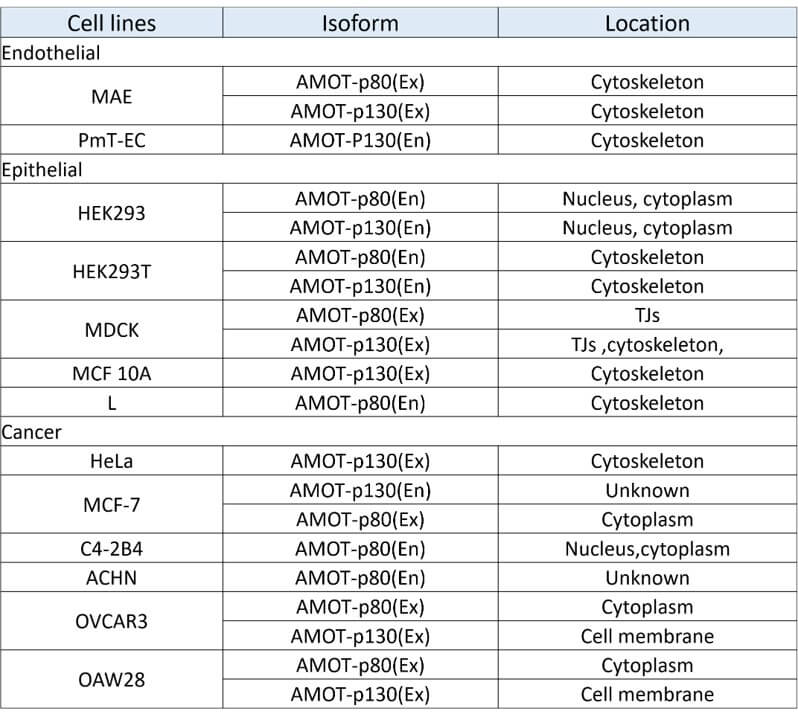
Angiomotin (AMOT) is a critical transmembrane scaffold protein frequently dysregulated across diverse solid tumors. Characterized by alternative splicing, it primarily manifests as two functional isoforms: the 130 kDa (p130) variant, which contains an extended N-terminal domain for F-actin binding, and the 80 kDa (p80) variant.
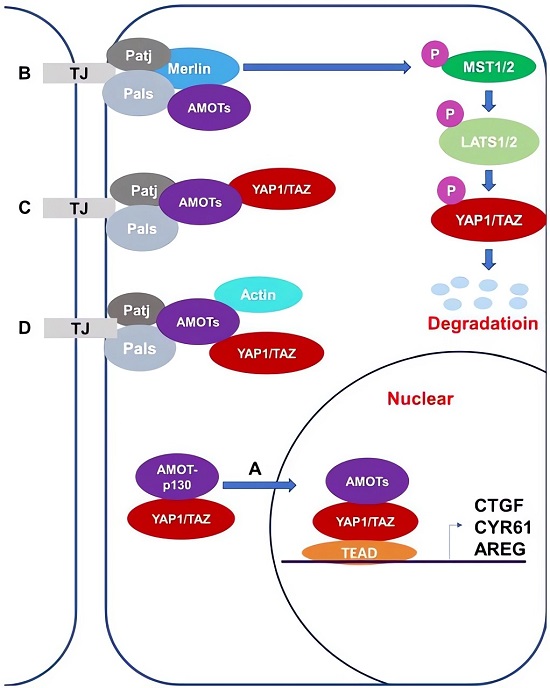 Fig.1 Models of AMOTs interplayed with the Hippo-YAP1 cascade.1
Beyond its structural role in maintaining tight junction integrity, AMOT is a master regulator of the Hippo signaling pathway, influencing the nuclear translocation of YAP/TAZ. Growing evidence confirms that AMOT dictates pathological trajectories in tumor proliferation, apoptosis evasion, and invasive angiogenesis, making its precise quantification essential for prognostic and therapeutic development.
Table.1 The expression and location of AMOT isoforms.
AMOT Analysis Services at Creative Biolabs
Creative Biolabs provides an elite suite of custom biomarker solutions designed to decode the functional state of AMOT within complex biological systems. Utilizing our proprietary isoform-specific antibodies, we distinguish between p130 and p80 expressions to provide a granular view of cellular signaling. Our platform integrates advanced proteomics and PTM analysis to monitor protein abundance changes relative to disease progression. Our core services include:
AMOT Expression Profiling
AMOT-TNKS Interaction Analysis
Our experts investigate the biochemical interplay between AMOT and Tankyrase (TNKS) to elucidate complex Wnt/Hippo signaling crosstalk and identify potential regulatory disruption nodes.
AMOT-AMOTL1 Interaction Analysis
We offer detailed mapping of homotypic and heterotypic protein associations that are fundamental to stabilizing apical-basal polarity and maintaining cellular junctional integrity during oncogenic stress.
Cell Cycle Analysis
Utilizing multi-parameter flow cytometry, we evaluate the direct impact of AMOT dysregulation on aberrant mitosis, providing insights into how these scaffold proteins influence genomic stability.
AMOT Isoform Identification
Our platform ensures the precise differentiation and characterization of splicing variants, such as the p130 and p80 isoforms, within highly heterogeneous tumor microenvironments.
Lateral Flow Assay (LFA) Development
We specialize in engineering rapid, reliable diagnostic tools tailored for clinical biomarker monitoring, facilitating the transition of AMOT research from the laboratory to point-of-care applications.
Service Workflow
Our workflow is designed for maximum transparency and scientific rigor:
01Initial Consultation
Our Ph.D. scientists discuss your specific research goals, target isoforms, and desired sensitivity levels.
02Material Submission
Clients provide starting materials, which may include frozen tissue biopsies, cell pellets, or purified serum/plasma samples.
03Sample Processing
We perform optimized lysis and fractionation, ensuring the preservation of transient protein-protein interactions.
04Assay Execution
Depending on the strategy, samples undergo high-resolution imaging (IF/ICC), quantitative immunoassays, or interaction mapping via Co-IP.
05Data Analysis
Raw data is processed using advanced bioinformatics to correlate AMOT levels with phenotypic outcomes.
06Final Delivery
You receive a comprehensive report containing high-resolution blots/images, raw data spreadsheets, and a professional interpretation of the findings.
Applications
Oncology Drug Discovery & Target Validation
AMOT serves as a critical target for small molecules and monoclonal antibodies aiming to disrupt YAP-driven tumor growth. Our analysis identifies lead compounds that successfully inhibit transcriptional activity by sequestering YAP in the cytoplasm or preventing its nuclear translocation.
Vascular Biology & Pathological Angiogenesis
Researchers utilize precise AMOT profiling to study endothelial cell migration, polarization, and capillary tube formation. These insights are essential for developing next-generation anti-angiogenic therapies for conditions like age-related macular degeneration and hyper-vascularized solid tumors.
Precision Diagnostic Biomarker Development
Quantitative AMOT levels in liquid biopsies, including circulating tumor cells and exosomes, are being rigorously explored as high-fidelity prognostic indicators for metastatic potential and disease recurrence in breast, prostate, and hepatic carcinomas.
Hippo pathway Mechanotransduction Mapping
Comprehensive AMOT analysis provides a robust read-out for Hippo pathway activity. We help researchers decode the complex mechanotransduction signals that regulate organ size, tissue regeneration, and the bypass of contact inhibition in cancer models.
Service Highlights
- Absolute Isoform Specificity: Our platform uses antibodies targeting the unique N-terminal of p130, eliminating "masking" effects in generic assays and ensuring precise differentiation from the p80 variant.
- High-Throughput Standardization: We leverage automated liquid handling and digital imaging to ensure consistency across large-scale longitudinal studies while minimizing inter-assay variability.
- Rigorous Quality Control: Projects undergo multi-tier verification, including signal-to-noise optimization and control validation, meeting strict certification standards for every data point.
- Specialized Interactome Expertise: We perform deep-dive interactome analysis using proprietary buffers to preserve delicate, transient associations between AMOT and partners like YAP, TNKS, and Merlin.
FAQs
-
Q: Can your platform distinguish between the p130 and p80 isoforms in a single tissue sample?
A: Yes. We utilize multiplexed immunofluorescence and isoform-specific Western blotting. By targeting the unique N-terminal domain present only in the p130 variant, we can provide precise quantification of each isoform's relative abundance within the same lysate or tissue section.
-
Q: What is the primary challenge in maintaining AMOT-TNKS interactions during analysis?
A: These interactions are often transient and sensitive to lysis buffers. We utilize specialized cross-linking protocols and optimized mild detergents that stabilize the protein complex without disrupting the binding epitopes required for our interaction assays.
-
Q: Are your AMOT antibodies suitable for use in Flow Cytometry (FACS)?
A: Absolutely. Our benchmark mAbs are validated for intracellular staining, allowing you to correlate AMOT expression levels with specific phases of the cell cycle or surface marker expression in heterogeneous cell populations.
-
Q: Can I provide formalin-fixed paraffin-embedded (FFPE) slides for AMOT analysis?
A: We accept FFPE samples and employ advanced heat-induced epitope retrieval (HIER) techniques specifically calibrated for the AMOT transmembrane structure to ensure high-fidelity immunohistochemical staining.
-
Q: Does Creative Biolabs offer custom inhibitory mAb development for AMOT-targeted therapy research?
A: We do. We can generate and express benchmark inhibitory antibodies in mammalian cell lines, which are suitable for functional assays, affinity binding studies, and early-stage animal model development.
-
Q: Can you help with the interpretation of AMOT's role in the Hippo pathway for my specific data?
A: Our team includes Hippo pathway experts who provide a detailed discussion section in every report, correlating your AMOT data with YAP/TAZ localization and downstream gene expression profiles.
Creative Biolabs integrates advanced technology with deep biological expertise to deliver the industry's most reliable AMOT analysis. Whether you are identifying splicing variants or developing companion diagnostics, we provide the high-resolution data essential for your success. Contact us today to develop a custom solution tailored to your research needs and accelerate your journey toward therapeutic breakthroughs.
Reference
- Huang, Tingting, et al. "The physiological role of Motin family and its dysregulation in tumorigenesis." Journal of translational medicine 16.1 (2018): 98. Distributed under Open Access license CC BY 4.0, without modification. https://doi.org/10.1186/s12967-018-1466-y.
For Research Use Only.