ADNP analysis is key to identifying and validating drug targets that modulate the ADNP-Tau axis. Understanding how specific mutations affect microtubule dynamics allows researchers to test small molecule induction strategies aimed at restoring ADNP function or expression.
Creative Biolabs provides comprehensive ADNP analysis services, helping customers navigate the complexities of activity-dependent neuroprotector protein (ADNP) dysfunction. We deliver high-resolution, multi-omic analysis to accelerate neurotherapeutic and oncology biomarker research.
Introduction of ADNP
ADNP is a highly conserved, vertebrate-specific 124 kDa protein encoded on human chromosome 20q12-13.2. It is essential for brain formation, cognition, and motor function. Functionally, ADNP is a vital component of the ChAHP chromatin remodeling complex in the nucleus, controlling the transcription and splicing of thousands of developmental genes. In the cytoplasm, it directly correlates with Tau, stabilizing microtubules and offering critical neuroprotection against tauopathy.
De novo truncating mutations in ADNP cause ADNP syndrome (Helsmoortel-Van der Aa syndrome), a significant single-gene cause of ASD characterized by severe intellectual and motor deficits. Latest research also positions ADNP as a critical tumor suppressor, linking its silencing to increased colon cancer proliferation. Diagnosis is often achieved via WES or multigene panels. Serum ADNP protein levels analyzed by ELISA serve as valuable biomarkers for intelligence and cortical amyloid burden in the elderly.
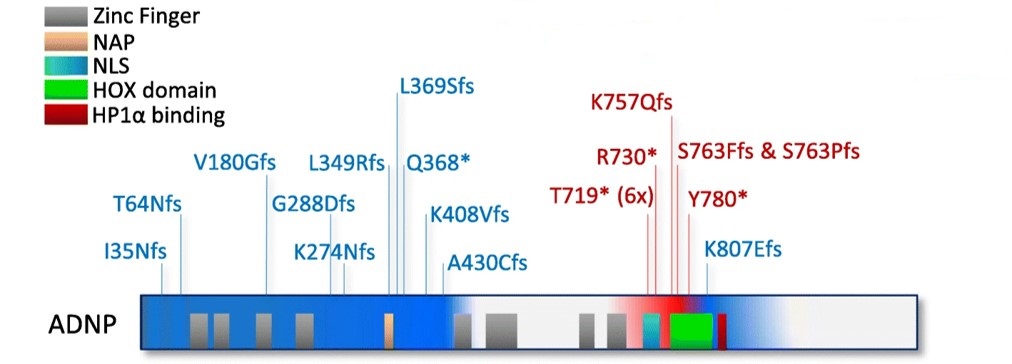 Fig.1 Diagrammatic overview of mutations spanning the ADNP protein.1
ADNP Analysis Services at Creative Biolabs
Creative Biolabs offers an integrated, multi-platform approach to comprehensively study ADNP from the genetic level to functional protein interactions. We move beyond simple screening to explore the direct molecular consequences of ADNP mutations, which is crucial for lead validation and defining disease prognosis. Our services include construction and testing of ADNP mutant proteins and the development of custom anti-ADNP antibodies validated for various applications (WB, ICC, IP). We also specialize in ADNP analysis, including but not limited to the following:
- Whole-Exome Sequencing (WES)
High-resolution identification of de novo and inherited mutations across the full coding sequence.
- Transcriptomics (qRT-PCR, RNA-seq)
Quantifying ADNP mRNA levels and defining deregulation signatures relevant to neurodevelopment.
- Functional Proteomics (ELISA, WB, IP)
Analyzing protein levels, truncation, and complex formation with key binding partners (ADNP-Tau, ADNP-SIRT1) for functional impact.
- In Situ Analysis (IHC, ICC)
Determining subcellular localization and expression in tissue/cell models with high spatial resolution.
- Epigenetic Analysis (DNA Methylation)
Mapping ADNP-specific CpG episignatures, which are crucial for diagnostic confirmation.
- In Vivo Model Testing
Comparison and validation of different ADNP mutants in relevant animal models.
Service Workflow
Our ADNP Analysis workflow follows a rigorous process designed to ensure precision and clarity from project inception to final data delivery:
01Initial Scientific Consultation
Our experts collaborate with the client to define the specific research question and therapeutic goal, establishing the optimal, tailored analysis strategy (e.g., selection between WES or RNA-seq).
02Starting Material Submission
The client securely provides the necessary biological samples, which typically include high-quality DNA, RNA, protein samples, or patient-derived hiPSCs for functional modeling.
03Assay Execution and Core Analysis
This phase involves the sequential, multi-omic processing of materials, including initial mutation identification, subsequent transcriptomic analysis, and culminating in functional protein characterization or ADNP mutant construction.
04Comprehensive Data Reporting
The final output is a detailed report, which includes all raw data, validated analytical insights, and specific, actionable therapeutic recommendations for advancing research on the ADNP pathway.
Applications
Target Identification for Neurotherapeutics
Defining Disease Mechanisms in ADNP Syndrome
We utilize multi-omic data (genomics, proteomics, methylation) to delineate the molecular pathogenesis of Helsmoortel-Van der Aa syndrome. This includes identifying novel protein complexes (ADNP-SIRT1) or impaired pathways (autophagy, mitochondrial stress) that serve as intervention points.
Oncology and Prognostic Marker Discovery
Given ADNP's role as a tumor suppressor, our analysis helps characterize ADNP heterogeneity and loss-of-function variants in cancer (e.g., colorectal cancer). This is essential for determining prognosis and stratifying patients for targeted anti-cancer therapies based on ADNP status.
Translational Biomarker Validation
Analysis of serum ADNP levels and specific DNA methylation episignatures enables the validation of non-invasive biomarkers, crucial for monitoring disease progression, assessing drug efficacy, and optimizing clinical trial design for ADNP-related disorders.
Service Highlights
- Multi-Omic Integration: Our platform systematically combines genomic, transcriptomic, and proteomic data, ensuring a holistic understanding of ADNP pathology from DNA mutation to functional protein impairment.
- Specialized Mutant Construction: We offer tailored services for synthesizing and functionally testing specific ADNP mutant proteins, providing essential tools for mechanistic studies and drug screening validation.
- Advanced In Situ Profiling: We apply cutting-edge IHC and ICC techniques to precisely map ADNP localization and protein interaction partners within patient-derived cells and tissue models.
- Translational Relevance: Our analytical focus is constantly guided by the therapeutic landscape, directly linking biomarker discovery (e.g., ADNP serum levels, episignatures) to viable clinical endpoints for ASD and AD.
FAQs
-
Which starting material is typically required for the most comprehensive ADNP functional analysis offered by your service?
The most comprehensive ADNP functional analysis typically requires patient-derived hiPSCs or high-quality DNA and RNA extracted from primary cells. Utilizing hiPSCs allows us to perform transcriptomic and proteomic assays in a relevant neurological background, accurately modeling the cellular effects of ADNP de novo mutations. We can effectively generate highly relevant models from these sophisticated starting materials.
-
How can ADNP syndrome be accurately diagnosed beyond standard molecular genetic testing like WES?
Diagnosis of ADNP syndrome can be significantly enhanced by the analysis of ADNP-specific DNA methylation episignatures, offering high sensitivity and specificity. These unique CpG methylation patterns, which are distinct for different mutation classes, act as stable biomarkers in peripheral cells. Analyzing the episignatures assists in the genetic variant classification and confirms pathogenicity when standard WES results are equivocal.
-
What advanced proteomic techniques are used to characterize ADNP's complex formation with other relevant cellular proteins?
We employ techniques such as co-immunoprecipitation (Co-IP) combined with mass spectrometry (MS) to meticulously map ADNP's protein-protein interaction network. This sophisticated approach is essential for identifying novel partnerships, such as the ADNP-SIRT1 complex, which links chromatin remodeling to mitochondrial energy metabolism. Understanding these complexes provides clear mechanistic targets for novel therapeutic intervention strategies.
-
In the context of ADNP analysis for cancer, what kind of specific data can be provided to guide personalized oncology treatment?
The ADNP analysis provides crucial data on tumor heterogeneity by identifying the position and frequency of ADNP mutations in the sample. This analysis is important because ADNP mutations can occur during tumor progression, affecting clinical outcome and prognosis. This specific data guides personalized oncology treatment and identifies patients who might benefit from ADNP-related therapeutic induction.
-
Can the ADNP analysis be used to stratify patients for clinical trials, particularly for neurodevelopmental disorders like ASD?
Yes, ADNP analysis is a powerful tool for patient stratification in clinical trials, especially for ASD and ADNP syndrome. Providing WES data identifies the specific de novo mutations and their resulting functional classifications, allowing for homogeneous patient cohort creation. Stratification is crucial for trials testing targeted therapies, like NAP, ensuring that the drug is evaluated in the most relevant and responsive patient population based on their molecular profile.
If you are interested in our services at Creative Biolabs, please contact us for more information.
Reference
- Bend, Eric G., et al. "Gene domain-specific DNA methylation episignatures highlight distinct molecular entities of ADNP syndrome." Clinical epigenetics 11.1 (2019): 64. Distributed under Open Access license CC BY 4.0. The image was modified by extracting and using only part of the original image. https://doi.org/10.1186/s13148-019-0658-5
For Research Use Only.