A2M analysis is key in identifying novel diagnostic and prognostic markers for early OA progression and assessing therapeutic efficacy in joint health interventions. Its role in cartilage protection makes it a prime candidate.
At Creative Biolabs, our expert team and cutting-edge platform provide comprehensive A2M analysis services, offering a variety of strategic options to precisely quantify and characterize this critical biomarker, propelling your research forward with unparalleled accuracy and efficiency.
Introduction of A2M
Alpha-2 macroglobulin (A2M) is a remarkably large (approx.720 kDa) plasma glycoprotein, primarily synthesized by the liver. It's a tetramer, composed of four identical (180 kDa) subunits linked by two disulfide bond-formed dimers. A2M possesses a unique "trap" mechanism, enabling it to bind to and neutralize a vast array of proteases, growth factors, cytokines, and hormones. This versatility positions A2M as a crucial protein inhibitor involved in a variety of fundamental biological functions, including intricate processes like coagulation and fibrinolysis. In humans, altered blood levels of A2M have been consistently associated with conditions such as nephrotic syndrome and neurodegenerative disorders like Alzheimer's disease. Furthermore, in rodent models, A2M has been shown to modulate critical cellular behaviors, including tumor cell adhesion, migration, and growth, often through its inhibitory effects on pathways like PI3K/Akt and SMAD.
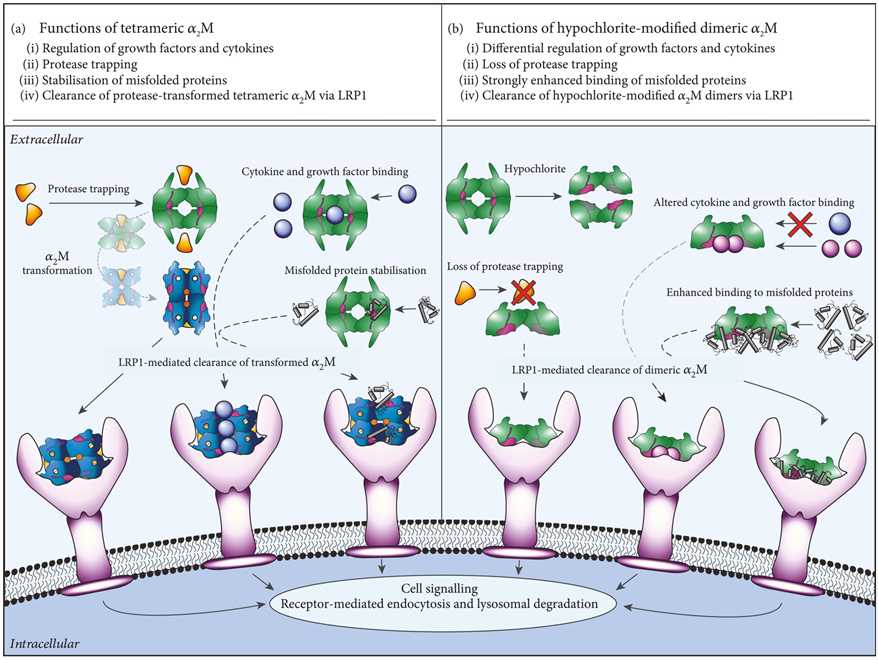 Fig.1 Function of A2M and hypochlorite-modified dimeric A2M.1
A2M Analysis Services at Creative Biolabs
Creative Biolabs offers a suite of specialized A2M analysis services tailored to meet the diverse needs of preclinical and clinical research. Our offerings extend beyond simple concentration measurements, encompassing highly sensitive quantitative assays, functional activity assessments, and advanced conformational analyses. We are equipped to process a wide range of biological samples, providing you with detailed insights into A2M's levels, integrity, and functional capabilities.
- A2M-Sandwich ELISA
This custom A2M sandwich ELISA assay is suitable for measuring natural and recombinant human A2M. Optimized capture and detection antibody pairs with recommended concentrations are provided to save lengthy development time.
- A2M-Nephelometry
In this method, the light scattered onto the A2M antigen-antibody complexes is measured. The intensity of the measured scattered light is proportional to the amount of A2M antigen-antibody complexes in the sample under certain conditions. The distribution of intensity of the scattered light depends on the ratio of the particle size of the antigen-antibody complexes to the radiated wavelength. If the antibody volume is kept constant, the signal behaves proportionally to the antigen volume. The turbidity induced by the formation of the A2M antigen-antibody immune complex is measured at 340 nm and 700 nm.
- A2M-ImmunoPCR
ImmunoPCR is a promising assay that combines the specificity and ease of use of an ELISA with the sensitivity of real-time PCR (RT-PCR). A2M-ImmunoPCR is a modified ELISA assay with high sensitivity qPCR readout for the quantitative measurement of A2M in plasma, serum, and cell culture supernatants. This assay employs an antibody specific for human A2M coated on a 96-well PCR plate. Standards and samples are pipetted into the wells and A2M present in a sample is bound to the wells by the immobilized antibody. The wells are washed and a detection affinity molecule is added to the plates. After washing away the unbound detection affinity molecule, primers and a PCR master mix are added to the wells, and data is collected using qPCR. CT values obtained from the qPCR are then used to calculate the amount of antigen contained in each sample, where lower CT values indicate a higher concentration of the antigen.
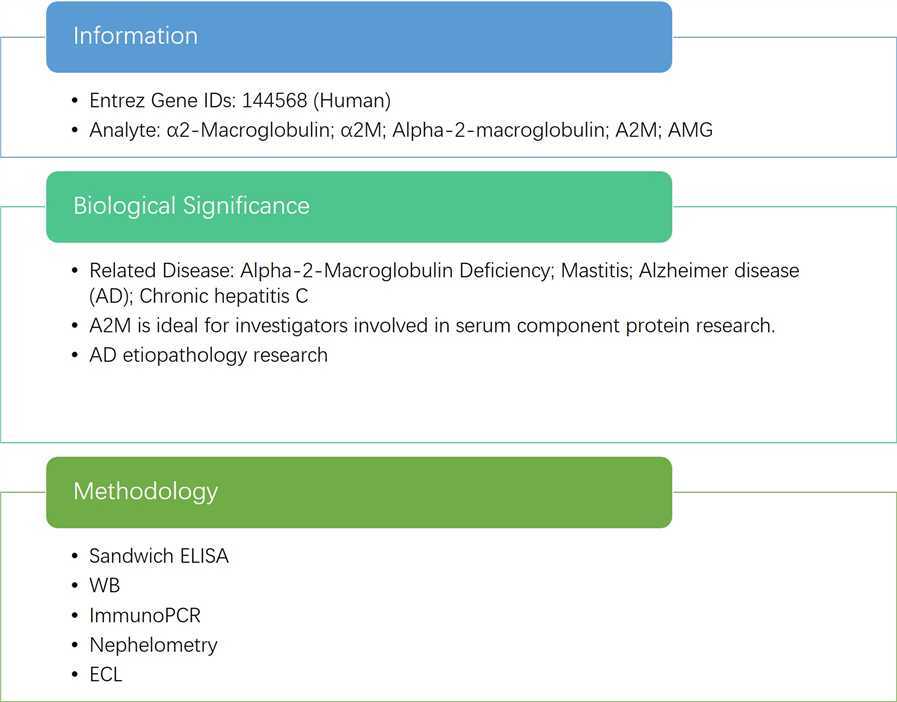 Fig.2 A2M analysis summary.
Service Workflow
Our A2M analysis service is meticulously structured to ensure a seamless and efficient research partnership, from initial inquiry to final data delivery:
01Initial Consultation
Your journey begins with a detailed discussion with our scientific experts. We collaborate closely to thoroughly understand your specific research objectives, the nature of your sample types, and the desired depth of A2M analysis. This ensures a truly customized and effective approach for your project.
02Starting Materials Submission
Following the consultation, you securely provide your biological samples to our facility. This submission is accompanied by all relevant sample information and any necessary regulatory documentation, ensuring proper handling and tracking.
03Advanced Laboratory Processing
Upon receipt, our skilled technicians meticulously process your samples using optimized, rigorously controlled protocols. We then proceed with the selected A2M analysis assays, employing our state-of-the-art platforms for quantitative profiling, functional assessments, or advanced conformational studies.
04Data Analysis & Interpretation
Raw data generated from the assays undergo rigorous quality control checks and in-depth bioinformatics analysis. Our expert team then thoroughly interprets these results, meticulously correlating them with your original research questions to extract meaningful insights.
05Final Delivery
You receive a comprehensive, easy-to-understand report. This includes all raw data, meticulously processed results, a detailed description of the methodologies employed, and expert scientific interpretation, all designed to empower your next critical research steps.
Applications
Osteoarthritis (OA) Biomarker Discovery
Fibrosis Research and Drug Development
Measuring A2M's ability to neutralize profibrotic factors like TGF-β provides crucial insights into the mechanisms and therapeutic targeting of fibrotic diseases affecting organs such as the liver, lung, and kidney.
Neurodegenerative Disease Mechanisms
Investigating A2M levels and functional states helps elucidate its involvement in amyloid clearance and neuroprotection, offering potential avenues for understanding and treating conditions like Alzheimer's disease.
Inflammation and Immunity Studies
Analyzing changes in A2M levels and its protease-trapping efficiency provides valuable data for assessing systemic inflammatory responses and understanding immune modulation.
Oncology and Metastasis Research
Deciphering A2M's complex role in tumor progression and metastasis, including its paradoxical effects on protease activity and immune cell interactions, can reveal novel therapeutic targets.
Service Highlights
- Diverse Assay Portfolio: We offer versatile A2M assays, from sensitive quantification (e.g., ELISAs) to functional activity assessments, providing data tailored to your specific research needs.
- Customized Study Design: Each project receives a personalized approach. Our team tailors the A2M analysis strategy to your unique research hypotheses.
- Robust Quality Control: Stringent quality protocols across all A2M analysis stages guarantee high accuracy, precision, and reproducibility.
- Expert Data Interpretation: Beyond raw data, our biologists provide comprehensive interpretation, transforming A2M profiles into actionable insights for discovery and validation.
FAQs
-
What types of samples can you analyze for A2M?
We are equipped to analyze A2M across a broad spectrum of biological matrices. Our validated methodologies are suitable for common sample types, including human or animal plasma, serum, and synovial fluid. We can also accommodate more specialized samples, such as cerebrospinal fluid (CSF) or various tissue lysates, depending on your specific research requirements.
-
Can your A2M analysis distinguish between active and inactive forms of A2M?
Absolutely. A key strength of our service lies in our ability to go beyond total A2M quantification. We offer specialized functional activity assays designed to measure the active, protease-binding capacity of A2M. This distinction is crucial for understanding its true biological role, as total levels might not always reflect its functional integrity, especially in pathological states.
-
Is A2M analysis applicable to both human and animal samples?
Yes, our A2M analysis capabilities extend to both human and various animal species. We have established protocols for common preclinical models, ensuring that our services support a wide range of translational research. Our team can discuss the specific requirements for different species to ensure optimal assay performance and data relevance.
-
What is the minimum sample volume required for A2M analysis?
The minimum sample volume for A2M analysis varies depending on the specific assay chosen and the concentration of A2M expected in your samples. During your initial consultation, our experts will provide detailed guidance on the precise volume requirements for each test, helping you optimize sample collection and utilization for your study design.
-
How do you handle samples during transport and storage to maintain A2M integrity?
Maintaining sample integrity is critical for accurate A2M analysis. We provide clear guidelines for sample collection, processing, and storage conditions, including recommended anticoagulants and temperature ranges. Upon receipt, our laboratory adheres to strict protocols for sample handling, ensuring A2M stability throughout the analytical process.
-
What quality control measures are in place for your A2M assays?
Robust quality control is integral to all our A2M assays. We implement multi-level QC strategies, including comprehensive instrument calibration, internal and external control samples, and strict adherence to validated standard operating procedures. This meticulous approach guarantees the highest level of assay performance, precision, and data reliability for your research.
Our biomarker analysis service is furnished for research use only. Not for use in diagnostic procedures. If you want to order this test, please feel free to contact us for more information.
Reference
- Cater, Jordan H., Mark R. Wilson, and Amy R. Wyatt. "Alpha‐2‐macroglobulin, a hypochlorite‐regulated chaperone and immune system modulator." Oxidative medicine and cellular longevity 2019.1 (2019): 5410657. Distributed under Open Access license CC BY 4.0, without modification.
For Research Use Only.