RNASE3 analysis is instrumental in identifying and validating novel biomarkers for various inflammatory diseases, guiding the development of new diagnostic and prognostic tools.
The full promise of precision medicine hinges on advanced biomarker analysis. Creative Biolabs offers extensive services for protein biomarker quantification, characterization, and gene analysis. We're dedicated to in-depth ribonuclease 3 (RNASE3) analysis, aiming to uncover vital biomarker signatures for our clients.
Introduction of RNASE3
RNASE3, commonly known as eosinophil cationic protein (ECP), is a highly basic and potent cytotoxic single-chain zinc-containing protein prominently found within the primary matrix of eosinophil granulocytes. This remarkable molecule consists of a single polypeptide chain of 133 amino acids, with its initial 40 amino acids being crucial for its membrane-interfering, heparin-binding, and cytotoxic activities.
RNASE3, commonly known as eosinophil cationic protein (ECP), is a highly basic and potent cytotoxic single-chain zinc-containing protein prominently found within the primary matrix of eosinophil granulocytes. This remarkable molecule consists of a single polypeptide chain of 133 amino acids, with its initial 40 amino acids being crucial for its membrane-interfering, heparin-binding, and cytotoxic activities. Serum RNASE3 has been widely recognized as a pivotal marker reflecting the activation state of eosinophils in conditions like asthma, often correlating directly with the severity of airway inflammation. Furthermore, extensive studies have collectively concluded that serum RNASE3 serves as an independent and significant biomarker for various cardiovascular and pulmonary conditions, including coronary artery disease (CAD), acute exacerbation of chronic obstructive pulmonary disease (AECOPD), coronary slow flow (CSF), and Churg-Strauss syndrome (CSS).
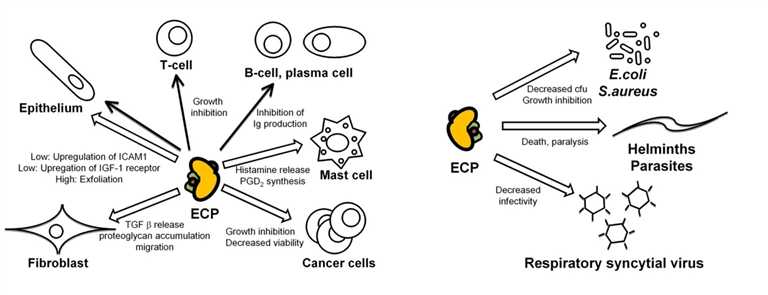 Fig.1 RNASE3's specific influences on various cell types and microorganisms in vitro. (Bystrom, 2011)
RNASE3 Analysis Services at Creative Biolabs
At Creative Biolabs, we deliver comprehensive and precise RNASE3 analysis services designed to meet your specific research and diagnostic needs. Our offerings include advanced quantification of RNASE3 protein levels, detailed characterization of its binding capacities, assessment of its functional activities, and in-depth analysis of its molecular heterogeneity. We provide a tailored approach to ensure optimal results for your unique samples and research objectives.
- RNASE3 Binding Capacity Assay
- RNASE3- Triggered Membrane Depolarization Assay
- RNASE3 Protein Quantification
- RNASE3 Heterogeneity Analysis
- Other
- Enzymatic deglycosylation of RNASE3
- Cytotoxicity assay of purified RNASE3
RNASE3 can specifically bind with high affinity to the bacteria-wall components. The binding capacity to lipopolysaccharides (LPSs), lipid A, and peptidoglycans (PGNs) could be analyzed by a fluorescent displacement assay, and the corresponding dissociation constants could be calculated using the protein labeled with a fluorophore.
The ability of RNASE3 protein to depolarize the bacteria cytoplasmic membrane provides a direct assessment of their effect at the membrane inner level.
ELISA kits are normally used to measure the concentrations of plasma RNASE3. Creative Biolabs has developed a sensitive and specific enzyme immunoassay by using our own native RNASE3 protein and high-quality antibody materials.
Due to glycosylation of the protein, the molecular mass of RNASE3 can differ between 16 and 22 kDa. RNASE3 heterogeneity could be studied using an affinity capture assay with the surface-enhanced laser desorption/ionization-time of flight mass spectrometry (SELDI-TOF MS) technique.
Service Workflow
Our RNASE3 analysis services follow a streamlined and client-focused workflow to ensure efficiency and precision:
01Initial Consultation and Project Design
Our expert team engages in a detailed discussion with you to understand your specific research goals, sample types, and desired outcomes. We collaboratively design a customized analysis plan tailored to your project.
02Client-Provided Sample Submission
You provide us with your biological samples (e.g., serum, plasma, sputum, tissue lysates). Strict guidelines are provided for sample preparation and shipment to maintain integrity.
03Sample Processing and Quality Control
Upon receipt, samples undergo rigorous quality control checks and appropriate processing steps, including purification or extraction, to prepare them for downstream analysis.
04Targeted RNASE3 Analysis
We perform the agreed-upon RNASE3 analyses, utilizing high-sensitivity ELISA for quantification, fluorescent displacement assays for binding capacity, membrane depolarization assays for functional assessment, and SELDI-TOF MS for heterogeneity analysis.
05Data Generation and Quality Assurance
Raw data is meticulously generated, processed, and subjected to stringent quality assurance protocols to ensure accuracy and reliability.
06Comprehensive Data Analysis and Reporting
Our bioinformaticians and biologists meticulously analyze the data, providing insightful interpretations and comprehensive reports that include detailed methodologies, results, and conclusions, delivered in a clear and actionable format.
Applications
Biomarker Discovery and Validation
Disease Monitoring and Progression
Accurate quantification of RNASE3 levels allows for the effective monitoring of disease activity, therapeutic response, and progression in conditions like asthma, allergic rhinitis, and autoimmune disorders.
Therapeutic Target Identification
By understanding RNASE3's functional roles, researchers can identify it as a potential therapeutic target, facilitating the development of precision interventions for eosinophil-driven inflammatory conditions.
Immune Response Characterization
RNASE3 analysis provides crucial insights into the innate immune response, helping to elucidate the mechanisms of host defense against pathogens and the dynamics of inflammation.
Service Highlights
- Highly Specific Assays: Our services utilize highly specific and validated assays that exclusively target RNASE3, minimizing cross-reactivity and ensuring precise measurements.
- Advanced Functional Insights: Beyond mere quantification, we offer functional assays to assess RNASE3's biological activity, providing a deeper understanding of its pathogenic or protective roles.
- Expert Data Interpretation: Benefit from our team's extensive experience in interpreting complex biomarker data, translating raw results into meaningful biological insights and actionable conclusions.
- Customized Solutions: Every project is unique; we provide flexible and tailored analytical solutions to perfectly align with your specific research objectives and sample requirements.
FAQs
-
How sensitive are your RNASE3 quantification methods?
We employ high-sensitivity ELISA kits for RNASE3 quantification, enabling the detection of even extremely low concentrations of the protein in biological samples, which is crucial for early disease detection and monitoring subtle changes in disease states and therapeutic responses, even at baseline levels.
-
Can your service differentiate between different forms of RNASE3?
Yes, our RNASE3 Heterogeneity Analysis, utilizing techniques like affinity capture coupled with mass spectrometry, can identify and characterize different molecular mass variants of RNASE3, often arising from varying glycosylation patterns, providing deeper insights into its biological roles and potential post-translational modifications.
-
Is your RNASE3 analysis service suitable for clinical diagnostic purposes?
Our RNASE3 analysis services are primarily designed for research use only, providing robust data for scientific investigation and biomarker discovery rather than for routine clinical diagnostic procedures, ensuring our focus remains on generating novel insights and advancing scientific understanding.
-
What quality control measures are in place for RNASE3 analysis?
We implement rigorous quality control measures throughout the entire RNASE3 analysis workflow, including internal standards, calibration curves, and replicate analyses, all designed to ensure the highest levels of accuracy and reproducibility for your critical data and reliable conclusions, meeting stringent research standards.
-
Can I customize the scope of the RNASE3 analysis for my project?
Absolutely, our services are highly customizable; you can select specific RNASE3 analysis techniques, such as quantification, functional assays, or heterogeneity analysis, based on your unique research objectives and budgetary considerations, ensuring a perfectly aligned service that maximizes your research investment.
-
How do your functional assays for RNASE3 work?
Our functional assays for RNASE3 assess its biological activity by measuring its binding capacity to microbial components like LPS and peptidoglycans using fluorescent displacement, and its ability to depolarize bacterial membranes, providing insights into its innate immune roles and potential as a novel therapeutic target in inflammatory pathways.
-
What support is available after I receive my RNASE3 analysis report?
Creative Biolabs provides dedicated post-delivery support, where our scientific team is available to answer any questions regarding your RNASE3 analysis report, discuss further experimental design, or offer additional consultations to maximize your research outcomes and ensure long-term success in your scientific endeavors.
Our biomarker analysis service is furnished for research use only. Not for use in diagnostic procedures. If you want to order custom analysis services, please feel free to contact us for more information.
Reference
- Bystrom, J. Analyzing the eosinophil cationic protein-a clue to the function of the eosinophil granulocyte. Respiratory research. 2011, 12(1): 1-20.
For Research Use Only.