The Wnt/β-catenin pathway directly upregulates ABCG2 transcription via β-catenin/TCF4 binding to its promoter. In colorectal cancer, activated Wnt signaling enhances ABCG2 expression, promoting chemoresistance. Knockdown of β-catenin reduces ABCG2 levels, sensitizing cells to therapy.
ABCG2 Overview
ABCG2 (ATP-Binding Cassette Subfamily G Member 2) is a critical transmembrane transporter encoded by the ABCG2 gene. This 72 kDa protein belongs to the ATP-binding cassette (ABC) transporter family and utilizes ATP hydrolysis to export diverse substrates, including drugs, metabolites, and toxins from cells. ABCG2 is widely expressed in tissues such as the intestine, placenta, liver, and blood-brain barrier, where it regulates drug absorption, distribution, and excretion. Its dysfunction is linked to multidrug resistance in cancer, hyperuricemia, and impaired drug efficacy. By analyzing ABCG2, researchers can unravel mechanisms of drug resistance.
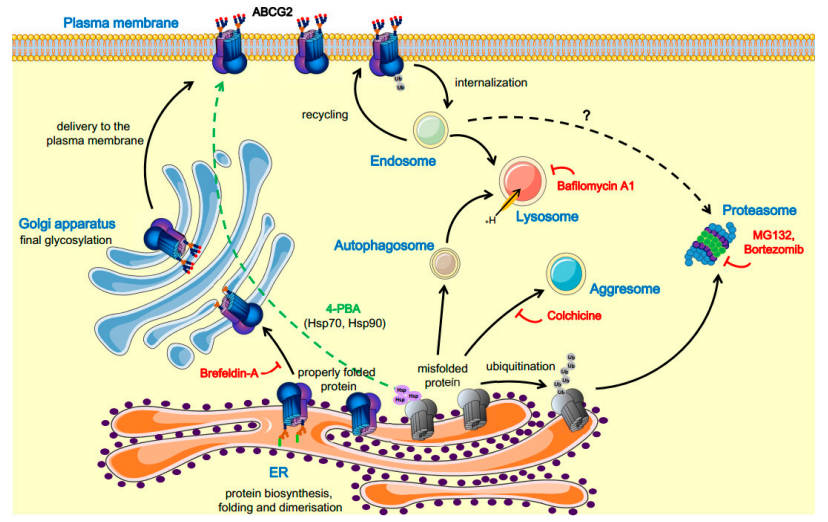 Fig.1 Schematic representation of the ABCG2 trafficking pathways and the respective modulators.1
Key Pathways and Biological Roles
Wnt/β-Catenin Pathway
PI3K/AKT/mTOR Axis
PI3K/AKT activation phosphorylates ABCG2 at Ser440, stabilizing its membrane localization and efflux activity. Inhibitors disrupt this pathway, reducing ABCG2-mediated drug resistance in breast cancer.
HIF-1α Pathway
Under hypoxia, HIF-1α accumulates and binds to hypoxia-responsive elements (HREs) in the ABCG2 promoter. This mechanism is critical in solid tumors, where ABCG2 effluxes hypoxia-activated prodrugs.
Notch Signaling
Notch intracellular domain (NICD) transactivates ABCG2 via RBP-Jκ binding to its promoter. During intestinal development, Notch-driven ABCG2 expression maintains stem cell niches.
JAK/STAT Pathway
Interferons (IFN-γ) and interleukins (IL-13) activate JAK/STAT3, which binds to the ABCG2 promoter STAT-binding sites.
Cutting-Edge Analysis Technologies
Quantitative Real-Time PCR (qRT-PCR)
qRT-PCR quantifies ABCG2 mRNA with probes, normalized to housekeeping genes. In resistant cancer cells, it detects 5-fold mRNA upregulation, identifying resistance biomarkers.
Chromatin Immunoprecipitation (ChIP)
ChIP-qPCR maps binding of β-catenin/HIF-1α to the ABCG2 promoter. In Wnt-activated cells, β-catenin enrichment at TCF4 motifs increases 4-fold, confirming transcriptional regulation.
Flow Cytometry
Flow cytometry measures ABCG2 surface expression and efflux activity.
Confocal Microscopy
Confocal imaging with ABCG2-GFP tracks plasma membrane and intracellular pools. Live-cell imaging reveals rapid ABCG2 recycling upon PI3K inhibition, confirming dynamic trafficking.
Mass Spectrometry (MS)
Label-free/TMT-based MS identifies ABCG2-binding partners. Co-IP followed by MS detects hypoxia-induced HIF-1α-ABCG2 interaction, linking environmental cues to efflux.
Western Blotting
Western blotting quantifies total ABCG2 and phospho-modifications.
Core Applications
ABCG2 in Cancer Multidrug Resistance
ABCG2, a half-transporter in the ABC superfamily, is a key driver of multidrug resistance (MDR) in cancers. Studies demonstrate that overexpression of ABCG2 in tumor cells correlates with poor prognosis in breast, lung, and prostate cancers.
Genetic Variants of ABCG2 and Gout Susceptibility
Polymorphisms in the ABCG2 gene significantly impair urate excretion, elevating serum uric acid levels and increasing gout risk. Pharmacogenomic trials are now exploring uricosuric drugs that bypass ABCG2-dependent transport, offering tailored gout management strategies.
ABCG2 as a Biomarker for Cancer Stem Cells
ABCG2 expression defines SP cells in tumors, which exhibit enhanced self-renewal and tumor-initiating capacity. Flow cytometry-based SP analysis, coupled with ABCG2 immunostaining, has identified stem-like populations in glioblastoma, leukemia, and neuroblastoma.
ABCG2 in Drug Metabolism and Pharmacokinetics
Beyond oncology, ABCG2 regulates the disposition of endogenous metabolites and xenobiotics. Its role in intestinal and hepatic efflux affects oral bioavailability and drug-drug interactions.
ABCG2 in Tissue Barriers
ABCG2 is highly expressed in the blood-brain barrier (BBB) and placenta, where it restricts fetal exposure to toxins and drugs. Animal models demonstrate that ABCG2 knockout mice accumulate neurotoxicants in the brain, leading to neurodegeneration.
FAQs
-
What is the role of ABCG2 in cancer drug resistance?
ABCG2 acts as a drug efflux pump, expelling chemotherapeutic agents from cancer cells. This mechanism reduces intracellular drug concentrations, contributing to multidrug resistance (MDR) in tumors such as breast, lung, and ovarian cancers.
-
How do ABCG2 genetic variants affect gout risk?
Polymorphisms in the ABCG2 gene, particularly Q141K, impair urate excretion by reducing transporter function. This leads to elevated serum uric acid levels, a primary cause of gout.
-
What is the link between ABCG2 and cancer stem cells?
ABCG2-expressing side population (SP) cells in tumors exhibit stem-like properties, including self-renewal and tumor-initiating capacity. These cells resist chemotherapy due to drug efflux, driving relapse. Flow cytometry and ABCG2 immunostaining identify SP cells in glioblastoma and leukemia.
-
How can ABCG2 analysis benefit personalized medicine?
ABCG2 genotyping informs risk stratification for gout, drug-induced toxicity, and cancer therapy outcomes.
Get in touch with us to discuss your tailored ABCG2 analysis plan!
Reference
- Mózner, Orsolya, et al. "Cellular processing of the ABCG2 transporter-Potential effects on gout and drug metabolism." Cells 8.10 (2019): 1215. Distributed under Open Access license CC BY 4.0, without modification. https://doi.org/10.3390/cells8101215
For Research Use Only.