TCR-controlled Fuzzy Logic CAR Construction Service
Online Inquiry
Engineering a New Epoch in Immunotherapy: TCR-controlled Fuzzy Logic CAR Construction Service
The advent of Chimeric Antigen Receptor (CAR) T-cell therapy has marked a paradigm shift in oncology, offering potent therapeutic avenues for previously intractable hematological malignancies. However, the journey towards extending this success to solid tumors and mitigating treatment-related toxicities necessitates innovations that confer greater specificity and control upon these engineered immune cells. At Creative Biolabs, we are at the forefront of this evolution, pioneering TCR-controlled fuzzy logic CAR constructs designed to endow T-cells with unprecedented decision-making capabilities, thereby enhancing their safety and efficacy.
The Rationale of TCR-controlled Fuzzy Logic CARs
Conventional CAR T-cells typically recognize a single tumor-associated antigen (TAA), which can lead to significant challenges. On-target, off-tumor toxicity arises when the TAA is also expressed on healthy tissues. Furthermore, tumor heterogeneity and antigen escape mechanisms, where cancer cells downregulate or lose the target antigen, can lead to therapeutic resistance.
Early advancements to address these limitations led to the development of logic-gated CARs, incorporating Boolean operators. While these Boolean systems, such as those explored in various next-generation CAR designs, represent a significant step forward, biological systems rarely operate in a purely binary fashion. Antigen densities vary, and the tumor microenvironment presents a complex milieu of signals. TCR-controlled fuzzy logic CARs introduce a more sophisticated regulatory layer. Fuzzy logic in CAR T-cell design moves beyond simple ON/OFF switches. It allows T-cells to:
-
Process multiple antigen inputs with varying weights or importance.
-
Respond to graded levels of antigen expression rather than just presence or absence.
-
Execute nuanced effector functions tailored to the specific antigenic signature of a target cell.
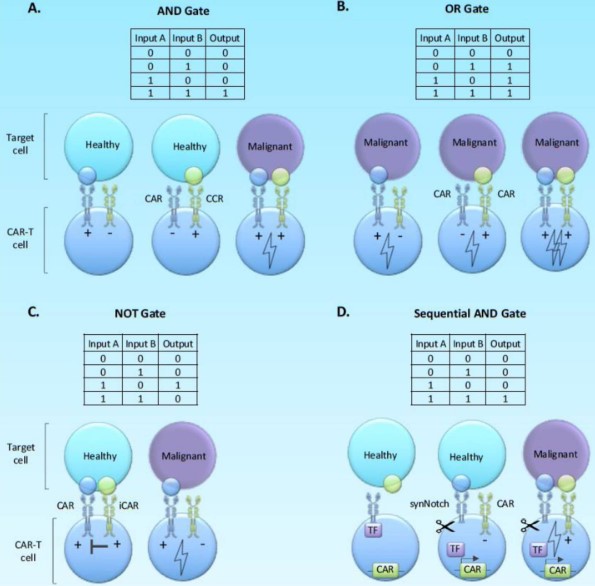 Fig.1 Schematic Diagram of Boolean logic gate CAR.1
TCR-Controlled Fuzzy Logic CAR Construction Service at Creative Biolabs
Crucially, our approach integrates the T-Cell Receptor (TCR) into the decision-making process. The native TCR is an exquisitely sensitive and specific antigen recognition system. By tethering CAR activity to TCR engagement or by creating synergistic signaling pathways between the CAR and the TCR, we can:
-
Leverage the TCR's natural ability to discriminate subtle antigenic differences.
-
Introduce an additional, physiologically relevant checkpoint for CAR activation. This might involve the CAR construct being fully potent only when the TCR also recognizes a distinct peptide-MHC complex on the tumor cell, or when TCR signaling modulates the threshold for CAR activation.
-
Mimic natural T-cell activation more closely, potentially improving persistence and function.
This integration mirrors the cell's innate capacity to process a multitude of environmental and internal signals, such as how metabolic states can fine-tune global cellular functions like translation, ensuring responses are appropriately scaled and context-dependent. Creative Biolabs harnesses these principles to engineer T-cells that are not just potent killers, but discerning decision-makers.
Our service encompasses:
Strategic Design Consultation
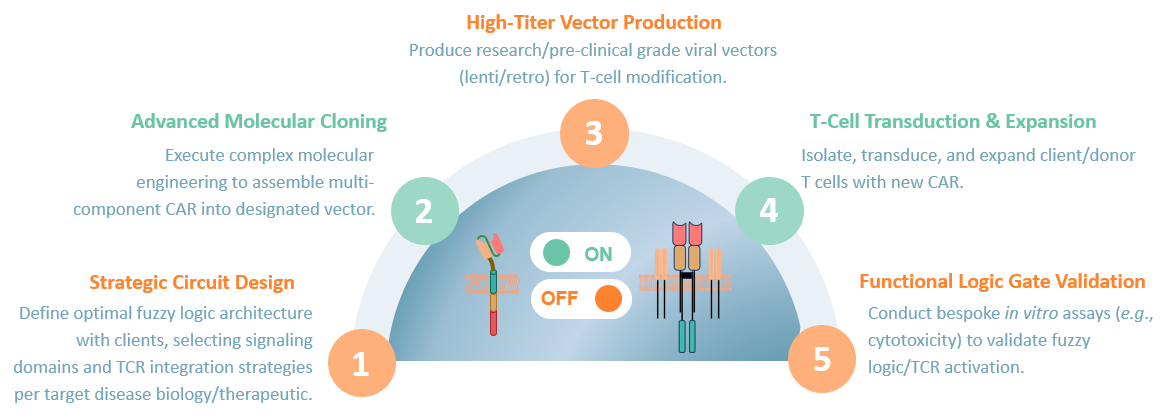
Our expert team collaborates closely with clients to define the optimal fuzzy logic circuit and TCR integration strategy based on the target cancer, antigen profiles, and desired therapeutic window. This includes selecting appropriate TAAs for CAR targeting and, if applicable, for TCR-mediated recognition.
Advanced Construct Design
We employ sophisticated molecular engineering to design multi-component CAR systems. This may involve:
-
Novel CAR architectures with split signaling domains responsive to multiple antigen inputs.
-
Integration of TCR signaling motifs or allosteric regulation of CAR activity by TCR engagement.
-
Incorporation of synthetic promoters or elements that respond to the combined strength of TCR and CAR signaling inputs.
Vector Construction and Production
High-quality lentiviral, retroviral, or non-viral vectors encoding the complex CAR constructs are produced, ready for T-cell transduction.
Proof-of-Concept Validation
We offer tailored in vitro assay development to validate the specificity, potency, and logic gate functionality of the engineered CAR T-cells. This includes co-culture assays with target cell lines expressing varying combinations and densities of antigens.
Creative Biolabs is committed to providing constructs that are not only innovative but also meticulously engineered for robust expression and reliable function, empowering our clients to accelerate their therapeutic programs.
Workflow
The service provides a meticulously structured process, moving from initial concept to a validated therapeutic candidate ready for preclinical testing.
Feel free to contact our team to arrange a personalized consultation and receive a comprehensive technical proposal.
Related Services
CAR-T Gene Packaging and Delivery Services provide high-efficiency, scalable viral and non-viral platforms to deliver CAR constructs into T cells, ensuring robust expression, functional potency, and reproducible manufacturing for research and clinical applications.
CAR Cell In Vitro Assay offers comprehensive functional evaluation of engineered CAR cells, including cytotoxicity, cytokine release, proliferation, and target specificity, ensuring reliable performance and optimized therapeutic potential before in vivo or clinical application.
CAR-T Preclinical In Vivo Assay provides robust evaluation of CAR-T efficacy, safety, persistence, and tumor-targeting in animal models, generating critical data to guide therapeutic optimization and support translational development.
Highlights of TCR-Controlled Fuzzy Logic CARs
The integration of TCR control with fuzzy logic principles in CAR T-cell design, a specialty of Creative Biolabs, offers several transformative advantages:
-
Unprecedented Target Discrimination
-
Tunable and Graded Therapeutic Responses
-
Enhanced Safety Profile
-
Overcoming Antigenic Heterogeneity and Escape
-
Broader Applicability to Challenging Cancers
-
Sophisticated Cellular Programming
FAQs
Q1: What is "fuzzy logic" in the context of CAR T-cells?
A1: Fuzzy logic in CAR T-cells refers to an engineered system where the T-cell's activation and response are not based on simple binary (yes/no) recognition of one or two antigens, but rather on the integration of multiple antigen inputs, potentially including their expression levels. This allows for more nuanced decision-making and graded effector functions, mimicking the complex signal processing of natural immune cells.
Q2: How does integrating TCR control improve CAR T-cell function?
A2: Integrating the native T-Cell Receptor (TCR) system can enhance CAR T-cell specificity and physiological relevance. The TCR can act as an additional checkpoint, requiring its engagement (e.g., by a tumor-specific peptide-MHC complex) for optimal CAR activity. This leverages the TCR's inherent sensitivity and specificity, potentially reducing off-target effects and allowing for finer discrimination between healthy and cancerous cells.
Q3: What types of targeting moieties can be used in these advanced CAR constructs?
A3: A variety of targeting moieties can be employed. Standard scFvs (single-chain variable fragments) derived from antibodies are common for CARs targeting cell surface proteins. For TCR-mediated recognition, the system relies on the interaction of the engineered or native TCR with peptide-MHC complexes. The fuzzy logic system can be designed to integrate signals from diverse types of receptors.
Contact Us
Embark on the next generation of immunotherapy with Creative Biolabs. If you are seeking to develop highly specific, controllable, and effective T-cell therapies leveraging the power of TCR-controlled fuzzy logic, our team of experts is ready to assist.
Contact us today to discuss your project needs and discover how Creative Biolabs can help you engineer the future of cancer treatment.
Reference
-
Gavriil, Artemis, et al. "Engineering solutions for mitigation of chimeric antigen receptor T-Cell dysfunction." Cancers 12.8 (2020): 2326. Distributed under Open Access License CC BY 4.0, without modification.