Creative Biolabs has a tradition of commitment. To achieve efficient execution and regulatory approval, we offer careful considerations of your program for the development of a cellular or gene therapy product – now and in the future.
EXPLORE MORE HighlightsWe focus on unmet needs and develop novel cellular and gene drugs and solutions that offer significant benefits over existing options.
EXPLORE MORE HighlightsThe advent of Chimeric Antigen Receptor T-cell (CAR-T) therapies has revolutionized the field of oncology, providing new avenues for treating various forms of cancer. Our 20 years of experience in the biotechnology sector have equipped us with the expertise and technological capabilities to support the entire lifecycle of CAR-T products, from early development to commercialization.
EXPLORE MORETo accelerate advanced breakthroughs of your projects, we offer broad range of platforms which enable our clients be free to tackle problems with cutting-edge technologies from different angles and in different methods.
EXPLORE MORE HighlightsUse the resources in our library to help you understand your options and make critical decisions for your study. We offer oncolytic virus, CAR-T, and dendritic cell related documents, as well as newsletter. If you don't find the answers you're looking for, contact us for additional assistance.
EXPLORE MORE HighlightsGet a real taste and understanding of the business and culture of one of the world's great research-based cellular and gene therapy discovery and development companies.
EXPLORE MORE
The oxygen-starved, acidic nature of tumor microenvironments (TME) directly cripples CD8+ T cell functionality, sabotaging anti-tumor immune defenses. Low oxygen levels compromise these immune cells through three coordinated strikes: ramping up inhibitory receptors that blunt activation signals, starving their energy reserves by disrupting oxidative phosphorylation-mediated ATP production, and intensifying competition for glucose and amino acids. Meanwhile, the acidic pH pervasive in solid tumors throws a wrench into critical signaling networks—particularly IL-2 survival signals and mTORC1-driven metabolic adaptation—leaving CD8+ T cells unable to multiply efficiently, secrete tumor-killing cytokines like IFN-γ, or deploy cytotoxic granules. These dual microenvironmental challenges collectively establish an immunological "blind spot," where disabled T cells fail to police malignant growth, granting tumors free rein to advance undetected.
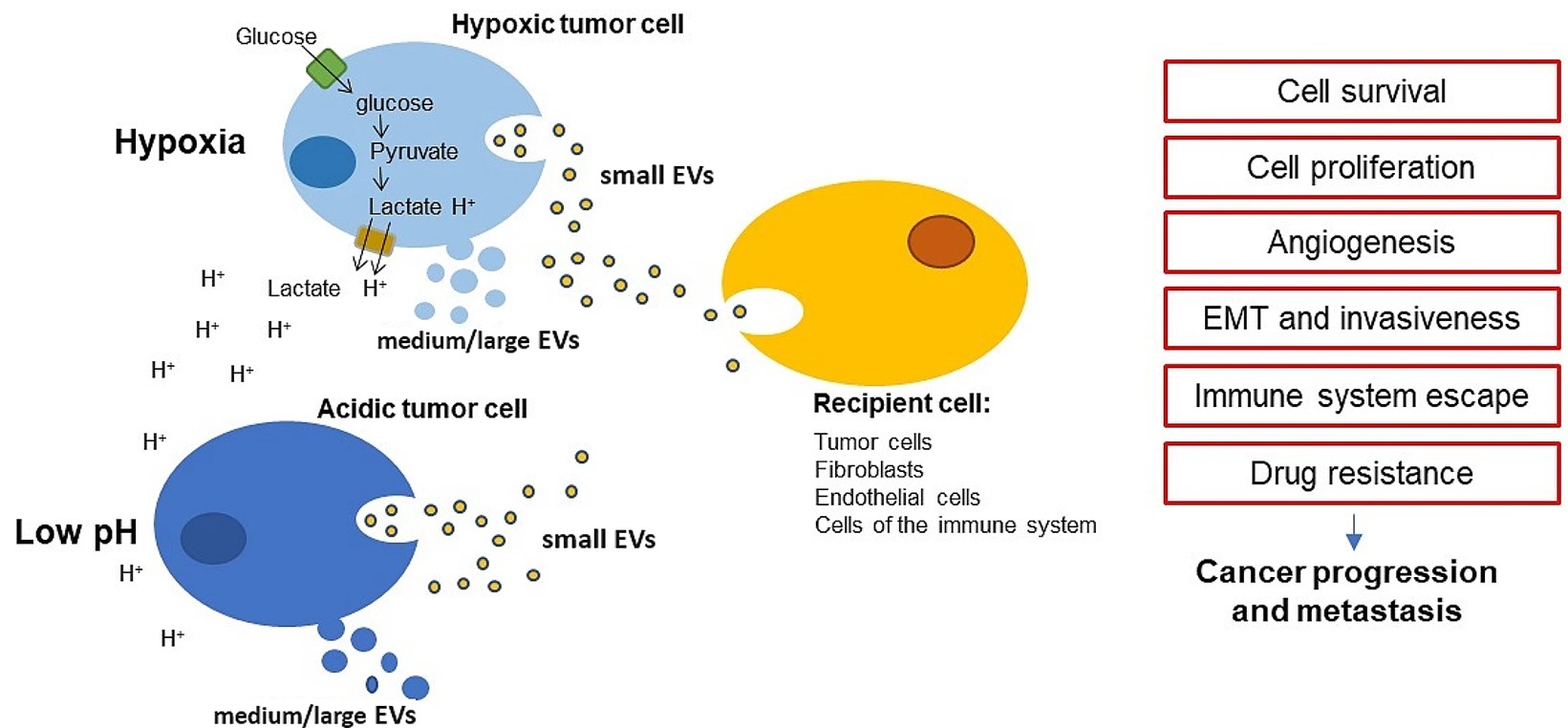 Fig.1 Extracellular vesicles secreted by acidic or hypoxic tumor cells and their effects on recipient cells.1
Creative Biolabs provides a comprehensive TME hypoxia and acidity assessment service for global customers with a detailed and accurate characterization of the tumor microenvironment. Our platform employs cutting-edge methodologies, including hypoxia marker immunohistochemistry, hypoxia-specific probes, and dual-modal pH quantification via microelectrode arrays paired with radiometric fluorescent dyes. These techniques synergize to map spatial-temporal variations in oxygen tension and proton gradients across tumor niches.
The service portfolio extends to metabolic profiling through lactate flux quantification and pathway-specific enzyme activity assays, complemented by advanced imaging workflows that resolve 3D hypoxia/acidosis distributions at sub-millimeter resolution. By correlating TME parameters with tumor proliferation kinetics, treatment resistance biomarkers, and metastatic potential, we equip research and clinical teams with actionable insights for therapeutic development and patient stratification. This multidimensional profiling supports data-driven strategies to counteract microenvironment-mediated immunosuppression and improve oncology outcomes.
Hypoxia Assessment
Acidity Assessment
In addition to TME hypoxia and acidity assessment services, we also provide a range of characterization services to evaluate the metabolic characteristics of tumor cells and immune cells under physiological conditions or in the tumor microenvironment, such as glucose uptake, amino acid utilization, and so on, which include:
Creative Biolabs' TME hypoxia and acidity evaluation service provides global customers with critical information for gaining a thorough understanding of the tumor microenvironment through its comprehensiveness, accuracy, and cutting-edge technology. We are able to accurately characterize the TME that influences tumor behavior, treatment response, and prognosis through a variety of modern technologies. Our expert analysis and interpretation are intended to assist researchers and clinicians in making more informed judgments about cancer research and clinical applications, ultimately fostering innovation and advancement in tumor therapy. If you're interested in our service, please get in touch with us at your convenience.
Reference
For any technical issues or product/service related questions, please leave your information below. Our team will contact you soon.
All products and services are For Research Use Only and CANNOT be used in the treatment or diagnosis of disease.
 NEWSLETTER
The latest newsletter to introduce the latest breaking information, our site updates, field and other scientific news, important events, and insights from industry leaders
LEARN MORE NEWSLETTER NEW SOLUTION
CellRapeutics™ In Vivo Cell Engineering: One-stop in vivo T/B/NK cell and macrophage engineering services covering vectors construction to function verification.
LEARN MORE SOLUTION NOVEL TECHNOLOGY
Silence™ CAR-T Cell: A novel platform to enhance CAR-T cell immunotherapy by combining RNAi technology to suppress genes that may impede CAR functionality.
LEARN MORE NOVEL TECHNOLOGY NEW SOLUTION
Canine CAR-T Therapy Development: From early target discovery, CAR design and construction, cell culture, and transfection, to in vitro and in vivo function validation.
LEARN MORE SOLUTION