Creative Biolabs has a tradition of commitment. To achieve efficient execution and regulatory approval, we offer careful considerations of your program for the development of a cellular or gene therapy product – now and in the future.
EXPLORE MORE HighlightsWe focus on unmet needs and develop novel cellular and gene drugs and solutions that offer significant benefits over existing options.
EXPLORE MORE HighlightsThe advent of Chimeric Antigen Receptor T-cell (CAR-T) therapies has revolutionized the field of oncology, providing new avenues for treating various forms of cancer. Our 20 years of experience in the biotechnology sector have equipped us with the expertise and technological capabilities to support the entire lifecycle of CAR-T products, from early development to commercialization.
EXPLORE MORETo accelerate advanced breakthroughs of your projects, we offer broad range of platforms which enable our clients be free to tackle problems with cutting-edge technologies from different angles and in different methods.
EXPLORE MORE HighlightsUse the resources in our library to help you understand your options and make critical decisions for your study. We offer oncolytic virus, CAR-T, and dendritic cell related documents, as well as newsletter. If you don't find the answers you're looking for, contact us for additional assistance.
EXPLORE MORE HighlightsGet a real taste and understanding of the business and culture of one of the world's great research-based cellular and gene therapy discovery and development companies.
EXPLORE MORE
Creative Biolabs provides an AI-Enhanced Construct Engineering & Design Service for CAR/TCR Development to address challenges in cell therapy pipelines, including high T-cell exhaustion rates, low signaling potency, and unpredictable off-target toxicities. This service enables the design of high-performance synthetic receptors with optimized signaling profiles through advanced protein language modeling and high-throughput in silico structural refinement. By integrating computational design with experimental validation, Creative Biolabs bridges the gap between digital receptor engineering and biological performance, accelerating the development of next-generation CAR and TCR immunotherapies.
Chimeric Antigen Receptor (CAR) and T-Cell Receptor (TCR) development is evolving from empirical testing to predictive engineering. Recent literature emphasizes that the spatial orientation and signaling kinetics of these receptors are primary drivers of clinical success. AI and Machine Learning can accurately predict construct stability and T-cell fitness. Creative Biolabs utilizes these data-driven insights to ensure every engineered construct is optimized for the complex environment of the human body, providing a scientifically grounded foundation for your next-generation therapy.
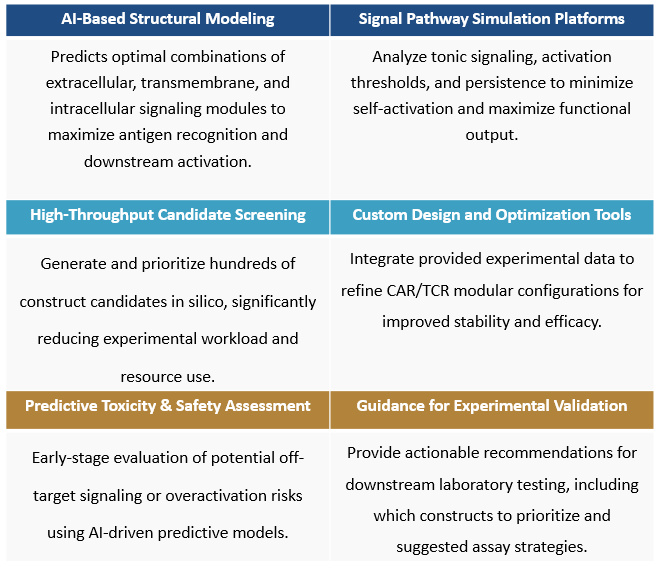
Creative Biolabs offers a suite of solutions for the modular optimization of CAR/TCR structures. By utilizing AI to navigate the vast combinatorial space of scFvs, linkers, and signaling domains, we deliver constructs tailored for maximum persistence and tumor-killing efficacy. We provide tailored AI-guided solutions for designing modular CAR and TCR constructs that improve signaling efficiency and cellular performance. Key capabilities include:
Discover How We Can Help - Request a Consultation.
Required Starting Materials: To initiate the project, clients typically provide target antigen sequences, desired effector cell types (T or NK cells), and any preliminary binding data or specific safety requirements for the intended tissue profile.
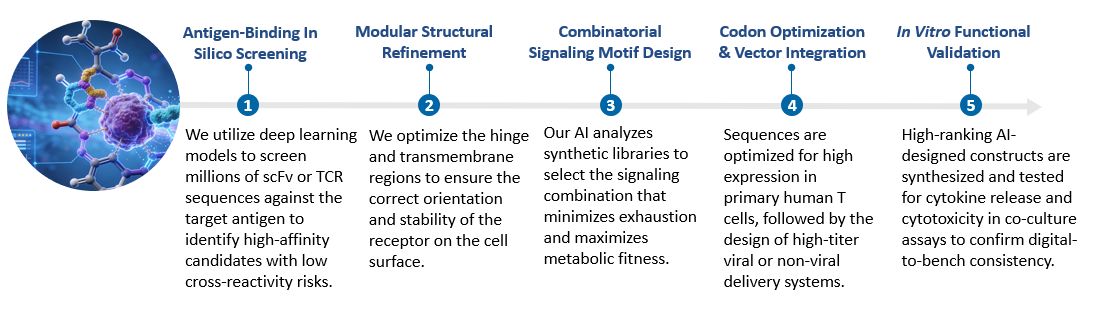
Final Deliverables: Clients receive a detailed Construct Optimization Report including structural docking scores and affinity kinetics, the Verified Synthetic Construct Sequence, and Preliminary Bio-Activity Data from initial cell-based validation.
Our team leverages advanced deep learning to model structural configurations of CAR. We optimize spatial orientation and docking stability to ensure your synthetic receptors maintain peak performance and structural integrity.
Learn More →We utilize high-fidelity AI simulations to analyze the temporal and spatial dynamics of the immunological synapse. This service predicts the quality of cell-to-cell interactions, ensuring efficient effector function and robust therapeutic signaling.
Learn More →Creative Biolabs employs predictive algorithms to identify synergistic combinations of costimulatory and activation domains. By analyzing intracellular signaling cascades, we design CARs that maximize metabolic fitness and prevent premature T-cell exhaustion.
Learn More →We engineer sophisticated "AND, OR, and NOT" logic gates using AI-driven Boolean modeling. Our approach enhances tumor-specific targeting and minimizes off-tumor toxicity by ensuring CAR activation occurs only under precise molecular conditions.
Learn More →Our experts utilize AI to design "Armored" CAR-Ts equipped with localized cytokine secretion and resistance factors. We optimize the expression of payloads that modify the immunosuppressive tumor microenvironment for superior therapeutic persistence.
Learn More →Creative Biolabs refines the critical hinge and transmembrane regions using AI-guided biophysical modeling. We optimize linker flexibility and membrane anchoring to enhance signal transduction efficiency and minimize unintended tonic signaling.
Learn More →Q: How does AI improve upon traditional CAR design?
A: Traditional methods rely on a mix-and-match of existing domains. Our AI models predict how new combinations will interact at the molecular level, identifying synergies that improve signaling without the need for thousands of physical prototypes.
Q: Can you work with proprietary antigen sequences?
A: Our service is fully customizable, and we can input your proprietary sequences into our AI models while maintaining strict confidentiality and data security.
Q: What measures do you take to ensure the AI's designs are biologically viable?
A: We use biological grounding where every design is cross-referenced against known structural constraints and validated in our wet labs to ensure expression and function.
Q: How do your services compare to standard library screening?
A: While libraries are vast, they are finite. AI-enhanced design allows for generative sequences that may not exist in natural or synthetic libraries, expanding your intellectual property space.
Creative Biolabs provides a transformative approach to AI-Enhanced Construct Engineering & Design for CAR/TCR Development. By focusing on modular precision and AI-driven signaling optimization, we empower researchers to develop therapies that are more potent, more persistent, and safer for patients. For detailed technical specifications and a personalized project roadmap, please reach out to our specialist team.
For any technical issues or product/service related questions, please leave your information below. Our team will contact you soon.
All products and services are For Research Use Only and CANNOT be used in the treatment or diagnosis of disease.
 NEWSLETTER
The latest newsletter to introduce the latest breaking information, our site updates, field and other scientific news, important events, and insights from industry leaders
LEARN MORE NEWSLETTER NEW SOLUTION
CellRapeutics™ In Vivo Cell Engineering: One-stop in vivo T/B/NK cell and macrophage engineering services covering vectors construction to function verification.
LEARN MORE SOLUTION NOVEL TECHNOLOGY
Silence™ CAR-T Cell: A novel platform to enhance CAR-T cell immunotherapy by combining RNAi technology to suppress genes that may impede CAR functionality.
LEARN MORE NOVEL TECHNOLOGY NEW SOLUTION
Canine CAR-T Therapy Development: From early target discovery, CAR design and construction, cell culture, and transfection, to in vitro and in vivo function validation.
LEARN MORE SOLUTION