Creative Biolabs has a tradition of commitment. To achieve efficient execution and regulatory approval, we offer careful considerations of your program for the development of a cellular or gene therapy product – now and in the future.
EXPLORE MORE HighlightsWe focus on unmet needs and develop novel cellular and gene drugs and solutions that offer significant benefits over existing options.
EXPLORE MORE HighlightsThe advent of Chimeric Antigen Receptor T-cell (CAR-T) therapies has revolutionized the field of oncology, providing new avenues for treating various forms of cancer. Our 20 years of experience in the biotechnology sector have equipped us with the expertise and technological capabilities to support the entire lifecycle of CAR-T products, from early development to commercialization.
EXPLORE MORETo accelerate advanced breakthroughs of your projects, we offer broad range of platforms which enable our clients be free to tackle problems with cutting-edge technologies from different angles and in different methods.
EXPLORE MORE HighlightsUse the resources in our library to help you understand your options and make critical decisions for your study. We offer oncolytic virus, CAR-T, and dendritic cell related documents, as well as newsletter. If you don't find the answers you're looking for, contact us for additional assistance.
EXPLORE MORE HighlightsGet a real taste and understanding of the business and culture of one of the world's great research-based cellular and gene therapy discovery and development companies.
EXPLORE MORE
Creative Biolabs provides an AI-Driven Target & Binder Discovery Service to address challenges in immunotherapy development, including high off-target toxicity risks, limited target availability in solid tumors, and the labor-intensive process of experimental binder screening. This service enables the identification of exclusive tumor antigens and the design of high-affinity binders with clinical-grade precision. By integrating deep learning architectures, 3D structural modeling, and high-throughput immunogenomics, Creative Biolabs accelerates the translation of raw genomic data into optimized CAR and TCR constructs, streamlining the discovery-to-clinic workflow.
The field of cancer immunotherapy has shifted toward personalized targets that bypass central immune tolerance. While traditional experimental identification is resource-intensive, AI/ML models now offer high-throughput alternatives for characterizing the multidimensional nature of tumor omics data. By modeling the biophysical properties of pMHC-TCR interactions, these tools enable the discovery of immunogenic neoantigens and high-affinity binders with unprecedented speed.
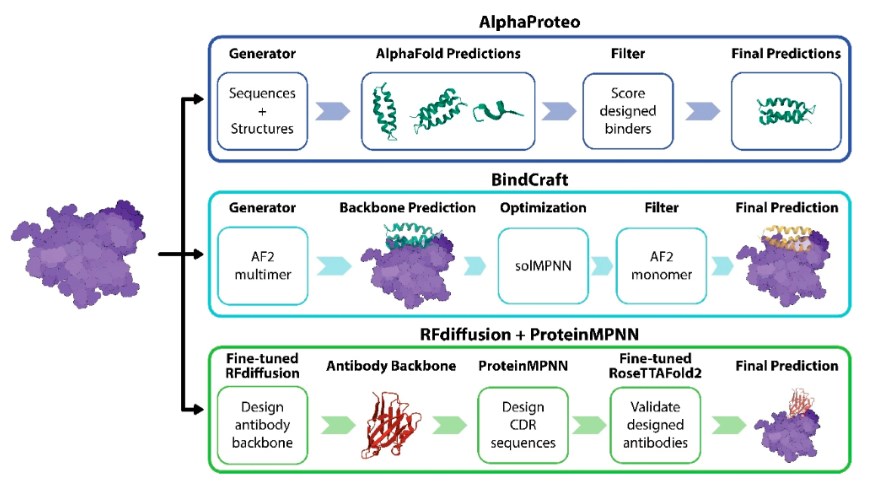 Fig.1 AI-driven approaches for the de novo design of binders and antibodies.1
At Creative Biolabs, we bridge the gap between complex multi-omics data and functional therapeutic candidates. Our service delivers high-confidence, tumor-specific antigens and binders designed to minimize "on-target, off-tumor" effects while maximizing T-cell activation and persistence. Our integrated computational platform enables comprehensive antigen discovery through AI-driven prioritization of tumor-specific antigens with minimal off-target risks, supports high-affinity binder selection by predicting and optimizing scFv, antibody fragments, or TCR sequences for superior specificity and stability, and provides structural and functional insights via computational modeling to assess binding interfaces, stability, and expression potential.
Discover How We Can Help - Request a Consultation.
Creative Biolabs leverages a suite of technologies to support CAR/TCR target and binder discovery:
Required Starting Materials: To initiate the service, clients typically provide raw patient-specific data or a list of pre-identified candidate protein sequences.
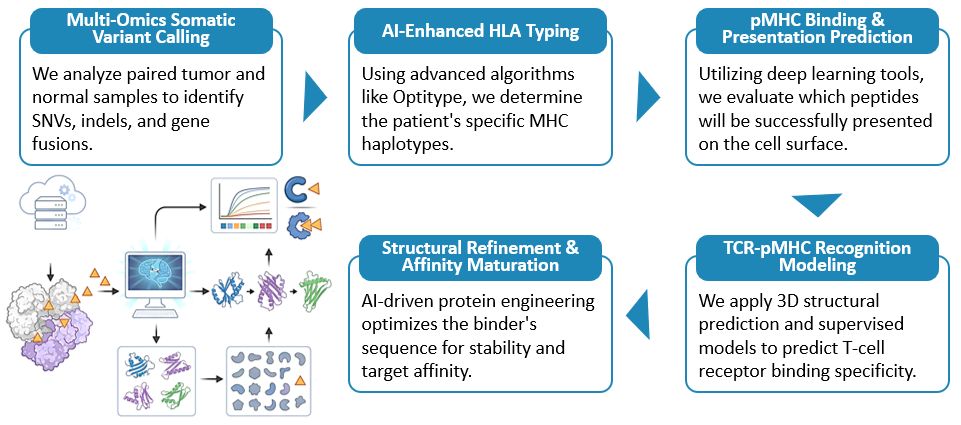
Final Deliverables: You will receive a Detailed Target Validation Report and a Binder Characterization Data Package containing predicted binding affinities, structural docking models, and immunogenicity scores.
Creative Biolabs leverages deep learning and multi-omics integration to identify novel tumor-associated surface antigens. Our AI-powered platform accelerates target discovery and prioritization, supporting the development of highly specific CAR and TCR-based immunotherapies.
Learn More →Creative Biolabs applies advanced AI algorithms to predict patient-specific neoantigens from genomic and transcriptomic data. This approach enables precise identification of immunogenic neoepitopes, supporting personalized TCR-T therapy development.
Learn More →Creative Biolabs utilizes AI-driven in silico high-throughput screening to rapidly evaluate large scFv libraries. Our platform identifies high-affinity, stable antibody fragments, accelerating binder discovery for next-generation CAR constructs.
Learn More →Creative Biolabs employs AI-based structural modeling to predict TCR–pMHC binding affinity and interaction stability. This technology enables rapid prioritization of potent TCR candidates for therapeutic development.
Learn More →Creative Biolabs integrates neural network based structural prediction with epitope mapping algorithms to precisely identify antigen-binding sites. This enables improved receptor specificity and optimized immunotherapy design.
Learn More →Creative Biolabs applies AI-guided antibody humanization to reduce immunogenicity while maintaining binding affinity and structural stability, supporting the development of safer therapeutic binders for CAR and TCR applications.
Learn More →Q: How does AI-driven discovery compare to traditional MS-based immunopeptidomics?
A: While mass spectrometry (MS) provides direct evidence of presented peptides, it requires large amounts of tumor tissue and cannot be used on fixed samples. AI-driven discovery requires only sequencing data and can predict rare antigens that MS might miss due to "flyability" biases.
Q: Can your platform handle MHC Class II targets?
A: Yes. While MHC-II is more complex due to open binding grooves and variable peptide lengths, our platform utilizes specialized algorithms to achieve high molecular coverage.
Q: How do you ensure the binders don't react with normal tissues?
A: We use AI to screen candidates against expansive healthy tissue databases and utilize structural prediction to identify potential cross-reactivity with self-antigens.
Q: What is the typical success rate of predicted neoantigens in functional assays?
A: Traditional affinity-only filters often see success rates as low as 2%. By incorporating AI-driven immunogenicity features, our integrated pipelines have demonstrated recall rates over 50%.
Creative Biolabs is a global leader in providing end-to-end AI solutions for the next generation of cancer immunotherapies. From initial Target Identification using high-throughput immunogenomics to the Refinement of CAR/TCR Binders via 3D structural modeling, we empower your research with precision science and actionable data. Please contact us for detailed project discussions or to receive a customized quote.
Reference
For any technical issues or product/service related questions, please leave your information below. Our team will contact you soon.
All products and services are For Research Use Only and CANNOT be used in the treatment or diagnosis of disease.
 NEWSLETTER
The latest newsletter to introduce the latest breaking information, our site updates, field and other scientific news, important events, and insights from industry leaders
LEARN MORE NEWSLETTER NEW SOLUTION
CellRapeutics™ In Vivo Cell Engineering: One-stop in vivo T/B/NK cell and macrophage engineering services covering vectors construction to function verification.
LEARN MORE SOLUTION NOVEL TECHNOLOGY
Silence™ CAR-T Cell: A novel platform to enhance CAR-T cell immunotherapy by combining RNAi technology to suppress genes that may impede CAR functionality.
LEARN MORE NOVEL TECHNOLOGY NEW SOLUTION
Canine CAR-T Therapy Development: From early target discovery, CAR design and construction, cell culture, and transfection, to in vitro and in vivo function validation.
LEARN MORE SOLUTION