Creative Biolabs has a tradition of commitment. To achieve efficient execution and regulatory approval, we offer careful considerations of your program for the development of a cellular or gene therapy product – now and in the future.
EXPLORE MORE HighlightsWe focus on unmet needs and develop novel cellular and gene drugs and solutions that offer significant benefits over existing options.
EXPLORE MORE HighlightsThe advent of Chimeric Antigen Receptor T-cell (CAR-T) therapies has revolutionized the field of oncology, providing new avenues for treating various forms of cancer. Our 20 years of experience in the biotechnology sector have equipped us with the expertise and technological capabilities to support the entire lifecycle of CAR-T products, from early development to commercialization.
EXPLORE MORETo accelerate advanced breakthroughs of your projects, we offer broad range of platforms which enable our clients be free to tackle problems with cutting-edge technologies from different angles and in different methods.
EXPLORE MORE HighlightsUse the resources in our library to help you understand your options and make critical decisions for your study. We offer oncolytic virus, CAR-T, and dendritic cell related documents, as well as newsletter. If you don't find the answers you're looking for, contact us for additional assistance.
EXPLORE MORE HighlightsGet a real taste and understanding of the business and culture of one of the world's great research-based cellular and gene therapy discovery and development companies.
EXPLORE MORE
Creative Biolabs provides "Armored" & TME Penetration TRuC-T Development Services to overcome major barriers in solid tumor immunotherapy, including poor T-cell persistence, therapeutic exhaustion, and limited infiltration into immunosuppressive tumor microenvironments. These services enable the development of highly potent and durable T-cell therapeutics through advanced T cell receptor fusion constructs integrated with membrane-bound cytokines and specialized tumor microenvironment modulating factors. By combining physiological TCR signaling with enhanced microenvironment adaptability, Creative Biolabs supports improved tumor penetration and sustained anti-tumor activity.
Solid tumors present a formidable barrier due to their immunosuppressive microenvironment and physical density. Traditional CAR-T therapies often fail here due to limited signaling and exhaustion. TRuC-T technology addresses this by integrating antibody-based binders into the intact TCR complex, engaging all six subunits. By adding armors, we create a cell therapy that self-sustains and penetrates deep into the TME without the need for high-dose systemic cytokines.
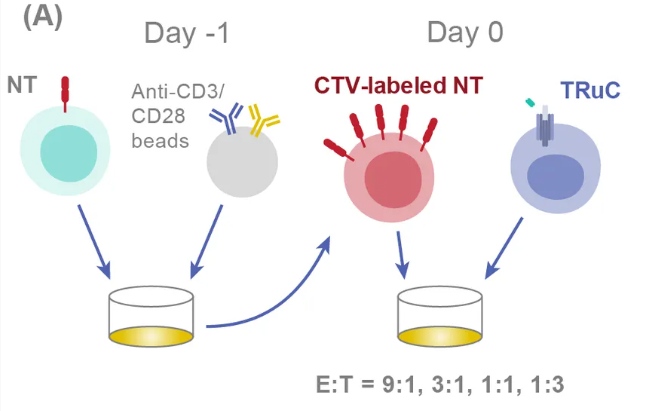 Fig.1 TRuC-T cell cytotoxicity assay design.1
Creative Biolabs provides a comprehensive, end-to-end solution for developing next-generation TRuC-T therapies specifically designed to thrive where conventional CAR-T cells fail. By leveraging the full signaling capacity of the TCR complex and "armoring" the cells with constitutive survival signals, we deliver a product capable of overcoming physical and chemical barriers within the TME.
Our services support clients from early design to functional validation, including targeted TRuC construct engineering for optimized antigen recognition and physiological signaling, armored T‑cell engineering to enhance resistance to immunosuppression, TME penetration optimization to improve tumor infiltration, and comprehensive in vitro and in vivo functional characterization and preclinical evaluation of cytotoxicity, persistence, immune activation, and tumor infiltration capacity.
Discover How We Can Help - Request a Consultation.
Creative Biolabs supports comprehensive TRuC-T engineering and TME adaptation strategies, enabling flexible development of advanced cell therapy candidates.
| TRuC Receptor Engineering Platform | Armored T-Cell Functional Enhancement Platform |
| Enables construction and optimization of fusion receptors linking antigen‑binding domains with TCR signaling components, supporting receptor design, construct optimization, and functional screening. | Integrates immune‑supportive elements to enhance cell persistence, survival, and anti‑tumor activity in immunosuppressive tumor microenvironments. |
| Tumor Microenvironment Adaptation Platform | Solid Tumor Functional Evaluation Platform |
| Improves T‑cell trafficking and tumor infiltration via chemokine guidance, stromal interaction modulation, and resistance to inhibitory signals. | Assesses anti‑tumor activity and immune function of TRuC‑T cells using tumor co‑culture and tumor microenvironment simulation models. |
Required Starting Materials: To launch the service, clients generally submit target antigen details and, where applicable, specified binder sequences. For projects lacking predefined binders, our in-house antibody discovery platforms can generate high-affinity candidates.
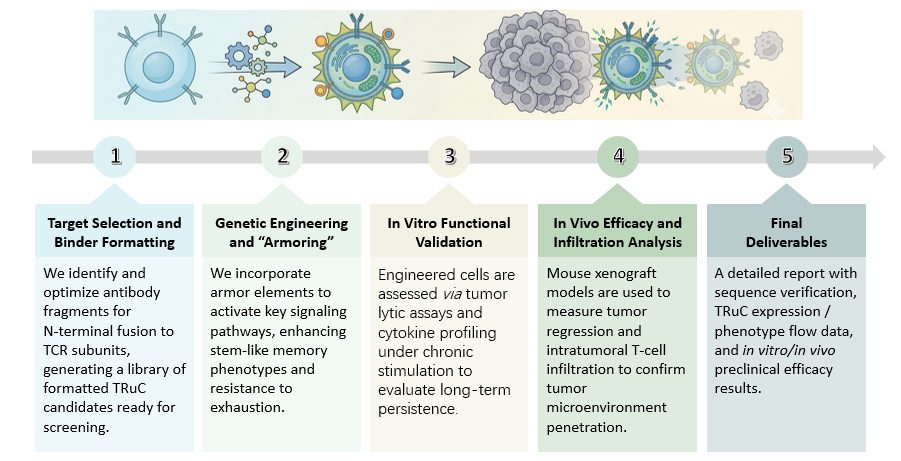
We design armored TRuC constructs with TME-shielding features to resist immunosuppression, enhance signaling strength, and improve persistence and antitumor efficacy in hostile tumor microenvironments.
Creative Biolabs provides T cell persistence and exhaustion modeling to evaluate durability, functional decline, and exhaustion markers, enabling optimization of TRuC-T performance and long-term therapeutic efficacy.
We offer tumor homing and migration assays to assess TRuC-T trafficking, chemotaxis, and infiltration capabilities, supporting the development of cell therapies with improved tumor-targeting efficiency.
Q: What is the main advantage of TRuC-T over second-generation CAR-T?
A: TRuC-T cells utilize the entire TCR complex, which provides more physiological signaling and lower cytokine release than CARs, reducing the risk of tonic signaling and over-activation.
Q: Can you develop TRuC-T cells for targets that cause fratricide?
A: Yes. For targets like CD70, we select specific binders that exhibit "cis-masking," where the TRuC occupies the antigen on the T cell's own surface, protecting it from being killed by its neighbors.
Q: How do you verify TME penetration?
A: We use ex vivo analysis of tumor tissues from xenograft models to quantify human T-cell infiltration. Our armored TRuC-T cells often show up to a 25-fold increase in intratumoral accumulation compared to standard constructs.
Creative Biolabs stands at the forefront of TCR-based engineering. Unlike competitors who rely on standard CAR-T designs, our TRuC-T platform utilizes the entire physiological signaling machinery of the T cell, resulting in lower cytokine release and reduced risk of Cytokine Release Syndrome (CRS). Our "armored" variants provide the necessary metabolic fuel to survive and infiltrate cold, immunosuppressive tumors. To obtain detailed information and discuss your specific project needs with our scientists, feel free to contact our team for further communication and project consultation.
Reference
For any technical issues or product/service related questions, please leave your information below. Our team will contact you soon.
All products and services are For Research Use Only and CANNOT be used in the treatment or diagnosis of disease.
 NEWSLETTER
The latest newsletter to introduce the latest breaking information, our site updates, field and other scientific news, important events, and insights from industry leaders
LEARN MORE NEWSLETTER NEW SOLUTION
CellRapeutics™ In Vivo Cell Engineering: One-stop in vivo T/B/NK cell and macrophage engineering services covering vectors construction to function verification.
LEARN MORE SOLUTION NOVEL TECHNOLOGY
Silence™ CAR-T Cell: A novel platform to enhance CAR-T cell immunotherapy by combining RNAi technology to suppress genes that may impede CAR functionality.
LEARN MORE NOVEL TECHNOLOGY NEW SOLUTION
Canine CAR-T Therapy Development: From early target discovery, CAR design and construction, cell culture, and transfection, to in vitro and in vivo function validation.
LEARN MORE SOLUTION