Creative Biolabs has a tradition of commitment. To achieve efficient execution and regulatory approval, we offer careful considerations of your program for the development of a cellular or gene therapy product – now and in the future.
EXPLORE MORE HighlightsWe focus on unmet needs and develop novel cellular and gene drugs and solutions that offer significant benefits over existing options.
EXPLORE MORE HighlightsThe advent of Chimeric Antigen Receptor T-cell (CAR-T) therapies has revolutionized the field of oncology, providing new avenues for treating various forms of cancer. Our 20 years of experience in the biotechnology sector have equipped us with the expertise and technological capabilities to support the entire lifecycle of CAR-T products, from early development to commercialization.
EXPLORE MORETo accelerate advanced breakthroughs of your projects, we offer broad range of platforms which enable our clients be free to tackle problems with cutting-edge technologies from different angles and in different methods.
EXPLORE MORE HighlightsUse the resources in our library to help you understand your options and make critical decisions for your study. We offer oncolytic virus, CAR-T, and dendritic cell related documents, as well as newsletter. If you don't find the answers you're looking for, contact us for additional assistance.
EXPLORE MORE HighlightsGet a real taste and understanding of the business and culture of one of the world's great research-based cellular and gene therapy discovery and development companies.
EXPLORE MORE
Creative Biolabs provides an AI-Powered Safety & Specificity Profiling Service for CAR/TCR Development to address key challenges in immunotherapy pipelines, including off-target toxicity risks, unpredictable cross-reactivity, and limited confidence in target specificity. This service enables comprehensive identification of hidden safety liabilities and supports improved target selection through advanced computational modeling, proteome-wide screening, and data-driven predictive analytics. By delivering high-resolution specificity profiling, Creative Biolabs enhances therapeutic safety and accelerates the development of precise, next-generation CAR and TCR-based immunotherapies.
Safety remains a critical bottleneck in CAR/TCR therapies, with toxicity often arising from unintended target recognition or cross-reactivity. Immune receptors can recognize structurally similar epitopes across unrelated proteins, leading to severe adverse effects. Advances in AI and computational biology now enable systematic prediction of such risks through large-scale sequence analysis and binding modeling. These approaches provide early insights into specificity and safety, supporting more reliable therapeutic design and reducing clinical uncertainty.
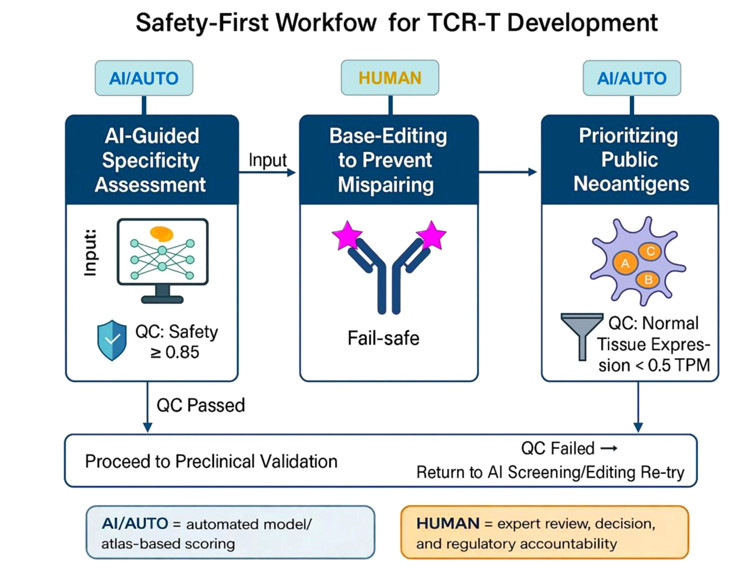 Fig.1 Safety assessment workflow for TCR-T cell development. 1
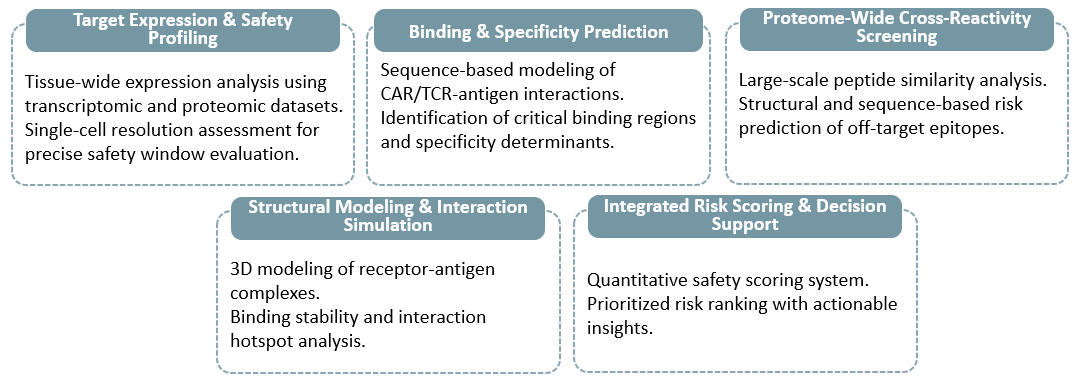
Creative Biolabs provides a comprehensive suite of in silico deliverables designed to identify and mitigate the risks associated with engineered T-cell therapies. By leveraging high-dimensional computational immunology, we transition your project from reactive testing to proactive safety-by-design.
We provide key solutions, including cross-reactivity prediction, target safety evaluation, sequence optimization support, risk scoring system, and preclinical strategy guidance to detect off-target recognition, minimize on-target/off-tumor toxicity, guide molecular redesign, offer safety rankings, and support data-driven go/no-go decisions for TCR-T development.
Discover How We Can Help - Request a Consultation.
To initiate the service, clients typically provide target epitope sequences of amino acids with restricted HLA type, as well as candidate TCR/CAR binding data from experimental scanning assays to refine the AI's specificity parameters.
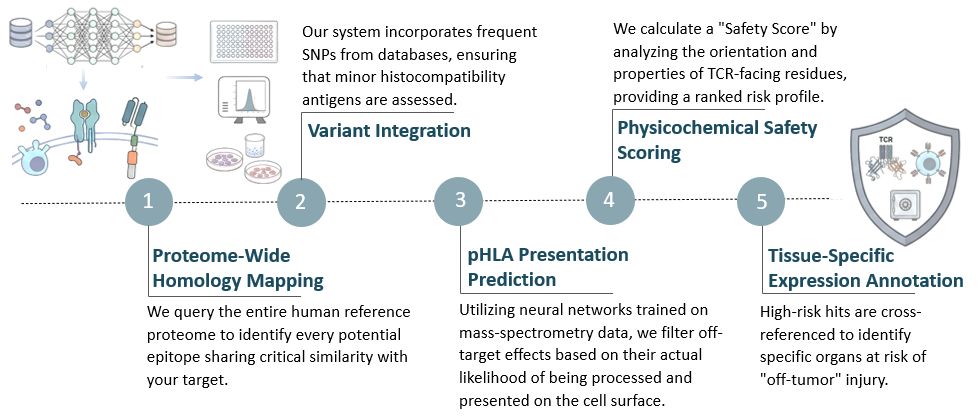
Final Deliverables: A safety profiling report detailing all predicted off-target effects with safety scores, and a risk mitigation strategy including a prioritized list of candidates for in vitro validation and recommendations for molecular re-engineering to enhance specificity.
Creative Biolabs leverages AI models to systematically predict off-target toxicity across the human proteome. By integrating sequence, structure, and expression data, we enable early risk identification and improve specificity for safer CAR/TCR therapeutic development.
Learn More →Creative Biolabs applies AI-driven modeling to evaluate CRS risk by analyzing cytokine signaling networks and immune activation patterns. This approach supports proactive safety design, helping minimize severe immune-related toxicities in CAR-T therapies.
Learn More →Creative Biolabs utilizes AI-based screening to detect potential cross-reactivity with neural tissues. By integrating tissue-specific expression and binding prediction, our platform enhances early neurotoxicity risk assessment and improves safety profiling for CAR/TCR candidates.
Learn More →Creative Biolabs employs AI to assess on-target off-tumor effects by profiling antigen distribution across normal tissues. This enables precise target validation, reducing unintended toxicity while maintaining therapeutic efficacy in CAR/TCR development.
Learn More →Creative Biolabs integrates AI algorithms to predict immunogenicity risk by evaluating peptide presentation and immune recognition potential. Our scoring system supports the design of low-immunogenic CAR/TCR constructs with improved safety and clinical success potential.
Learn More →Q: How does your AI differ from standard sequence alignment tools?
A: Creative Biolabs' AI models the structural and physicochemical orientation of residues. We distinguish between amino acids that bind to the HLA and those that interact with the TCR, which is critical for accurate cross-reactivity prediction.
Q: Can this service be used for antibody-based TCR mimics?
A: Yes. AI-driven specificity assessment is modality-agnostic and is highly recommended for any pHLA-targeting agent, including TCRm antibodies and bispecific T-cell engagers.
Q: What is the significance of a Safety Score below 3.0?
A: Based on retrospective analysis of clinical toxicities, a score below 3.0 indicates that the off-target epitope has an almost identical pHLA: TCR interaction profile to the target, making cross-reactive binding highly probable.
Q: Can I customize the profiling for a specific organ or disease?
A: Yes, Creative Biolabs offers customized services where we can prioritize the analysis of off-target effects expressed in specific critical tissues or focus on rare HLA alleles relevant to your target patient population.
Creative Biolabs delivers the industry's most sophisticated AI‑powered safety and specificity profiling to build your CAR/TCR therapies on a foundation of safety. Integrating proteome‑wide homology searches, advanced physicochemical scoring, and tissue expression data, we mitigate clinical risk and accelerate regulatory approval. Contact our team to discuss your project and learn more.
Reference
For any technical issues or product/service related questions, please leave your information below. Our team will contact you soon.
All products and services are For Research Use Only and CANNOT be used in the treatment or diagnosis of disease.
 NEWSLETTER
The latest newsletter to introduce the latest breaking information, our site updates, field and other scientific news, important events, and insights from industry leaders
LEARN MORE NEWSLETTER NEW SOLUTION
CellRapeutics™ In Vivo Cell Engineering: One-stop in vivo T/B/NK cell and macrophage engineering services covering vectors construction to function verification.
LEARN MORE SOLUTION NOVEL TECHNOLOGY
Silence™ CAR-T Cell: A novel platform to enhance CAR-T cell immunotherapy by combining RNAi technology to suppress genes that may impede CAR functionality.
LEARN MORE NOVEL TECHNOLOGY NEW SOLUTION
Canine CAR-T Therapy Development: From early target discovery, CAR design and construction, cell culture, and transfection, to in vitro and in vivo function validation.
LEARN MORE SOLUTION