Creative Biolabs has a tradition of commitment. To achieve efficient execution and regulatory approval, we offer careful considerations of your program for the development of a cellular or gene therapy product – now and in the future.
EXPLORE MORE HighlightsWe focus on unmet needs and develop novel cellular and gene drugs and solutions that offer significant benefits over existing options.
EXPLORE MORE HighlightsThe advent of Chimeric Antigen Receptor T-cell (CAR-T) therapies has revolutionized the field of oncology, providing new avenues for treating various forms of cancer. Our 20 years of experience in the biotechnology sector have equipped us with the expertise and technological capabilities to support the entire lifecycle of CAR-T products, from early development to commercialization.
EXPLORE MORETo accelerate advanced breakthroughs of your projects, we offer broad range of platforms which enable our clients be free to tackle problems with cutting-edge technologies from different angles and in different methods.
EXPLORE MORE HighlightsUse the resources in our library to help you understand your options and make critical decisions for your study. We offer oncolytic virus, CAR-T, and dendritic cell related documents, as well as newsletter. If you don't find the answers you're looking for, contact us for additional assistance.
EXPLORE MORE HighlightsGet a real taste and understanding of the business and culture of one of the world's great research-based cellular and gene therapy discovery and development companies.
EXPLORE MORE
Developing in vivo CAR-T, CAR-NK, and CAR-M therapies faces critical challenges, including inefficient transduction monitoring, poor phenotypic characterization, limited biodistribution data, and complex regulatory demands for clinical translation. Our End-to-End Flow Cytometry Solutions directly address these hurdles by offering fully integrated assays covering vector characterization, transduction tracking, kinetics, phenotyping, biodistribution, cytokine release, functional validation, and GxP-compliant services. Each solution is tailored to resolve complex in vivo samples with high-dimensional and quantitative flow cytometry. These services accelerate R&D timelines, reduce off-target risks, and provide reliable, audit-ready data, empowering seamless innovation from discovery to clinical application.
In vivo CAR-T/NK/M therapies enable direct immune cell engineering within the body, bypassing ex vivo manipulation and offering streamlined, potentially off-the-shelf treatment options. Flow cytometry provides a critical analytical backbone for these approaches, delivering high-dimensional, quantitative, and real-time assessment of transduction efficiency, cellular kinetics, phenotyping, biodistribution, and safety, empowering precise decision-making from discovery to clinical translation.
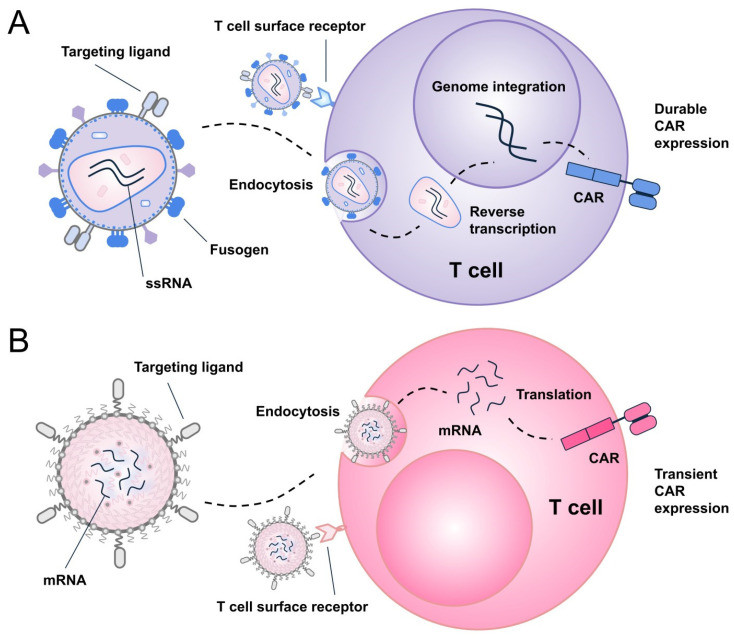 Fig.1 Cellular mechanisms and expression dynamics of in vivo CAR-T engineering.1
Our End-to-End Flow Cytometry Solutions provide integrated workflows for in vivo CAR-T/NK/M development from vector characterization to functional validation and GxP-compliant clinical support. We enable precise tracking, phenotyping, and safety assessment, accelerating your pipeline with specialized reagents, high-dimensional analysis, and regulatory-ready data under one roof.
Our service packages provide fully integrated flow cytometry solutions, from vector characterization to functional validation and GxP-compliant clinical support, empowering every stage of your in vivo CAR-T/NK/M innovation pipeline.
Quantify encapsulation efficiency, titer, and integrity of CAR-T delivery vehicles using high-resolution flow cytometry to ensure reliable in vivo gene transfer.
Learn More →Track CAR expression on T/NK cells post-delivery with sensitive flow cytometry, enabling early confirmation of successful in vivo engineering and vector performance.
Learn More →Quantify CAR-positive cell dynamics over time using absolute counting flow cytometry, providing critical data on expansion, distribution, and long-term engraftment.
Learn More →Perform high-dimensional immunophenotyping to distinguish memory from exhausted CAR-T subsets, guiding strategies for sustained antitumor function.
Learn More →Map spatial and quantitative distribution of CAR-T cells across tissues via flow cytometry, identifying potential off-target accumulation and safety concerns.
Learn More →Measure multiplex cytokine profiles in peripheral blood and tissues, supporting assessment of treatment-related inflammatory responses and CRs management.
Learn More →Develop custom flow cytometry reagents for specific detection of CAR proteins, enabling sensitive and lineage-independent identification of engineered cells.
Learn More →Resolve complex in vivo samples with full-spectrum analysis, enabling deep immunoprofiling of CAR-T/NK cells in mixed populations and tissues.
Learn More →Quantify functional activity of in vivo-derived CAR-T cells using flow-based killing assays, correlating phenotype with real cytotoxic capacity.
Learn More →Accelerate regulatory approval with validated flow cytometry workflows under GxP standards, ensuring reliable, auditable data for clinical translation.
Learn More →Q1: What makes in vivo CAR-T/NK/M flow cytometry different from ex vivo?
A1: In vivo samples contain complex tissue matrices, low cell frequencies, and high autofluorescence. Our solutions use advanced spectral flow cytometry and optimized tissue processing to resolve rare CAR-positive cells directly from blood, spleen, liver, and tumors.
Q2: Can you detect CAR expression without anti-idiotype antibodies?
A2: Yes, we offer alternative detection strategies including protein L, anti-Fab reagents, or CAR-specific detection probes. However, for precise lineage-independent tracking, we recommend custom anti-idiotype antibody development.
Choose us for unparalleled expertise in flow cytometry tailored to in vivo CAR engineering. We offer integrated, regulatory-ready solutions, from vector QC to functional validation, enabling precise tracking, phenotyping, and safety assessment. Accelerate your innovation with specialized reagents and GxP-compliant services under one roof.
Ready to accelerate your in vivo CAR-T/NK/M pipeline? Reach out to our flow cytometry specialists for a tailored consultation. Let's discuss your unique challenges, explore our integrated solutions, and request a custom quote, simply complete the contact form or email our team today.
Reference
For any technical issues or product/service related questions, please leave your information below. Our team will contact you soon.
All products and services are For Research Use Only and CANNOT be used in the treatment or diagnosis of disease.
 NEWSLETTER
The latest newsletter to introduce the latest breaking information, our site updates, field and other scientific news, important events, and insights from industry leaders
LEARN MORE NEWSLETTER NEW SOLUTION
CellRapeutics™ In Vivo Cell Engineering: One-stop in vivo T/B/NK cell and macrophage engineering services covering vectors construction to function verification.
LEARN MORE SOLUTION NOVEL TECHNOLOGY
Silence™ CAR-T Cell: A novel platform to enhance CAR-T cell immunotherapy by combining RNAi technology to suppress genes that may impede CAR functionality.
LEARN MORE NOVEL TECHNOLOGY NEW SOLUTION
Canine CAR-T Therapy Development: From early target discovery, CAR design and construction, cell culture, and transfection, to in vitro and in vivo function validation.
LEARN MORE SOLUTION









