Creative Biolabs has a tradition of commitment. To achieve efficient execution and regulatory approval, we offer careful considerations of your program for the development of a cellular or gene therapy product – now and in the future.
EXPLORE MORE HighlightsWe focus on unmet needs and develop novel cellular and gene drugs and solutions that offer significant benefits over existing options.
EXPLORE MORE HighlightsThe advent of Chimeric Antigen Receptor T-cell (CAR-T) therapies has revolutionized the field of oncology, providing new avenues for treating various forms of cancer. Our 20 years of experience in the biotechnology sector have equipped us with the expertise and technological capabilities to support the entire lifecycle of CAR-T products, from early development to commercialization.
EXPLORE MORETo accelerate advanced breakthroughs of your projects, we offer broad range of platforms which enable our clients be free to tackle problems with cutting-edge technologies from different angles and in different methods.
EXPLORE MORE HighlightsUse the resources in our library to help you understand your options and make critical decisions for your study. We offer oncolytic virus, CAR-T, and dendritic cell related documents, as well as newsletter. If you don't find the answers you're looking for, contact us for additional assistance.
EXPLORE MORE HighlightsGet a real taste and understanding of the business and culture of one of the world's great research-based cellular and gene therapy discovery and development companies.
EXPLORE MORE
Current non-viral CAR-T development faces major bottlenecks including low transgene expression, vector instability, and safety concerns from bacterial backbone sequences that trigger innate immune responses. To overcome these barriers, our Minicircle & Nanoplasmid Vector Platforms offer a next-generation, non-viral solution engineered for superior CAR expression and regulatory compliance. We provide customized vector design, rapid construct synthesis, and rigorous quality control, from plasmid backbone minimization to final CAR-T cell validation. Our platforms enhance transgene persistence, and reduce cytotoxicity, enabling you to generate safer, more potent CAR-T products with higher yields and shorter timelines.
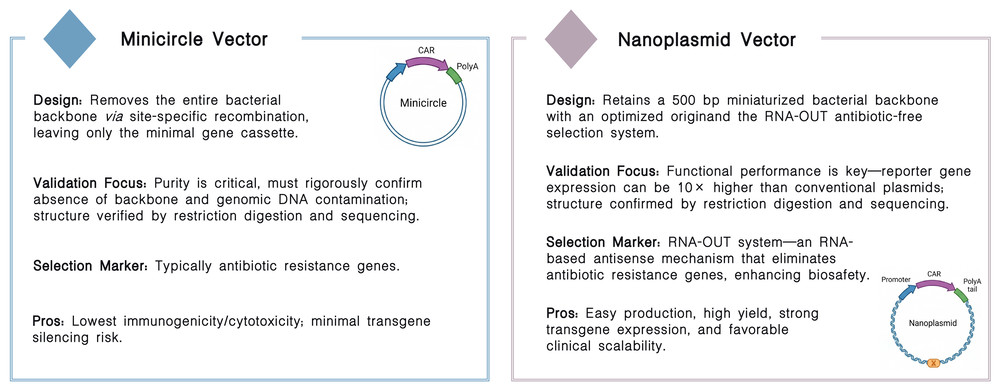
Minicircle vectors are non-viral DNA constructs devoid of bacterial backbone sequences, which enable sustained transgene expression with reduced epigenetic silencing and improved safety profiles. Nanoplasmid vectors retain a minimal bacterial origin and an antibiotic-free selection marker, thereby combining high-yield bacterial production with diminished immunogenicity and enhanced nuclear delivery. Both platforms offer compelling advantages over conventional plasmids, facilitating robust, persistent CAR expression while minimizing vector-derived innate immune activation, and thus representing promising tools for next-generation ex vivo T cell engineering with improved therapeutic durability and manufacturability.
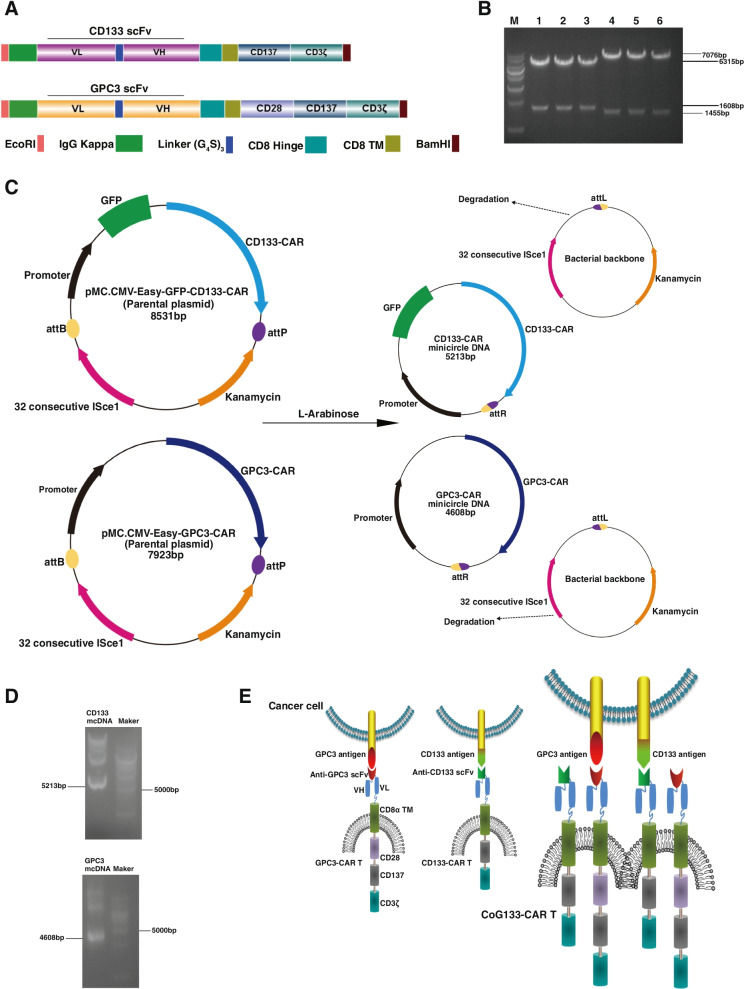 Fig.1 Development and analysis of two mcDNA vectors and the architecture of CAR-T cells. 1
Our Minicircle and Nanoplasmid platforms are next-generation non-viral vectors engineered for CAR-T cell manufacturing. By eliminating bacterial backbones and resistance genes, they drive sustained, high-level transgene expression with minimal innate immune activation. These systems accelerate development timelines, reduce regulatory complexity, and deliver cost-effective, scalable solutions, empowering you to create safer, more potent cellular immunotherapies with greater translational certainty.
Leveraging our Minicircle and Nanoplasmid platforms, we offer tailored non-viral CAR-T solutions: the Minicircle ensures minimal immunogenicity via backbone-free design, while the Nanoplasmid enables high-yield, antibiotic-free production with superior transgene expression.
Q1: What biological mechanisms enable these two vectors to significantly enhance T-cell viability during electroporation?
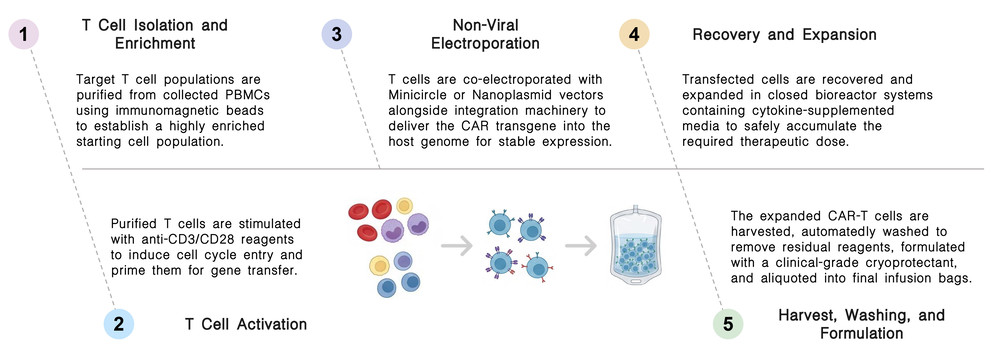
A1: By drastically condensing the vector size, these platforms minimize physical disruption to the cell membrane under lower electrical voltages while eliminating immunogenic bacterial backbones and CpG motifs that otherwise trigger sensor-mediated apoptosis via pathways like cGAS-STING.
Q2: What are the fundamental structural distinctions between Minicircle and Nanoplasmid vectors?
A2: While a Minicircle is a backbone-free circular DNA comprising solely the active expression cassette excised via intramolecular recombination, a Nanoplasmid retains an ultra-minimal replication origin of under 500 base pairs that utilizes an antibiotic-free, RNA-out selection system for propagation.
Our minicircle & nanoplasmid platforms enable safer, more persistent CAR-T engineering via minimized bacterial backbones and enhanced transgene expression. Devoid of antibiotic resistance genes and methylation-prone sequences, these vectors reduce immunogenicity and regulatory hurdles, ensuring high-yield, cost-effective production for next-generation non-viral cell therapies.
"Serving as a highly efficient homology-directed repair template for CRISPR/Cas9-mediated CAR knock-in, their Nanoplasmid platform outperforms conventional plasmids and linear dsDNA due to its minimal backbone. This technology minimizes cellular damage while doubling to tripling edited cell yields, offering a critical milestone for clinical-scale, non-viral CAR-T manufacturing." S* J*, Ph.D.
"They integrate Nanoplasmids with transposon systems in pilot clinical trials for BCMA-targeted CAR-T revealed remarkable therapeutic potential, yielding superior objective response rates compared to standard vectors. Furthermore, eliminating antibiotic markers through RNA-OUT and R6K replicon technologies mitigates horizontal gene transfer risks, aligning seamlessly with strict regulatory standards." Dr. J* L*.
Advance your non-viral CAR-T development with our next-generation Minicircle and Nanoplasmid vector systems. Engineered to preserve T cell functionality, lower manufacturing expenditures, and expedite the path from bench to bedside, these platforms offer a streamlined solution for translational success. Reach out to our specialists to define your project scope and obtain a bespoke pricing plan aligned with your clinical objectives.
Reference
For any technical issues or product/service related questions, please leave your information below. Our team will contact you soon.
All products and services are For Research Use Only and CANNOT be used in the treatment or diagnosis of disease.
 NEWSLETTER
The latest newsletter to introduce the latest breaking information, our site updates, field and other scientific news, important events, and insights from industry leaders
LEARN MORE NEWSLETTER NEW SOLUTION
CellRapeutics™ In Vivo Cell Engineering: One-stop in vivo T/B/NK cell and macrophage engineering services covering vectors construction to function verification.
LEARN MORE SOLUTION NOVEL TECHNOLOGY
Silence™ CAR-T Cell: A novel platform to enhance CAR-T cell immunotherapy by combining RNAi technology to suppress genes that may impede CAR functionality.
LEARN MORE NOVEL TECHNOLOGY NEW SOLUTION
Canine CAR-T Therapy Development: From early target discovery, CAR design and construction, cell culture, and transfection, to in vitro and in vivo function validation.
LEARN MORE SOLUTION









