Creative Biolabs has a tradition of commitment. To achieve efficient execution and regulatory approval, we offer careful considerations of your program for the development of a cellular or gene therapy product – now and in the future.
EXPLORE MORE HighlightsWe focus on unmet needs and develop novel cellular and gene drugs and solutions that offer significant benefits over existing options.
EXPLORE MORE HighlightsThe advent of Chimeric Antigen Receptor T-cell (CAR-T) therapies has revolutionized the field of oncology, providing new avenues for treating various forms of cancer. Our 20 years of experience in the biotechnology sector have equipped us with the expertise and technological capabilities to support the entire lifecycle of CAR-T products, from early development to commercialization.
EXPLORE MORETo accelerate advanced breakthroughs of your projects, we offer broad range of platforms which enable our clients be free to tackle problems with cutting-edge technologies from different angles and in different methods.
EXPLORE MORE HighlightsUse the resources in our library to help you understand your options and make critical decisions for your study. We offer oncolytic virus, CAR-T, and dendritic cell related documents, as well as newsletter. If you don't find the answers you're looking for, contact us for additional assistance.
EXPLORE MORE HighlightsGet a real taste and understanding of the business and culture of one of the world's great research-based cellular and gene therapy discovery and development companies.
EXPLORE MORE
Creative Biolabs provides a High-Affinity TCR-T Development Service to address key challenges in TCR-based immunotherapy, including off-target toxicity risks, low antigen sensitivity in solid tumors, and the difficulty of identifying rare neoantigen-specific TCRs. This service enables the discovery and optimization of highly specific, potent TCR candidates through proprietary affinity maturation technologies and safety screening platforms. By transforming naturally low-affinity TCRs into high-performance therapeutic assets with picomolar-level precision, Creative Biolabs supports efficient candidate selection and accelerates the transition from early discovery to clinical development.
High-affinity TCR-T development is essential for targeting intracellular cancer antigens that are inaccessible to antibodies. Natural TCRs often lack the potency required for robust anti-tumor responses due to thymic selection. By utilizing directed evolution and structural biology, we can enhance TCR affinity by over a million-fold while maintaining strict specificity. Current literature confirms that this engineering is the key to overcoming the immunosuppressive tumor microenvironment in solid cancers.
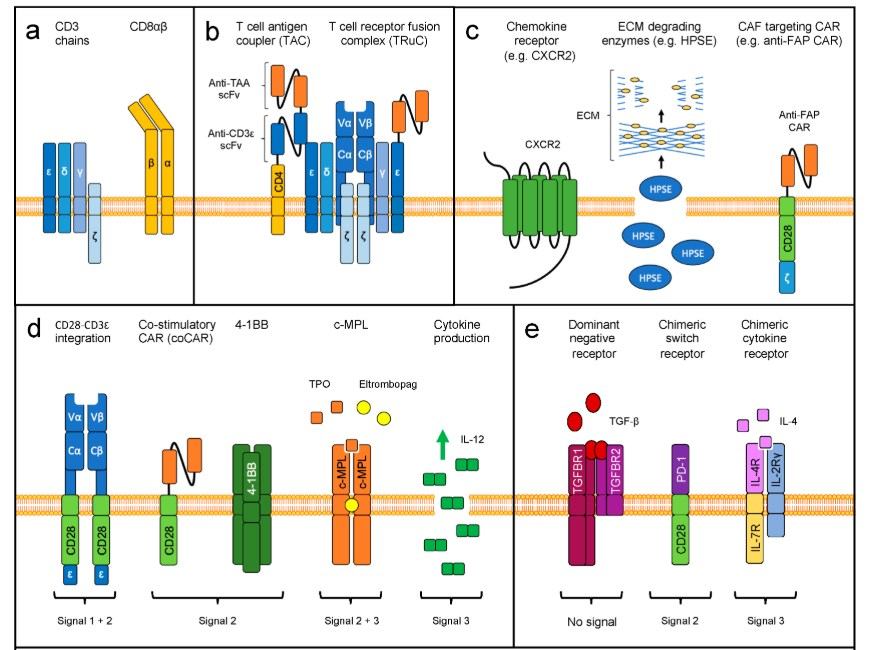 Fig.1 Engineering approaches to improve TCR-transgenic T Cell function.1
Creative Biolabs provides a suite of solutions designed to bridge the gap between basic TCR discovery and therapeutic application. We solve the primary challenge of natural TCRs, their inherent low affinity for self-antigens, by utilizing advanced directed evolution and structural modeling to enhance binding potency by up to a million-fold. Our services ensure that your lead candidates maintain an optimal affinity window, enabling them to distinguish between mutated neoantigens and wild-type proteins with exquisite sensitivity.
Our key capabilities cover the full development chain of TCR-T therapies: target-specific TCR discovery from immune repertoires or antigen-experienced T cells; affinity maturation to enhance peptide-MHC binding while preserving specificity; functional validation of cytotoxicity, cytokine secretion, and antigen sensitivity in tumor models; safety screening for off-target effects and cross-reactivity; as well as vector construction and T-cell engineering for preclinical research.
Discover How We Can Help - Request a Consultation.
Creative Biolabs integrates multiple advanced platforms to support the discovery, optimization, and evaluation of high-affinity TCR-T candidates.
| TCR Discovery and Repertoire Profiling | Affinity Optimization Platforms |
| High-throughput immune receptor profiling identifies antigen-responsive TCR sequences from antigen-stimulated or tumor-reactive immune cells. Candidate TCRs are cloned and validated for antigen specificity. | Targeted engineering optimizes TCR-peptide-MHC binding affinity and avidity via rational mutagenesis of variable domains and controlled variant screening. |
| Antigen Recognition Screening | Functional TCR-T Cell Evaluation |
| Engineered TCRs are assessed by pMHC binding, activation assays, and functional tests to select candidates with enhanced tumor recognition. |
|
To launch the service, clients are required to provide the target antigen sequence, the HLA restriction element, and any available parental TCR sequences.
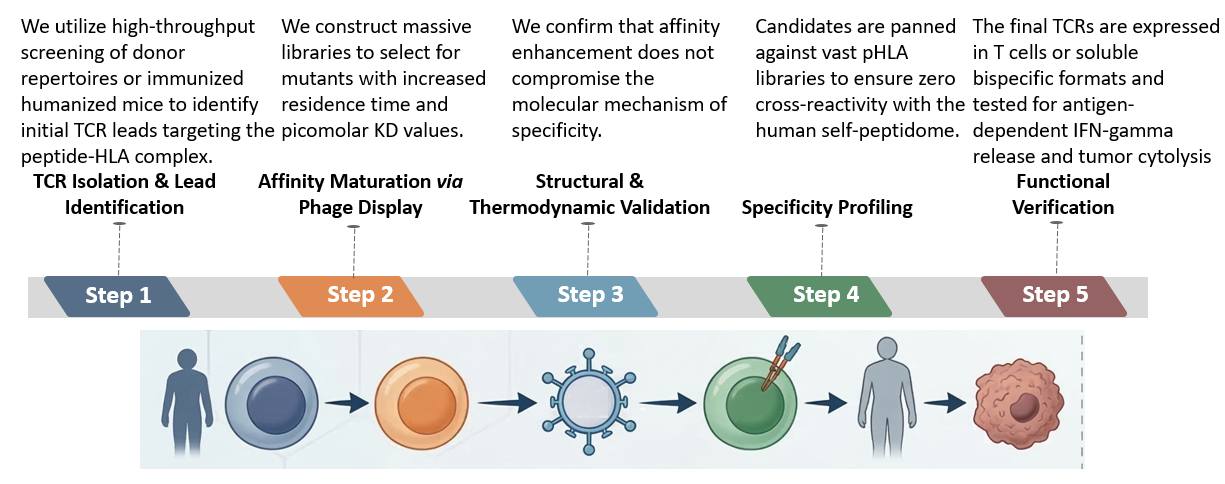
Clients receive a detailed Technical Validation Report including KD kinetics, a Safety Cross-Reactivity Matrix against mimetic peptides, and the Optimized TCR Genetic Sequences ready for viral vector integration.
Q: How do you ensure that increasing TCR affinity doesn't lead to off-target toxicity?
A: We utilize a dual-track selection process: negative selection against the wild-type peptide and the human self-peptidome, followed by positive selection for the mutant. This ensures a broad "affinity window" is maintained.
Q: Can you develop TCRs for non-classical HLA alleles?
A: Yes! While many focus on HLA-A02, we have extensive experience with HLA-A11, A03, C08, and other alleles to broaden the patient population reachable by your therapy.
Q: What is the advantage of a soluble TCR bispecific over traditional TCR-T cells?
A: Soluble bispecifics can redirect the entire existing pool of polyclonal T cells to the tumor, whereas TCR-T requires the manufacture of a specific cell product for each patient.
Q: How do you handle the "induced fit" conformational changes during binding?
A: We use MD simulations and structural analysis to understand how the TCR and pHLA interact at a thermodynamic level, ensuring that the engineered TCR accounts for peptide dynamics.
Creative Biolabs stands at the forefront of TCR technology, combining over 20 years of biology expertise with high-end synthetic biology tools. Our advantage lies in our ability to not just increase affinity, but to do so while preserving the "exquisite sensitivity" required for safe immunotherapy. We utilize Published Data to benchmark our platforms, ensuring our clients stay ahead of the competitive landscape in solid tumor targeting. Please feel free to contact our team for detailed information, customized solutions, and in-depth discussions about your specific project requirements.
Reference
For any technical issues or product/service related questions, please leave your information below. Our team will contact you soon.
All products and services are For Research Use Only and CANNOT be used in the treatment or diagnosis of disease.
 NEWSLETTER
The latest newsletter to introduce the latest breaking information, our site updates, field and other scientific news, important events, and insights from industry leaders
LEARN MORE NEWSLETTER NEW SOLUTION
CellRapeutics™ In Vivo Cell Engineering: One-stop in vivo T/B/NK cell and macrophage engineering services covering vectors construction to function verification.
LEARN MORE SOLUTION NOVEL TECHNOLOGY
Silence™ CAR-T Cell: A novel platform to enhance CAR-T cell immunotherapy by combining RNAi technology to suppress genes that may impede CAR functionality.
LEARN MORE NOVEL TECHNOLOGY NEW SOLUTION
Canine CAR-T Therapy Development: From early target discovery, CAR design and construction, cell culture, and transfection, to in vitro and in vivo function validation.
LEARN MORE SOLUTION