Creative Biolabs has a tradition of commitment. To achieve efficient execution and regulatory approval, we offer careful considerations of your program for the development of a cellular or gene therapy product – now and in the future.
EXPLORE MORE HighlightsWe focus on unmet needs and develop novel cellular and gene drugs and solutions that offer significant benefits over existing options.
EXPLORE MORE HighlightsThe advent of Chimeric Antigen Receptor T-cell (CAR-T) therapies has revolutionized the field of oncology, providing new avenues for treating various forms of cancer. Our 20 years of experience in the biotechnology sector have equipped us with the expertise and technological capabilities to support the entire lifecycle of CAR-T products, from early development to commercialization.
EXPLORE MORETo accelerate advanced breakthroughs of your projects, we offer broad range of platforms which enable our clients be free to tackle problems with cutting-edge technologies from different angles and in different methods.
EXPLORE MORE HighlightsUse the resources in our library to help you understand your options and make critical decisions for your study. We offer oncolytic virus, CAR-T, and dendritic cell related documents, as well as newsletter. If you don't find the answers you're looking for, contact us for additional assistance.
EXPLORE MORE HighlightsGet a real taste and understanding of the business and culture of one of the world's great research-based cellular and gene therapy discovery and development companies.
EXPLORE MORE
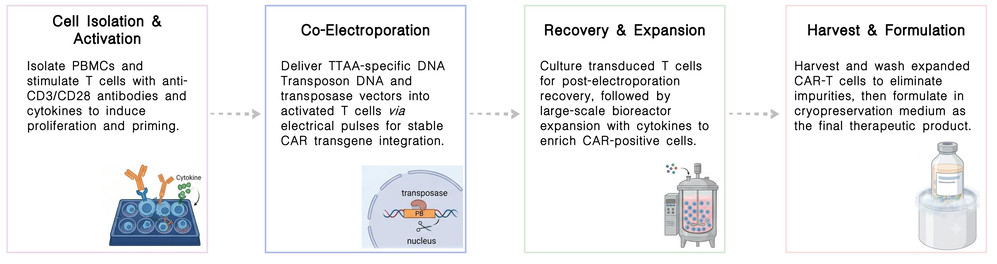
Current non-viral CAR engineering faces major bottlenecks, low transgene integration efficiency, random genomic insertion risks, and silencing of therapeutic cassettes, which collectively hinder durable and safe CAR expression in primary T cells. To address these limitations, we have established the TTAA-specific DNA Transposon Platform for Non-Viral CAR Integration, which directs CAR transgenes to TTAA chromosomal sites with high enzymatic activity. Our service offers custom vector design, optimized transposase formulations, and streamlined electroporation protocols tailored for both research and preclinical scales. Our platform ensures robust, long‑term CAR expression with minimal off‑target effects, significantly reducing clonal variability and genotoxicity risks, thereby providing you with a reliable and cost‑effective solution for next‑generation cell therapy development.
Transposon systems are versatile, non-viral genetic tools that enable stable chromosomal integration of therapeutic transgenes through a precise "cut-and-paste" mechanism, offering a safe and efficient alternative to viral vectors for immune cell engineering. The TTAA-specific transposon system, derived from insect cells, features a large cargo capacity and seamless excision capability, allowing for high-efficiency integration at TTAA target sites with minimal genomic footprint.
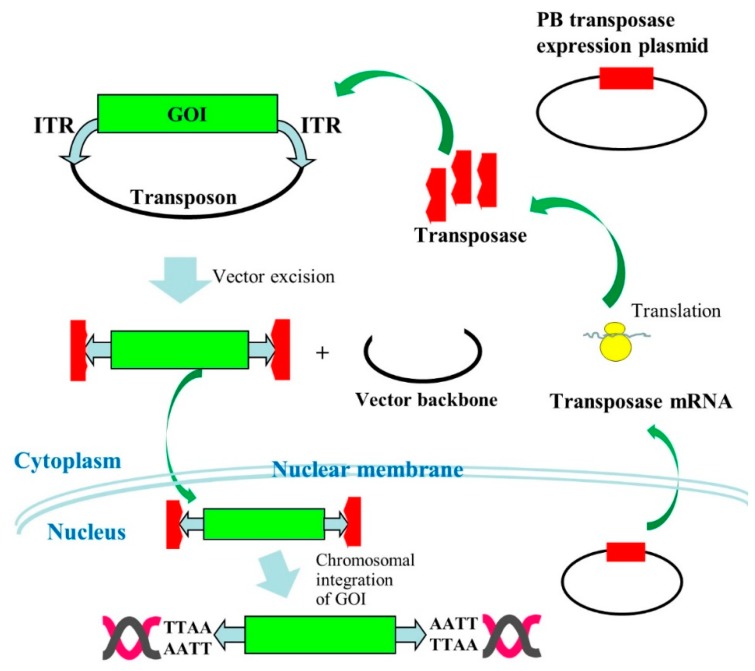 Fig.1 The TTAA-specific DNA transposon system facilitates the integration of target genes into the host chromosome. 1
Our TTAA-specific DNA transposon platform represents a next-generation non-viral system for efficient CAR gene delivery and stable genomic integration into primary T cells. By leveraging a highly active transposase, this technology enables rapid, cost-effective, and safe manufacturing of CAR-T products with durable transgene expression. We provide partners with a fully scalable solution, from construct design to clinical-grade production, accelerating your path from research to transformative cell therapies.
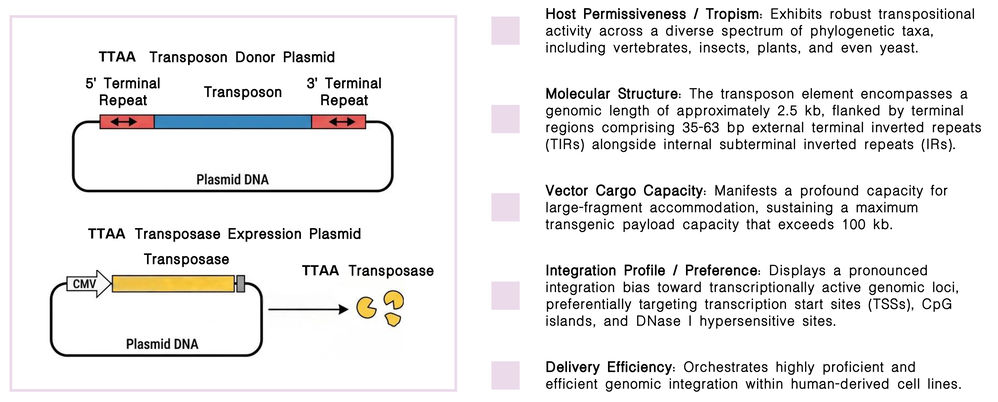
This non-viral, TTAA-specific DNA transposon platform delivers robust, high-efficiency genomic integration across diverse taxa.
Q1: Does the random integration of the transposon pose a risk of insertional mutagenesis?
A1: The platform exhibits a close-to-random integration profile with no preference for transcription start sites or coding sequences, significantly mitigating the risk of genotoxic events and secondary malignancies, a key advantage over viral vectors and some other transposon systems.
Q2: How long do the CAR-T cells persist in the body after infusion?
A2: CAR-T cells engineered with this platform can expand rapidly after infusion and remain detectable for over 2 years, demonstrating the stable and sustained expression of the therapeutic transgene.
Our TTAA-specific transposon platform offers a uniquely balanced solution, uncompromised safety, dramatically reduced manufacturing timelines and costs, and stable CAR expression through targeted genomic integration. Backed by robust clinical data and a streamlined workflow, we empower partners to accelerate next-generation cell therapies from discovery to patients efficiently and reliably.
"Developing next-generation dual-targeted CAR-T therapies for solid malignancies presented a critical bottleneck due to the strict cargo limitations of conventional lentiviral vectors. Shifting to this TTAA-specific DNA transposon service seamlessly accommodated our large genetic circuits, while demonstrating exceptional transcriptional stability and robust, prolonged anti-tumor efficacy within murine models." Dr. Elena Rostova.
"Mitigating insertional mutagenesis remains a paramount regulatory hurdle in CAR-T CMC development. This service's TTAA-specific platform provides footprint-free excision and high-fidelity integration; comprehensive whole-genome sequencing confirmed zero unintended genomic disruption. Additionally, the harvested CAR-T cells retained superb expansion capabilities alongside a highly potent stem cell memory phenotype." Dr. Hai Lin.
Interested in advancing your CAR-T programs with a non-viral integration system that combines speed, affordability, and an enhanced safety profile? Our specialist team is ready to engage on tailored development strategies, joint research ventures, and flexible licensing arrangements. Connect with us to evaluate how our TTAA-targeting transposon technology may streamline your translational path and support scalable, next-generation cell therapy manufacturing. We are eager to collaborate on bringing innovative treatments to patients.
Reference
For any technical issues or product/service related questions, please leave your information below. Our team will contact you soon.
All products and services are For Research Use Only and CANNOT be used in the treatment or diagnosis of disease.
 NEWSLETTER
The latest newsletter to introduce the latest breaking information, our site updates, field and other scientific news, important events, and insights from industry leaders
LEARN MORE NEWSLETTER NEW SOLUTION
CellRapeutics™ In Vivo Cell Engineering: One-stop in vivo T/B/NK cell and macrophage engineering services covering vectors construction to function verification.
LEARN MORE SOLUTION NOVEL TECHNOLOGY
Silence™ CAR-T Cell: A novel platform to enhance CAR-T cell immunotherapy by combining RNAi technology to suppress genes that may impede CAR functionality.
LEARN MORE NOVEL TECHNOLOGY NEW SOLUTION
Canine CAR-T Therapy Development: From early target discovery, CAR design and construction, cell culture, and transfection, to in vitro and in vivo function validation.
LEARN MORE SOLUTION









