Creative Biolabs has a tradition of commitment. To achieve efficient execution and regulatory approval, we offer careful considerations of your program for the development of a cellular or gene therapy product – now and in the future.
EXPLORE MORE HighlightsWe focus on unmet needs and develop novel cellular and gene drugs and solutions that offer significant benefits over existing options.
EXPLORE MORE HighlightsThe advent of Chimeric Antigen Receptor T-cell (CAR-T) therapies has revolutionized the field of oncology, providing new avenues for treating various forms of cancer. Our 20 years of experience in the biotechnology sector have equipped us with the expertise and technological capabilities to support the entire lifecycle of CAR-T products, from early development to commercialization.
EXPLORE MORETo accelerate advanced breakthroughs of your projects, we offer broad range of platforms which enable our clients be free to tackle problems with cutting-edge technologies from different angles and in different methods.
EXPLORE MORE HighlightsUse the resources in our library to help you understand your options and make critical decisions for your study. We offer oncolytic virus, CAR-T, and dendritic cell related documents, as well as newsletter. If you don't find the answers you're looking for, contact us for additional assistance.
EXPLORE MORE HighlightsGet a real taste and understanding of the business and culture of one of the world's great research-based cellular and gene therapy discovery and development companies.
EXPLORE MORE
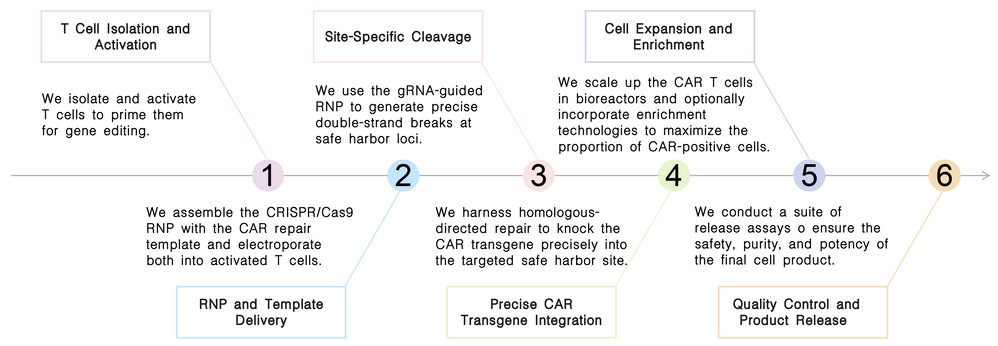
Current CAR-T cell manufacturing relies heavily on random viral integration, which poses risks of insertional mutagenesis, variegated transgene expression, and lengthy, costly production processes that limit patient access and consistent therapeutic outcomes. Our Site-Specific CAR Knock-In & Genomic "Safe Harbor" Integration Platform enable precise, targeted insertion of CAR transgenes into defined genomic loci, such as the TRAC gene or other validated safe-harbor sites. We offer a comprehensive, modular service that includes vector design, CRISPR/Cas9 ribonucleoprotein optimization, and high-efficiency HDR- or NHEJ-mediated knock-in workflows tailored to your specific CAR construct. Our platform ensures uniform transgene expression, eliminates positional effects, substantially reduces off-target risk, and accelerates pathway-to-clinic timelines, empowering you to develop safer, more potent, and reliably reproducible cell therapies with minimized batch-to-batch variability.
While CAR-T cell therapy has revolutionized oncology, its ex vivo manufacturing remains costly and limits accessibility. In vivo T cell engineering offers an alternative, yet current methods suffer from transient expression or random integration. Durable, cell-specific transgene expression is achievable through site-specific CAR knock-in into a safe harbor locus in vivo. Using a dual-vector system for T cell–targeted CRISPR-Cas9 delivery and DNA donor template supply, researchers achieved therapeutic levels of CAR-T cells in humanized mouse models of B cell aplasia and malignancies. This approach provides a path toward safer, more efficient, and broadly accessible T cell therapies.
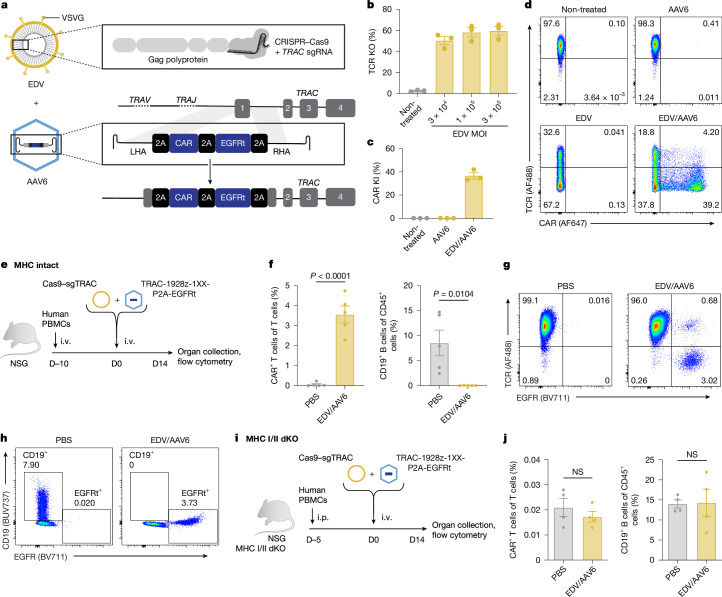 Fig.1 TRAC-CAR T cells are generated through the co-delivery of Cas9-EDV and HDRT-AAV. 1
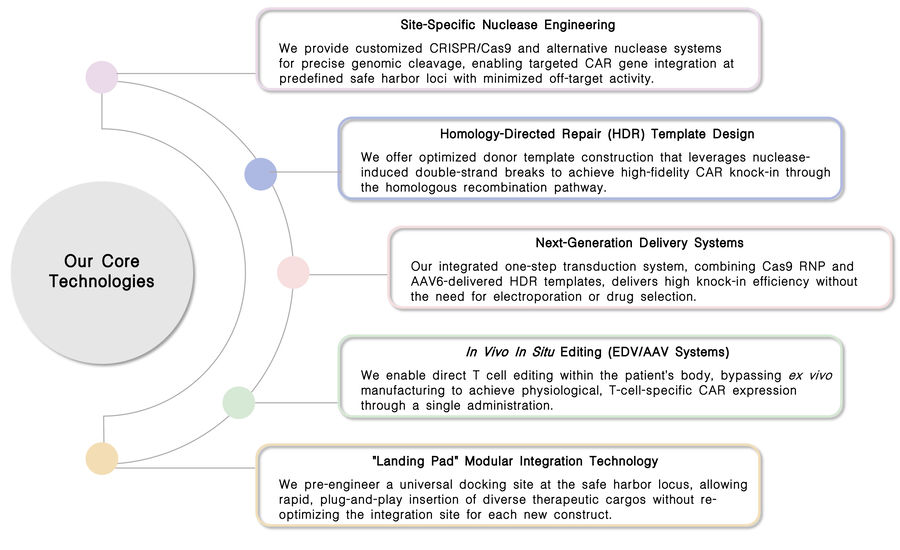
Our Site-Specific CAR Knock-In & Genomic Safe Harbor Integration Platform enables precise, predictable, and durable transgene expression by targeting validated genomic loci. Leveraging custom nucleases, optimized HDR templates, and advanced delivery systems, we empower clients with high-efficiency, clinically translatable solutions, from ex vivo engineering to single-administration in vivo editing, accelerating the development of safer, more effective cell therapies.
We offer a comprehensive suite of precision genome engineering solutions, encompassing custom nuclease design, optimized donor templates, advanced delivery platforms, in vivo editing capabilities, and modular docking systems, all tailored for site-specific CAR integration into validated genomic safe harbors.
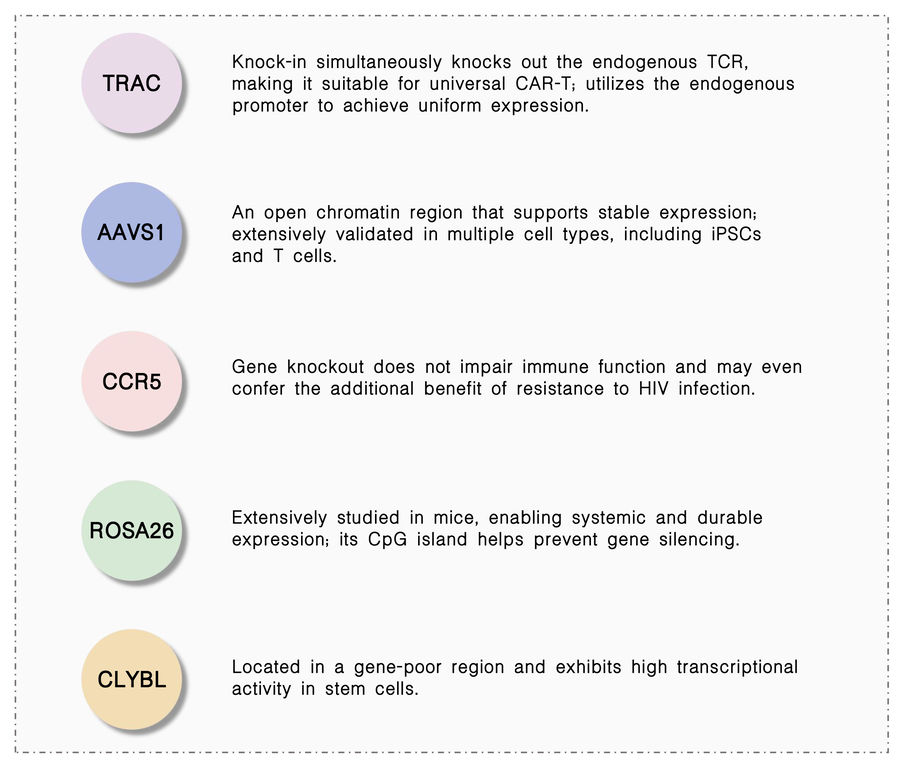
The selection of an appropriate genomic safe harbor (GSH) is a critical determinant of success in site-specific CAR knock-in strategies. An ideal safe harbor must support sustained, predictable transgene expression without disrupting essential host genes or perturbing cellular regulatory networks. To date, several loci have been rigorously validated across different cell types and therapeutic contexts, each offering distinct advantages depending on the specific application.
Q1: What exactly is a genomic "safe harbor" site, and why is it important?
A1: We define GSHs as validated loci that support stable, high-level transgene expression without disrupting essential genes or causing oncogenesis. These sites are distal from oncogenes, avoid fragile genomic regions, and resist epigenetic silencing, ensuring safe and predictable CAR transgene integration.
Q2: Which GSH loci are most commonly used in CAR-T engineering?
A2: The TRAC locus is particularly favored, as CAR integration there disrupts endogenous TCR expression, reducing graft-versus-host disease (GVHD) risk in allogeneic products, while maintaining uniform CAR activity under endogenous regulatory control. The AAVS1 locus on chromosome 19 is also widely validated for stable transgene expression across cell types.
We deliver precise, non-viral CAR integration into validated genomic safe harbors, eliminating insertional mutagenesis risks and positional effects. Our optimized CRISPR/Cas9 workflows ensure uniform transgene expression, preserve T cell stemness, and enable multiplex editing for allogeneic off-the-shelf products. We accelerate your pathway to clinic with reproducible, cost-effective manufacturing and comprehensive quality assurance at every step.
We are ready to accelerate your next-generation cell therapy program. Reach out to our scientific team to discuss your specific CAR construct and target loci. We provide expert guidance from vector design to manufacturing scale-up. Let us transform your vision into a precisely engineered, clinically viable product.
Reference
For any technical issues or product/service related questions, please leave your information below. Our team will contact you soon.
All products and services are For Research Use Only and CANNOT be used in the treatment or diagnosis of disease.
 NEWSLETTER
The latest newsletter to introduce the latest breaking information, our site updates, field and other scientific news, important events, and insights from industry leaders
LEARN MORE NEWSLETTER NEW SOLUTION
CellRapeutics™ In Vivo Cell Engineering: One-stop in vivo T/B/NK cell and macrophage engineering services covering vectors construction to function verification.
LEARN MORE SOLUTION NOVEL TECHNOLOGY
Silence™ CAR-T Cell: A novel platform to enhance CAR-T cell immunotherapy by combining RNAi technology to suppress genes that may impede CAR functionality.
LEARN MORE NOVEL TECHNOLOGY NEW SOLUTION
Canine CAR-T Therapy Development: From early target discovery, CAR design and construction, cell culture, and transfection, to in vitro and in vivo function validation.
LEARN MORE SOLUTION









