Creative Biolabs has a tradition of commitment. To achieve efficient execution and regulatory approval, we offer careful considerations of your program for the development of a cellular or gene therapy product – now and in the future.
EXPLORE MORE HighlightsWe focus on unmet needs and develop novel cellular and gene drugs and solutions that offer significant benefits over existing options.
EXPLORE MORE HighlightsThe advent of Chimeric Antigen Receptor T-cell (CAR-T) therapies has revolutionized the field of oncology, providing new avenues for treating various forms of cancer. Our 20 years of experience in the biotechnology sector have equipped us with the expertise and technological capabilities to support the entire lifecycle of CAR-T products, from early development to commercialization.
EXPLORE MORETo accelerate advanced breakthroughs of your projects, we offer broad range of platforms which enable our clients be free to tackle problems with cutting-edge technologies from different angles and in different methods.
EXPLORE MORE HighlightsUse the resources in our library to help you understand your options and make critical decisions for your study. We offer oncolytic virus, CAR-T, and dendritic cell related documents, as well as newsletter. If you don't find the answers you're looking for, contact us for additional assistance.
EXPLORE MORE HighlightsGet a real taste and understanding of the business and culture of one of the world's great research-based cellular and gene therapy discovery and development companies.
EXPLORE MORE
Creative Biolabs provides an AI-Driven Automated Cell Expansion Control Service to address key challenges in biomanufacturing, including high batch-to-batch variability, suboptimal cell density, and the high cost of manual media optimization. This service enables maximized biomass yield and consistent cellular metabolism through adaptive machine learning agents and real-time Raman spectroscopy integration. By dynamically regulating nutrient feeds and physicochemical parameters, Creative Biolabs replaces static, trial-and-error protocols with a self-optimizing, intelligent bioprocess system, accelerating the transition to scalable and cost-efficient commercial production.
AI-assisted metabolomic profiling integrates high-throughput metabolite analysis with machine learning to decode complex relationships between nutrient composition and cellular performance. Recent studies demonstrate that combining metabolite consumption data with predictive algorithms enables efficient identification of critical media components and optimization strategies. This approach significantly reduces experimental burden while enhancing yield, consistency, and product quality, making it a powerful tool in modern bioprocess development.
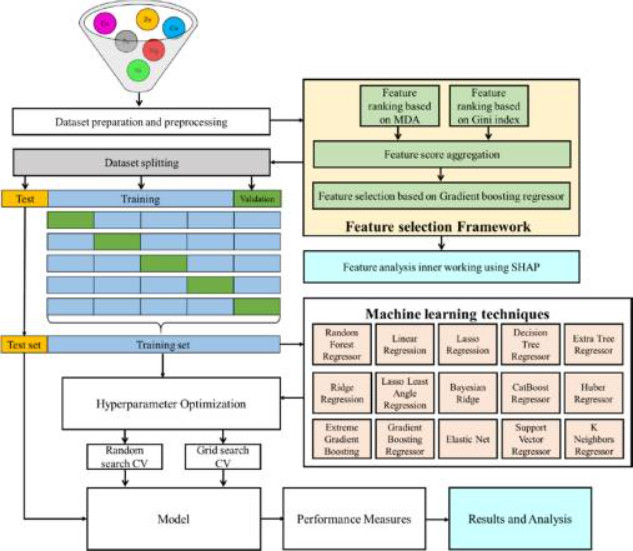 Fig.1 Machine learning framework for predicting critical quality attributes. 1
Creative Biolabs provides a data-driven solution that integrates metabolomic profiling with advanced computational modeling to systematically enhance cell culture performance and product quality. This service allows clients to identify key metabolic bottlenecks, optimize nutrient composition, and develop customized media formulations for specific cell lines and production objectives, supporting applications such as monoclonal antibody production, cell therapy manufacturing, and recombinant protein expression.
By combining experimental data with predictive modeling, we minimize trial-and-error experimentation while improving process reproducibility and scalability. For clients moving beyond generic off-the-shelf media, we deliver chemically defined, lot-to-lot consistent formulations tailored to the unique metabolic demands of each cell line, addressing nutrient depletion and toxic byproduct accumulation through precise metabolic fingerprint analysis.
Discover How We Can Help - Request a Consultation.
| Metabolomic Analysis Platforms | AI-Driven Media Design Models |
|
We provide advanced metabolite profiling solutions to quantify nutrient consumption and byproduct accumulation, enabling precise mapping of cellular metabolic states. |
Our platform applies machine learning algorithms to correlate metabolomic data with cell growth, productivity, and quality attributes, supporting predictive media formulation. |
| Dynamic Feeding Strategy Optimization | Multi-Parameter Optimization Framework |
|
We design adaptive nutrient feeding strategies based on real-time or time-course metabolomic insights to maintain optimal culture conditions. |
Our approach integrates multiple performance indicators, including cell density, viability, and product quality, ensuring balanced and application-specific media design. |
Required Starting Materials: To initiate the service, clients typically provide the host cell line and the current basal media/feed recipes used, along with historical growth and titer data.
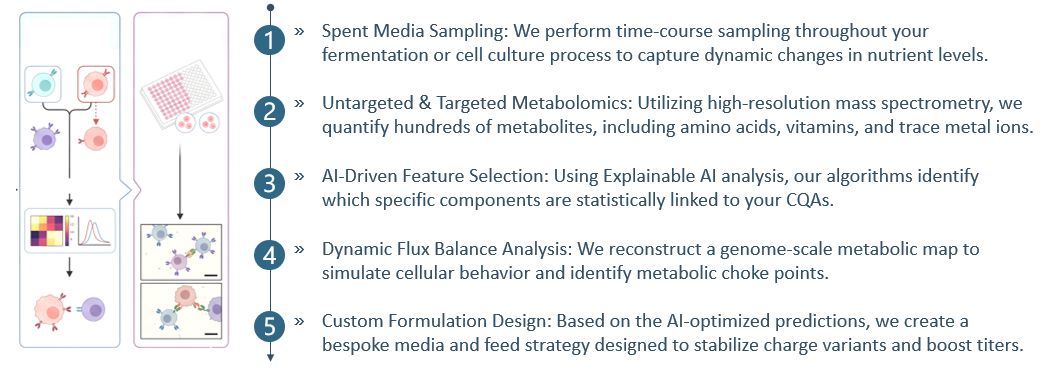
Final Deliverables: Clients receive a detailed Metabolic Profiling Report, an optimized media formulation sheet, and a Validation Data Package confirming the improved critical quality attribute profiles and yields.
Q: How does AI optimization differ from traditional design of experiments?
A: Traditional design of experiments is limited by the number of variables it can handle. Our AI framework can analyze hundreds of metabolites simultaneously, capturing non-linear interactions that simple quadratic models miss.
Q: Can this service be used for microbial fermentation as well as mammalian cells?
A: Our platform is adaptable to any biological system, provided the metabolic pathways are well-characterized.
Q: What if I have proprietary media components I cannot disclose?
A: We offer flexible, customized services. We can perform a blinded analysis or focus strictly on optimizing the variable components of your choosing.
Q: How do I know if my project is a good fit for AI profiling?
A: If you are struggling with low yields or inconsistent product quality, AI profiling is the most efficient way to diagnose and fix the root cause.
Creative Biolabs offers an AI-Assisted Metabolomic Profiling for Media Optimization Service that combines advanced metabolite analysis with machine learning to design customized culture media. The service identifies critical nutrients, optimizes formulations, and enhances cell growth, productivity, and product quality. It reduces experimental workload, shortens development timelines, and delivers reliable, scalable solutions for biopharmaceutical and cell therapy applications. To optimize your bioprocess workflow, our team offers professional consultations and customized AI integration solutions for laboratories and manufacturing facilities. Please get in touch with our team for more information.
Reference
For any technical issues or product/service related questions, please leave your information below. Our team will contact you soon.
All products and services are For Research Use Only and CANNOT be used in the treatment or diagnosis of disease.
 NEWSLETTER
The latest newsletter to introduce the latest breaking information, our site updates, field and other scientific news, important events, and insights from industry leaders
LEARN MORE NEWSLETTER NEW SOLUTION
CellRapeutics™ In Vivo Cell Engineering: One-stop in vivo T/B/NK cell and macrophage engineering services covering vectors construction to function verification.
LEARN MORE SOLUTION NOVEL TECHNOLOGY
Silence™ CAR-T Cell: A novel platform to enhance CAR-T cell immunotherapy by combining RNAi technology to suppress genes that may impede CAR functionality.
LEARN MORE NOVEL TECHNOLOGY NEW SOLUTION
Canine CAR-T Therapy Development: From early target discovery, CAR design and construction, cell culture, and transfection, to in vitro and in vivo function validation.
LEARN MORE SOLUTION