Creative Biolabs has a tradition of commitment. To achieve efficient execution and regulatory approval, we offer careful considerations of your program for the development of a cellular or gene therapy product – now and in the future.
EXPLORE MORE HighlightsWe focus on unmet needs and develop novel cellular and gene drugs and solutions that offer significant benefits over existing options.
EXPLORE MORE HighlightsThe advent of Chimeric Antigen Receptor T-cell (CAR-T) therapies has revolutionized the field of oncology, providing new avenues for treating various forms of cancer. Our 20 years of experience in the biotechnology sector have equipped us with the expertise and technological capabilities to support the entire lifecycle of CAR-T products, from early development to commercialization.
EXPLORE MORETo accelerate advanced breakthroughs of your projects, we offer broad range of platforms which enable our clients be free to tackle problems with cutting-edge technologies from different angles and in different methods.
EXPLORE MORE HighlightsUse the resources in our library to help you understand your options and make critical decisions for your study. We offer oncolytic virus, CAR-T, and dendritic cell related documents, as well as newsletter. If you don't find the answers you're looking for, contact us for additional assistance.
EXPLORE MORE HighlightsGet a real taste and understanding of the business and culture of one of the world's great research-based cellular and gene therapy discovery and development companies.
EXPLORE MORE
Creative Biolabs provides an AI-Powered Scalability & Process Standardization Service to address key challenges in cell therapy manufacturing, including high batch variability, elevated cleanroom costs, and the complexity of scaling autologous and allogeneic processes. This service enables rapid scale-up, consistent product quality, and reduced cost of goods through advanced digital twin modeling, hybrid AI-driven kinetic simulations, and real-time process optimization. By converting biological variability into controlled and predictable parameters, Creative Biolabs establishes standardized, efficient manufacturing workflows that support reliable and scalable production of next-generation cell therapies.
Digital twin modeling integrates real-time data and computational models to create a dynamic virtual representation of bioprocesses. Recent research shows that combining artificial intelligence with digital twins can enable predictive control, process optimization, and improved reproducibility in advanced therapy manufacturing. In cell therapy, this method supports scalable production, reduces variability, and improves compliance. It is thus a key tool for moving from research-scale workflows to standardized, commercial-ready manufacturing.
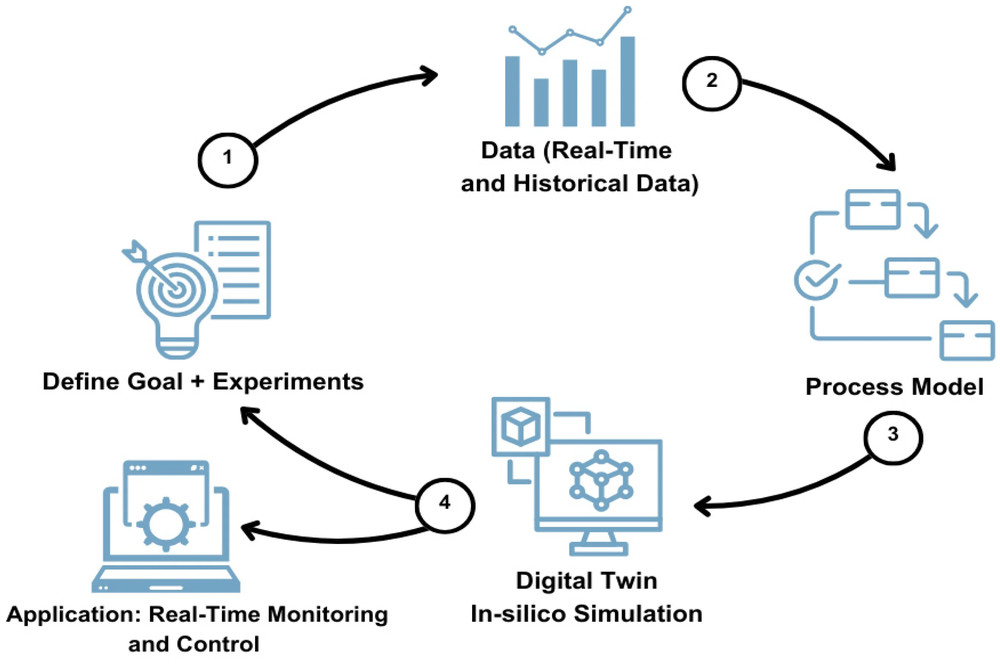 Fig.1 Digital twin cycle for real-time biomanufacturing process monitoring. 1
Creative Biolabs provides a digital mirror of your cell therapy manufacturing process. By creating a high-fidelity digital twin, we allow you to test-drive your scale-up strategies in a risk-free virtual environment before committing to expensive physical runs. Our digital twin modeling integrates real-time data with computational models to create dynamic virtual replicas of cell therapy processes. By simulating production conditions, we can identify and control critical process parameters (CPPs) and quality attributes (CQAs) with high fidelity. This enables the prediction of outcomes despite donor variability, ensures robust multi-site scaling, and minimizes batch failure through AI-driven anomaly detection, ultimately transitioning research workflows into standardized, commercial-ready manufacturing.
Discover How We Can Help - Request a Consultation.
| Multi-Source Data Integration Platform | AI-Driven Modeling & Simulation |
|
|
| Digital Twin Construction & Validation | Process Standardization Toolkit |
|
|
To initiate the digital twin construction, clients typically provide historical batch data in the form of CSV or Excel files containing time-series data of metabolites, gas exchange, and cell growth curves, bioprocess specifications including technical drawings or parameter limits of existing bioreactor systems, as well as a target product profile that defines the ranges required for the final therapeutic product.
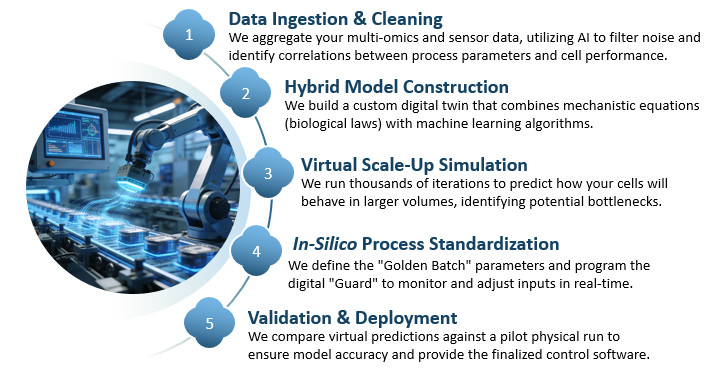
Final Deliverables include a Scalability Assessment Report with a detailed analysis of predicted yields, metabolic flux, and risk factors during volume expansion, Digital Twin Control Software featuring an executable model or API integration for real-time process monitoring and predictive intervention, as well as a Standardized Operating Procedure Optimization Package containing data-backed setpoints for pH, temperature, and feeding strategies to ensure batch-to-batch consistency.
Q: Can your digital twin model handle diverse bioreactor brands?
A: Yes! Our service is platform-agnostic. We can integrate data from any major bioreactor system as long as there is a data output for key parameters like pH, temperature, and gas flow.
Q: How does this service help with regulatory compliance?
A: Our standardization service follows Quality-by-Design principles. We provide comprehensive data trails and validation reports that demonstrate your process is controlled and predictable, which is a key requirement for CMC sections.
Q: Is my data secure during the modeling process?
A: Creative Biolabs follows strict data integrity and confidentiality protocols. Your proprietary bioprocess data is used exclusively for your project and is never shared or used to train models for other clients.
Q: Can the model predict cell potency, not just growth?
A: Yes. By integrating omics data into the digital twin, we can correlate process parameters with functional markers of potency, ensuring your scaled-up cells are as effective as your lab scale results.
Cell therapy manufacturing faces core challenges, including scale-up difficulties, high batch-to-batch variability, and non-reproducible processes. Creative Biolabs' AI-Powered Scalability & Process Standardization Service serves as the bridge between breakthrough research and commercial reality, as it establishes a reproducible, scalable, and regulatory-compliant standardized manufacturing system by constructing high-precision digital twin models that enable real-time mapping, predictive analysis, and intelligent optimization of the production process; through digital twin modeling, we empower you to scale your cell therapies with precision, consistency, and economic efficiency, and our team of biological and data science experts is ready to discuss your project, please contact our team.
Reference
For any technical issues or product/service related questions, please leave your information below. Our team will contact you soon.
All products and services are For Research Use Only and CANNOT be used in the treatment or diagnosis of disease.
 NEWSLETTER
The latest newsletter to introduce the latest breaking information, our site updates, field and other scientific news, important events, and insights from industry leaders
LEARN MORE NEWSLETTER NEW SOLUTION
CellRapeutics™ In Vivo Cell Engineering: One-stop in vivo T/B/NK cell and macrophage engineering services covering vectors construction to function verification.
LEARN MORE SOLUTION NOVEL TECHNOLOGY
Silence™ CAR-T Cell: A novel platform to enhance CAR-T cell immunotherapy by combining RNAi technology to suppress genes that may impede CAR functionality.
LEARN MORE NOVEL TECHNOLOGY NEW SOLUTION
Canine CAR-T Therapy Development: From early target discovery, CAR design and construction, cell culture, and transfection, to in vitro and in vivo function validation.
LEARN MORE SOLUTION