Creative Biolabs has a tradition of commitment. To achieve efficient execution and regulatory approval, we offer careful considerations of your program for the development of a cellular or gene therapy product – now and in the future.
EXPLORE MORE HighlightsWe focus on unmet needs and develop novel cellular and gene drugs and solutions that offer significant benefits over existing options.
EXPLORE MORE HighlightsThe advent of Chimeric Antigen Receptor T-cell (CAR-T) therapies has revolutionized the field of oncology, providing new avenues for treating various forms of cancer. Our 20 years of experience in the biotechnology sector have equipped us with the expertise and technological capabilities to support the entire lifecycle of CAR-T products, from early development to commercialization.
EXPLORE MORETo accelerate advanced breakthroughs of your projects, we offer broad range of platforms which enable our clients be free to tackle problems with cutting-edge technologies from different angles and in different methods.
EXPLORE MORE HighlightsUse the resources in our library to help you understand your options and make critical decisions for your study. We offer oncolytic virus, CAR-T, and dendritic cell related documents, as well as newsletter. If you don't find the answers you're looking for, contact us for additional assistance.
EXPLORE MORE HighlightsGet a real taste and understanding of the business and culture of one of the world's great research-based cellular and gene therapy discovery and development companies.
EXPLORE MORE
Creative Biolabs provides a Tumor Homing & Migration Assay Service to support the evaluation of immune cell trafficking in solid tumor research. This service addresses challenges such as limited infiltration of engineered immune cells into tumor tissues, uncertain chemokine-driven migration efficiency, and difficulty predicting in vivo trafficking performance. Through advanced chemotaxis assays, 3D tumor-mimetic models, and quantitative migration analysis platforms, Creative Biolabs enables detailed characterization and optimization of immune cell homing behavior, supporting improved design and functional validation of next-generation cell therapy candidates.
Effective cellular therapy requires not only potent killing but also efficient "homing" to the tumor site. While traditional CAR-T cells show success in B cell malignancies, their efficacy in solid tumors is often hampered by poor trafficking and the immunosuppressive microenvironment. Current literature highlights that endowing T cells with specific chemokine receptors or utilizing complete TCR signaling (TRuCs) can dramatically enhance tumor penetration and sustained anti-tumor response. Creative Biolabs provides the specialized assays needed to validate these physiological improvements.
Effective tumor infiltration is a critical determinant of the success of cell-based immunotherapies. Creative Biolabs provides integrated experimental strategies to evaluate and optimize immune cell migration toward tumor targets under physiologically relevant conditions. Our service supports projects involving engineered immune cells, including receptor-modified lymphocytes and other cytotoxic effector cells. Through robust in vitro and ex vivo assay systems, we help researchers determine whether therapeutic cells can efficiently recognize chemokine gradients, traverse physical barriers, and accumulate in tumor-like environments.
Our key capabilities encompass chemokine-driven migration assessment for directional movement toward tumor signals, 3D tumor microenvironment models simulating matrix and stromal components, quantitative infiltration analysis, comparative screening of engineered cell variants for enhanced trafficking, and mechanistic analysis of chemokine receptor-ligand interactions governing tumor homing.
Discover How We Can Help - Request a Consultation.
| Chemotaxis Migration Assays | Tumor-Conditioned Migration Models |
| Quantitative migration assays use porous membrane systems to measure immune cell movement toward tumor-derived chemokines, with migration efficiency and chemotactic index quantified via flow cytometry or automated counting. | Tumor-conditioned media establishes physiological chemokine gradients to evaluate immune cell responses to tumor-secreted signals. |
| Three-Dimensional Tumor Matrix Migration | Endothelial Barrier Transmigration Assays |
| Collagen/extracellular matrix 3D models mimic solid tumor structure, allowing analysis of immune cell infiltration, migration distance, and motility via live-cell imaging. | These assays recapitulate vascular crossing, assessing immune cell adhesion, migration, and transendothelial traversal into tumor tissue. |
Required Starting Materials: To initiate the service, clients typically provide 2-3 concrete components:
Therapeutic Effector Cells: Cryopreserved or fresh engineered T cells.
Target Tumor Cell Lines: Specific cell lines relevant to the project.
Sequence/Ligand Information: Details regarding the chemokine receptors being investigated.
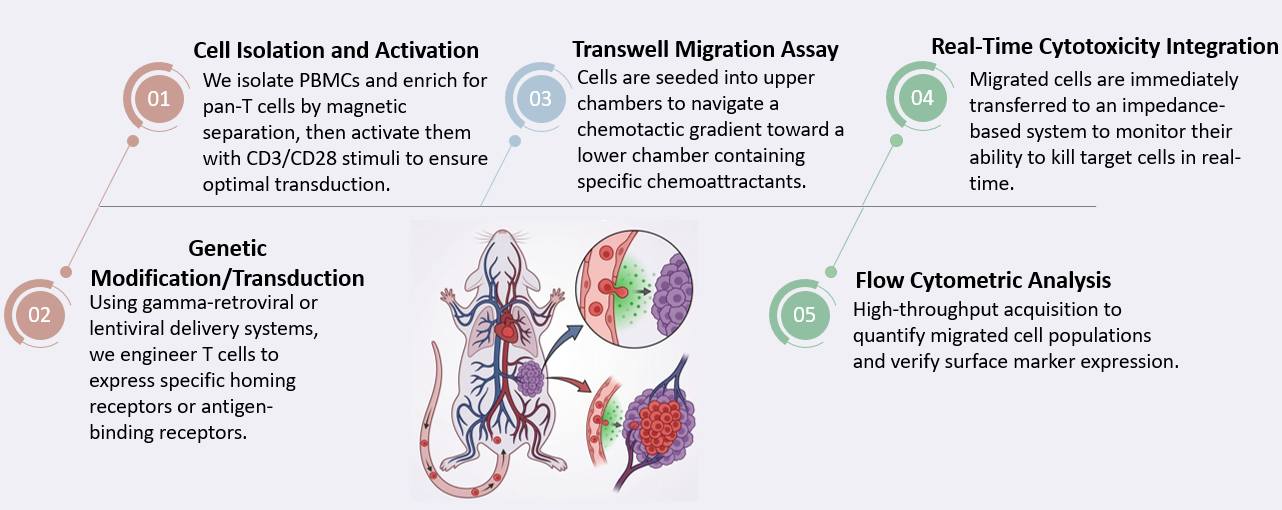
Final Deliverables: Clients receive a detailed technical report containing:
Quantitative Migration Data: Chemotactic indices and fold-change comparisons.
Cytotoxicity Profiles: Real-time cell index (CI) curves demonstrating the kinetics of target cell lysis.
Phenotypic Reports: Flow cytometry histograms and dot plots confirming transduction efficiency and viability.
Q: How do TRuC-T cells differ from standard CAR-T cells in your assays?
A: TRuCs integrate into the complete TCR complex, utilizing all six subunits for physiological signaling, whereas CARs use only the CD3 zeta chain. Our assays demonstrate that TRuCs often exhibit lower cytokine release and reduced exhaustion.
Q: Can you test migration toward specific ligands?
A: Yes. We specialize in chemoattractant titration to determine the optimal concentration range for inducing a migratory response, ensuring high sensitivity and minimal non-specific movement.
Q: What precautions are taken to ensure the health of effector cells?
A: We carefully monitor the bead-to-cell ratio during activation and provide cytokine support to prevent overstimulation and cell death.
Q: How do you handle edge effects in high-throughput migration plates?
A: To ensure data consistency, we can confine assays to the inner wells of the E-Plate 96 and fill outer wells with PBS to minimize evaporative variance.
Creative Biolabs offers a world‑class integrated platform dedicated to evaluating the trafficking and killing potential of next‑generation immunotherapies. Our service portfolio ranges from professional Tumor Homing & Migration Assay Services to complete biochemical signaling validation, delivering precise, reliable, and actionable experimental data. Supported by an experienced scientific team, we help streamline your research and development process, accelerate project progress, and support the efficient advancement of immunotherapy programs. For in‑depth project consultations or customized service quotes, please feel free to contact our expert team for professional support.
For any technical issues or product/service related questions, please leave your information below. Our team will contact you soon.
All products and services are For Research Use Only and CANNOT be used in the treatment or diagnosis of disease.
 NEWSLETTER
The latest newsletter to introduce the latest breaking information, our site updates, field and other scientific news, important events, and insights from industry leaders
LEARN MORE NEWSLETTER NEW SOLUTION
CellRapeutics™ In Vivo Cell Engineering: One-stop in vivo T/B/NK cell and macrophage engineering services covering vectors construction to function verification.
LEARN MORE SOLUTION NOVEL TECHNOLOGY
Silence™ CAR-T Cell: A novel platform to enhance CAR-T cell immunotherapy by combining RNAi technology to suppress genes that may impede CAR functionality.
LEARN MORE NOVEL TECHNOLOGY NEW SOLUTION
Canine CAR-T Therapy Development: From early target discovery, CAR design and construction, cell culture, and transfection, to in vitro and in vivo function validation.
LEARN MORE SOLUTION









