Creative Biolabs has a tradition of commitment. To achieve efficient execution and regulatory approval, we offer careful considerations of your program for the development of a cellular or gene therapy product – now and in the future.
EXPLORE MORE HighlightsWe focus on unmet needs and develop novel cellular and gene drugs and solutions that offer significant benefits over existing options.
EXPLORE MORE HighlightsThe advent of Chimeric Antigen Receptor T-cell (CAR-T) therapies has revolutionized the field of oncology, providing new avenues for treating various forms of cancer. Our 20 years of experience in the biotechnology sector have equipped us with the expertise and technological capabilities to support the entire lifecycle of CAR-T products, from early development to commercialization.
EXPLORE MORETo accelerate advanced breakthroughs of your projects, we offer broad range of platforms which enable our clients be free to tackle problems with cutting-edge technologies from different angles and in different methods.
EXPLORE MORE HighlightsUse the resources in our library to help you understand your options and make critical decisions for your study. We offer oncolytic virus, CAR-T, and dendritic cell related documents, as well as newsletter. If you don't find the answers you're looking for, contact us for additional assistance.
EXPLORE MORE HighlightsGet a real taste and understanding of the business and culture of one of the world's great research-based cellular and gene therapy discovery and development companies.
EXPLORE MORE
Our laboratory specializes in flow cytometry work, with a core focus on tracking cytokine dynamics throughout CAR-T cell research. When working with complex animal models, our team can capture abrupt shifts in cytokine levels. Beyond that, we are able to distinguish distinct cell populations that trigger unwanted toxic immune responses within test subjects. We combine multi-parameter intracellular staining with well-tested gating methods to map the varied functional traits of CAR-T cells. With these analytical approaches in place, research teams can spot early warning signs of Cytokine Release Syndrome, a common risk in related studies. Data collected from our lab work delivers tangible references for ongoing research, and it also pushes the real-world application of modern immunotherapy forward step by step.
CAR-T therapy targeting CD19 has shown promise for patients with refractory hematological malignancies, but managing adverse reactions like CRS and immune effector cell-associated neurotoxicity syndrome (ICANS) remains a significant challenge. To mitigate human errors in multi-center research, pre-formulated dry antibody kits are commonly used for high-parameter flow tests. However, rapid immune cell expansion can lead to severe toxic effects, making comprehensive preclinical animal testing essential. Researchers typically use high-dimensional flow cytometry for long-term dynamic tracking to establish safety boundaries for CAR-T treatments.
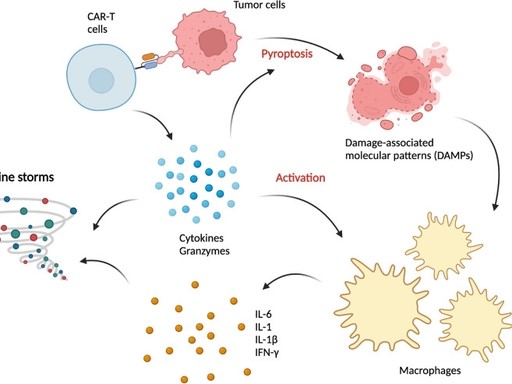 Fig.1 Mechanism of CAR-T cell-induced CRS.1
Rigorous analytical testing is essential to evaluate the efficacy and toxicity of CAR-T products. Creative Biolabs offers a comprehensive suite of multi-parameter flow cytometry solutions using preclinical models and clinical samples. This allows researchers to continuously monitor CAR-T cell proliferation, phenotypes, and functional dynamics within the biological microenvironment.
To address the common challenge of incomplete data during R&D, our standardized workflows fill critical data gaps. By measuring target cell clearance and cytokine production in peripheral blood and local tissues, we ensure that localized excessive immune activation is never overlooked.
Discover How We Can Help - Request a Consultation.
Whether your CAR-T project is in the translational phase or clinical trials, our team provides fully customized, one-stop flow cytometry services for in vivo cytokine release monitoring. We flexibly adjust antibody panels, assay frameworks, and gating strategies to precisely match your unique CAR structure and phase-specific regulatory requirements.
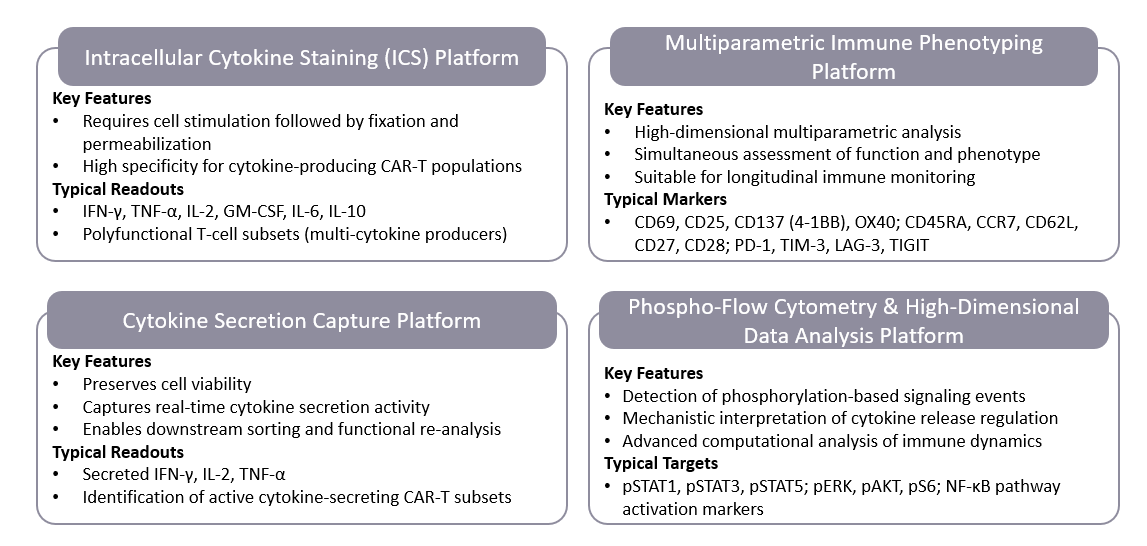
All testing procedures follow unified operational specifications. Even when projects face tight delivery schedules, our team can generate stable and reproducible cellular analysis data consistently. The complete workflow acts as a reliable bridge, connecting raw biological specimens to quantitative analysis results that meet clinical industry standards.
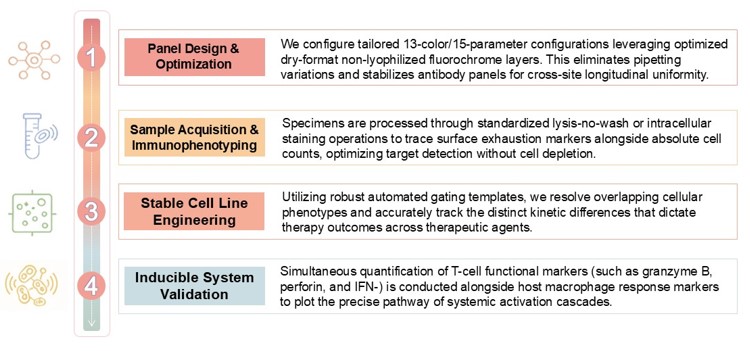
Q1: How do dry-format antibody panels improve data quality over liquid cocktails?
A: They use stabilized, pre-fixed antibody layers that eliminate pipetting errors, reagent degradation, and batch variations, ensuring highly stable baselines across multi-site projects.
Q2: Can this assay differentiate CAR-T-driven cytokines from host immune responses?
A: Yes. By utilizing 13-color panels in humanized models, the assay simultaneously tracks human intracellular markers and host myeloid markers to map cellular cross-talk.
Q3: What parameters assess the long-term exhaustion profile of persisting cells?
A: The panels combine co-stimulatory tracking with specific exhaustion networks, monitoring surface marker co-expression across naive, memory, and effector T-cell populations.
Q4: Are automated gating templates compatible with custom exploratory endpoints?
A: Yes. The open-architecture design allows for seamless "drop-in" custom targets without disrupting the validated, standardized baseline parameters.
Q5: How does flow cytometry compare to qPCR/dPCR for tracking persistent cells?
A: PCR only quantifies transgene copy numbers. Flow cytometry simultaneously delivers protein expression, viable phenotypic subsets, and functional activation statuses.
We have developed advanced flow cytometry testing solutions, which focus on monitoring cytokine release during in vivo CAR-T research. These professional tools can fully meet researchers' demands for real-time tracking of cytokine surges and cell-related toxic events. We apply high-dimensional intracellular staining and refined gating rules to help research teams analyze dynamic changes in CAR-T cells and assess potential CRS risks in advance. In the long run, our professional support can effectively enhance both the safety and overall clinical value of your therapeutic products.
Contact our team for more information and to discuss your project needs, assay customization, data analysis strategies, and comprehensive solutions for your CAR-T therapy development programs.
Reference
For any technical issues or product/service related questions, please leave your information below. Our team will contact you soon.
All products and services are For Research Use Only and CANNOT be used in the treatment or diagnosis of disease.
 NEWSLETTER
The latest newsletter to introduce the latest breaking information, our site updates, field and other scientific news, important events, and insights from industry leaders
LEARN MORE NEWSLETTER NEW SOLUTION
CellRapeutics™ In Vivo Cell Engineering: One-stop in vivo T/B/NK cell and macrophage engineering services covering vectors construction to function verification.
LEARN MORE SOLUTION NOVEL TECHNOLOGY
Silence™ CAR-T Cell: A novel platform to enhance CAR-T cell immunotherapy by combining RNAi technology to suppress genes that may impede CAR functionality.
LEARN MORE NOVEL TECHNOLOGY NEW SOLUTION
Canine CAR-T Therapy Development: From early target discovery, CAR design and construction, cell culture, and transfection, to in vitro and in vivo function validation.
LEARN MORE SOLUTION









